August 26, 2018. Stealth camp before cedar Creek to stealth camp before Yellow Bank.
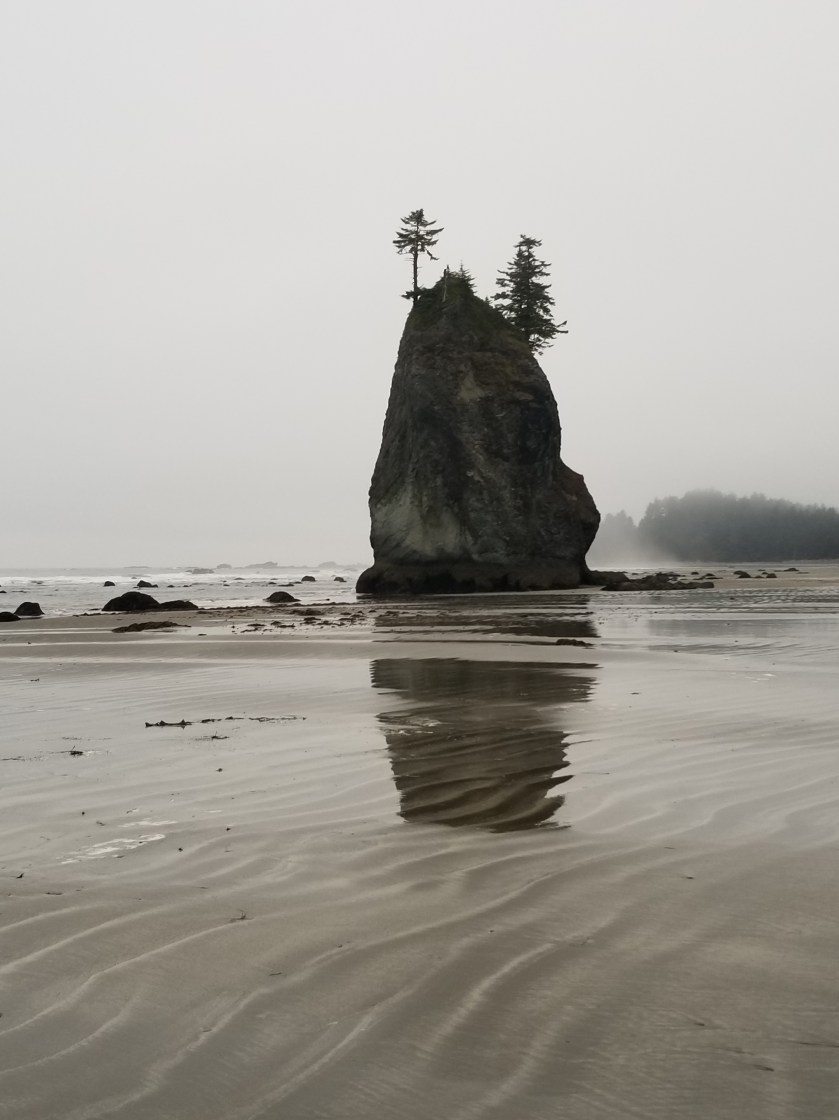
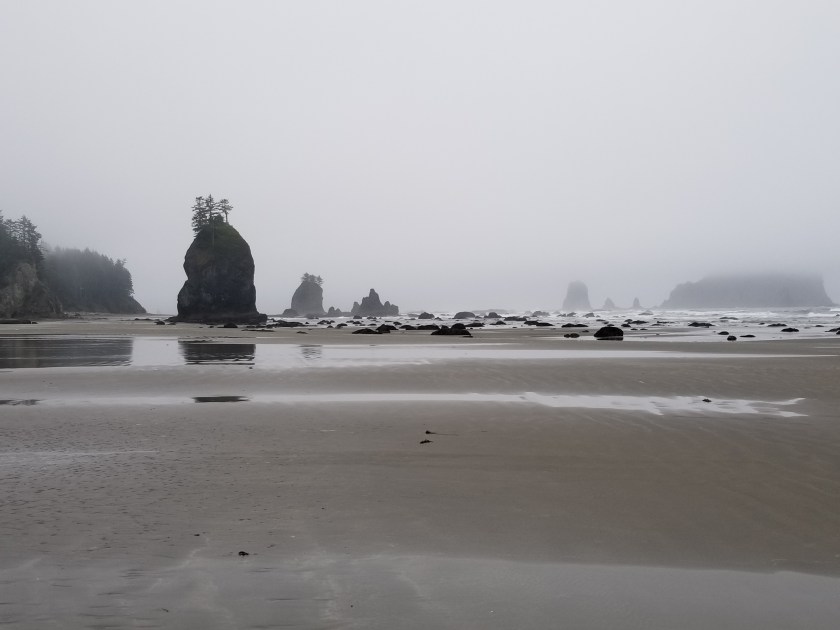
I got up early because low tide was around 7:30. The first part of my morning was easy hiking on firm sand. It was overcast with de minimis drizzle.
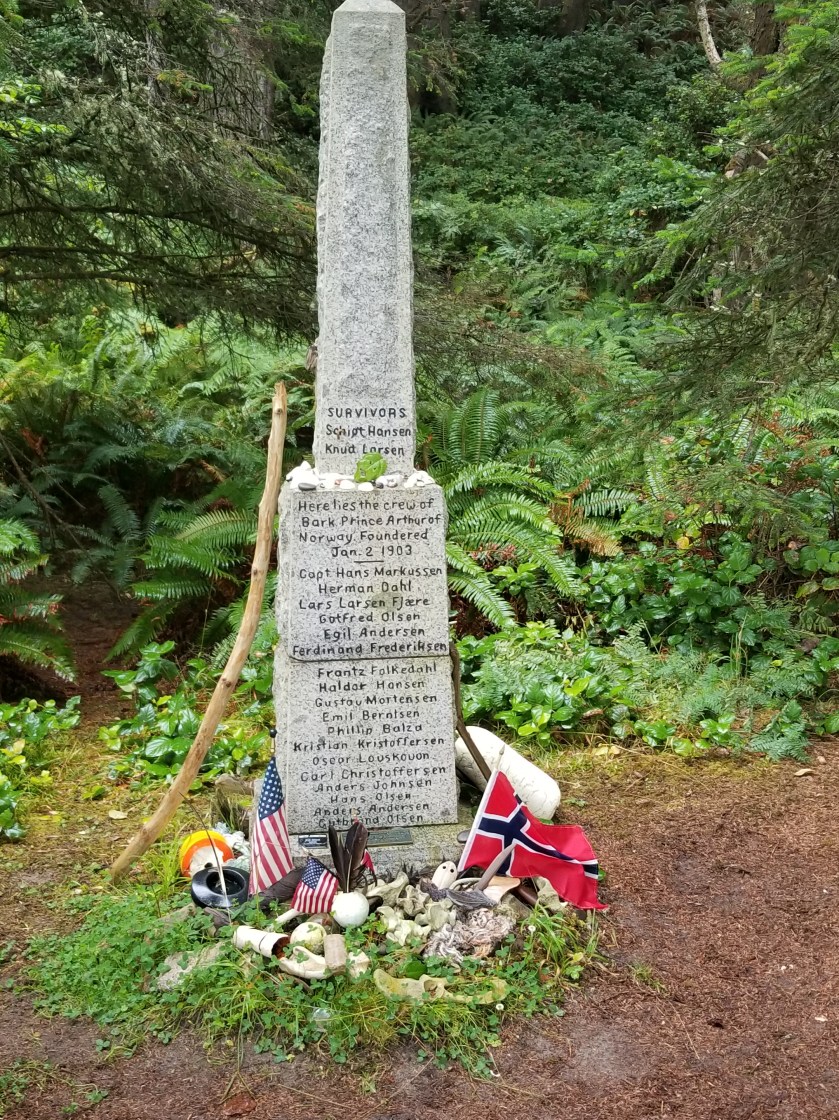
After the easy hiking, I rounded one headland and fortunately hit another lengthy sand beach leading up to the Norwegian Memorial and the adjacent campsite. The Prince Arthur of Norway crashed on the rocks nearby in 1903 and a monument was erected in honor. There were some appropriate mementos at the base of the memorial (flags for the US and Norway) and inappropriate (a shoe insert).
I could’ve stayed at this campsite, but it was still morning and high tide would not happen until after 1:00. However, designated campsites after Norwegian required a reservation. I opted to get close to the first restricted site (Yellow Banks), leaving just six miles of beach before reaching the trail’s end at Cape Alava tomorrow.
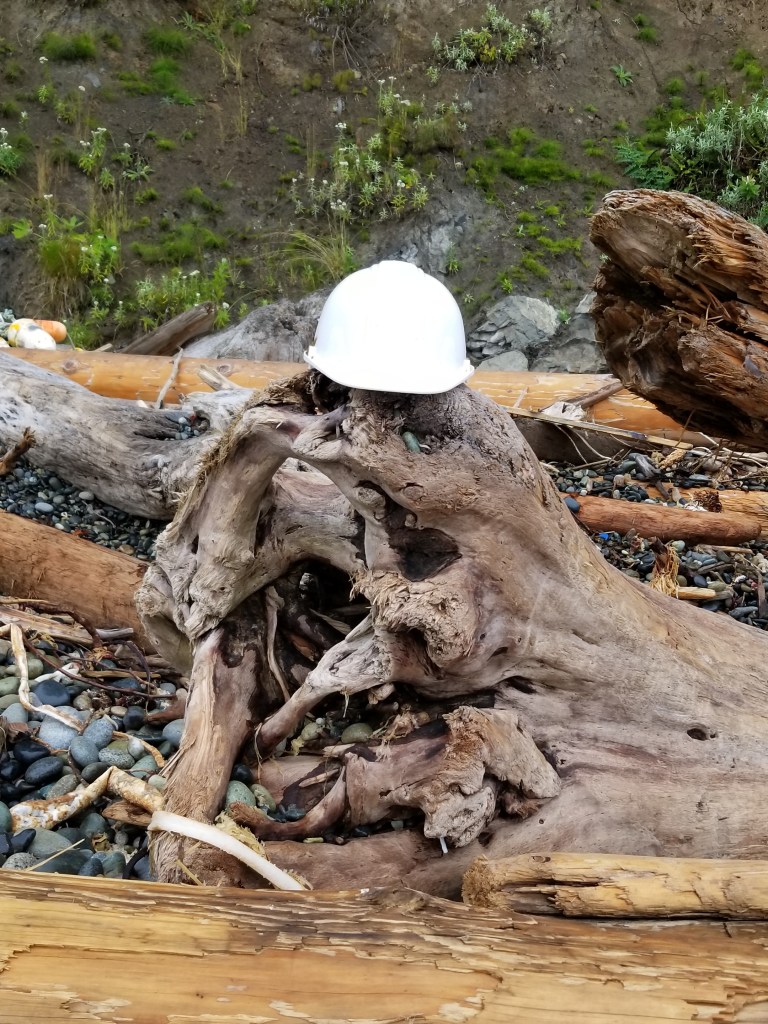
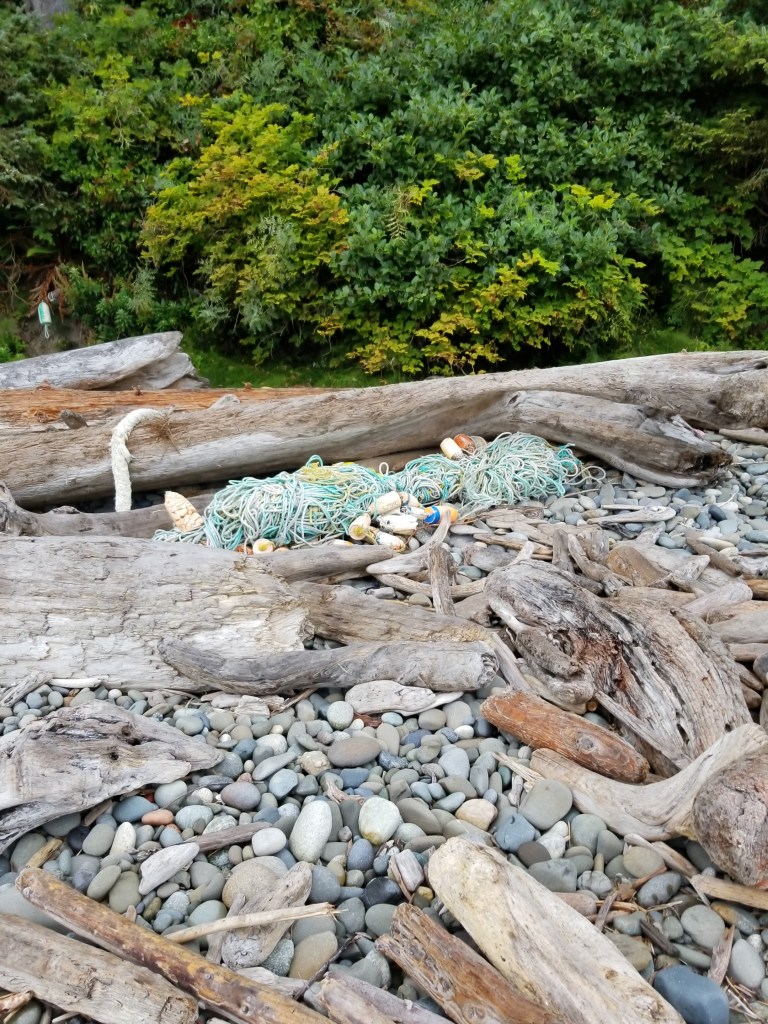
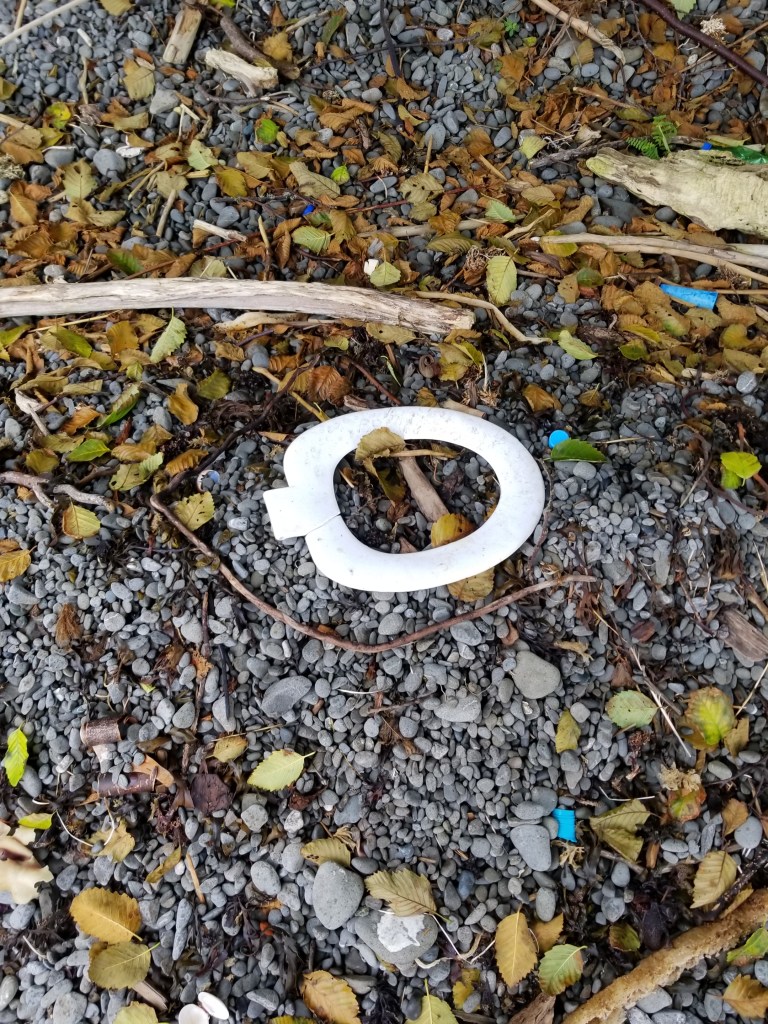
Based on this decision, I had to do some rock scrambling. Along the way I found an amazing variety and volume of waste on the beach. Fishing nets, flotation devices, cable protectors, rusty barrels. The most depressing was the sheer volume of plastic water bottles. Worse, so many of them were half full. Terrible.
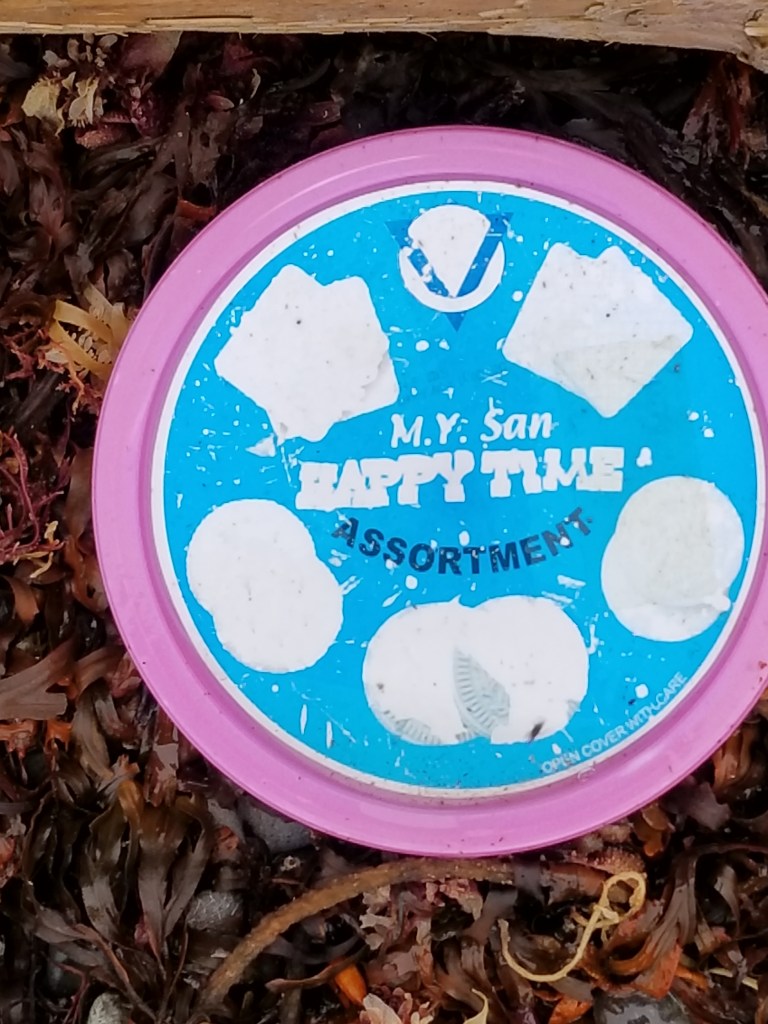
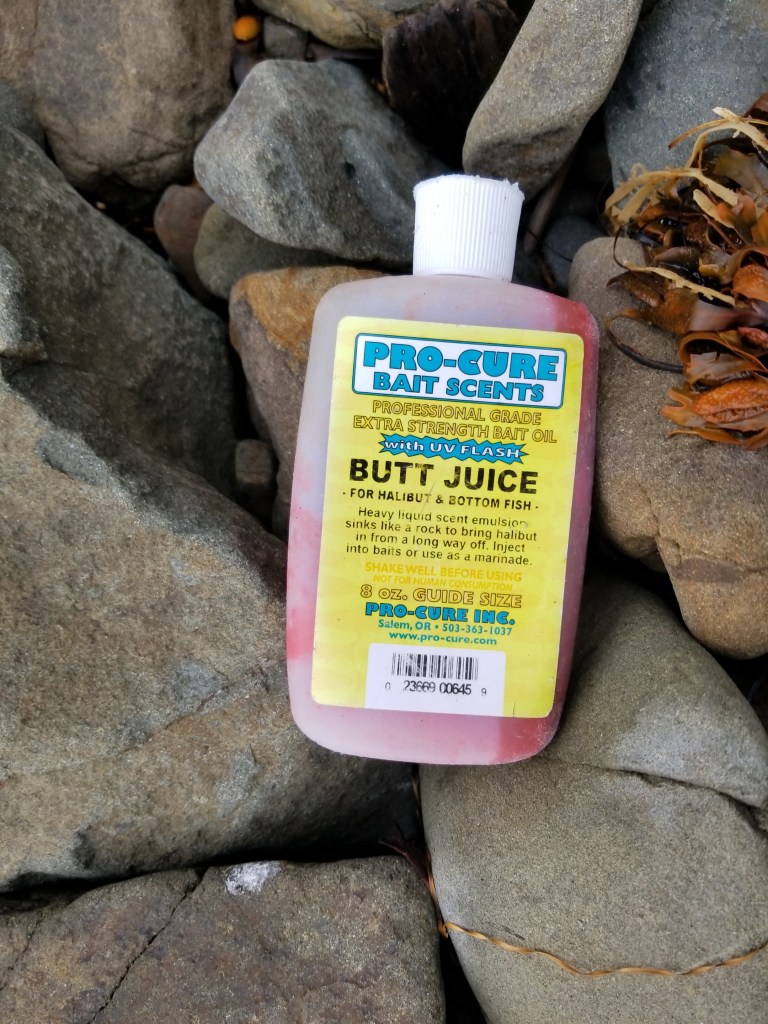
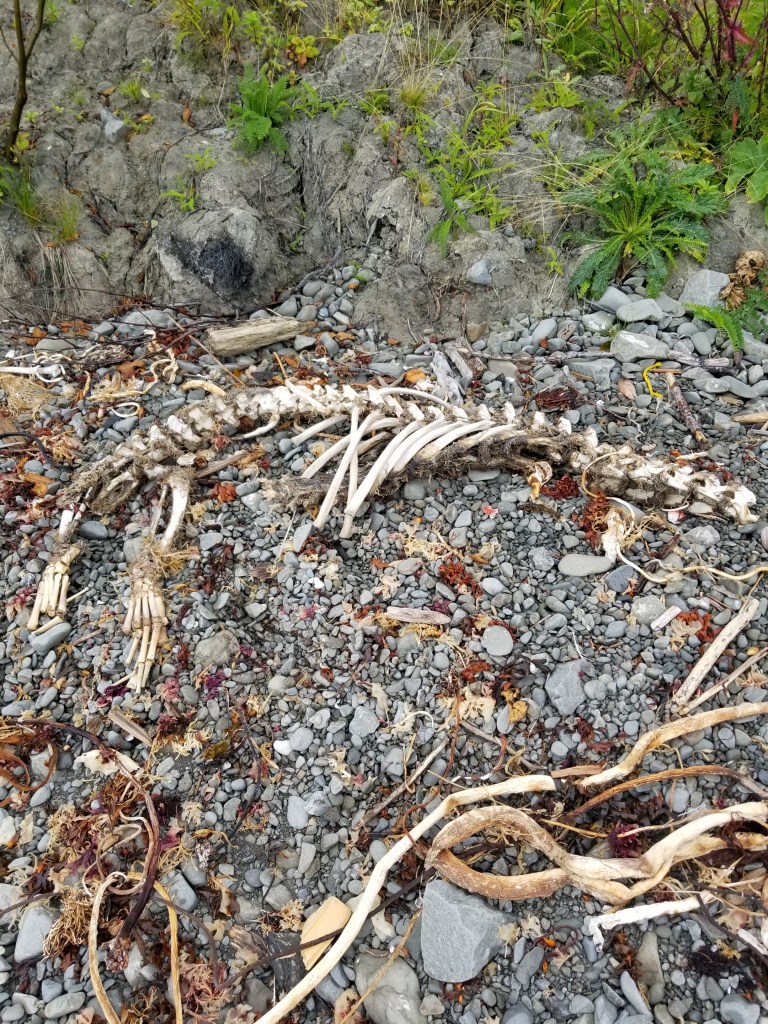
Fortunately, no head was attached.I was shocked by the large amount of netting that had washed up.Try as I might, I couldn’t come up with an explanation.OK. So just once in college I did experiment with Happy Time Assortment.No comment.This headless skeleton appeared to from a sea lion.
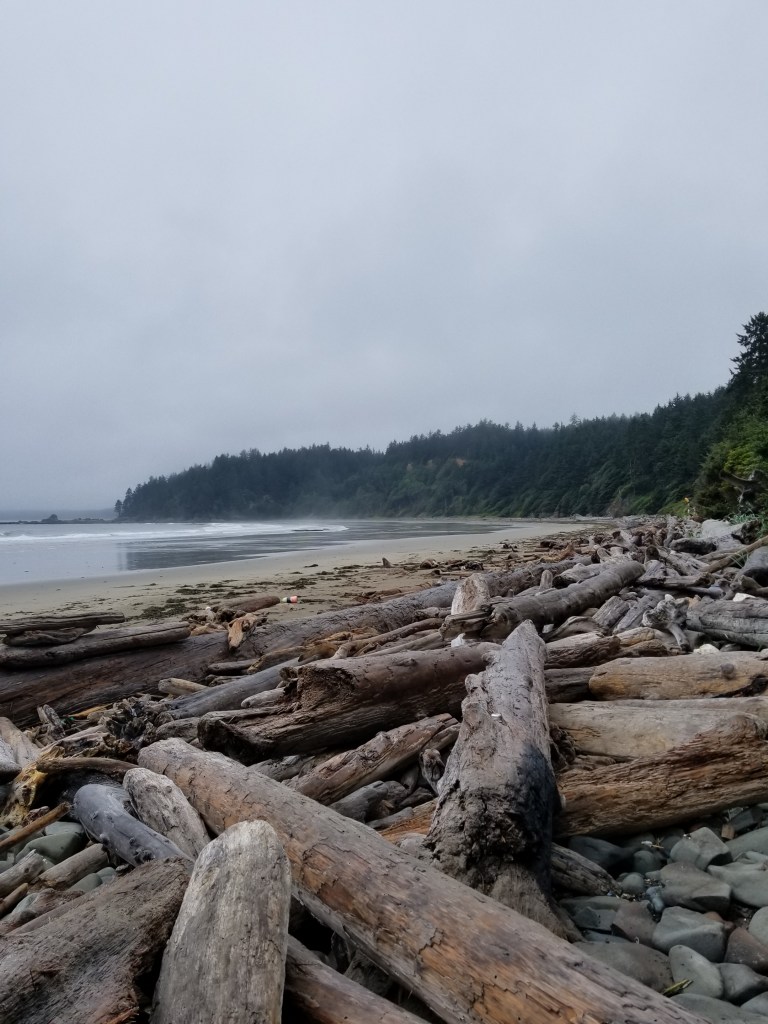
I found a cove that seemed very remote based on the amount of material washed up. It had little beach and a lot of driftwood. Since high tide would be in soon, I opted to get up high and wait for the tide to recede. I found a good spot and even managed a short nap.
Moving again, I soon approached Yellow Banks. Before it, there was a well-used campsite that I grabbed. I had a late dinner and watched the horizon, hoping for a repeat of last night’s show. Unfortunately, the sky remained gray. As this was my last night, I reflected a bit but did not get sentimental. It was time to finish.
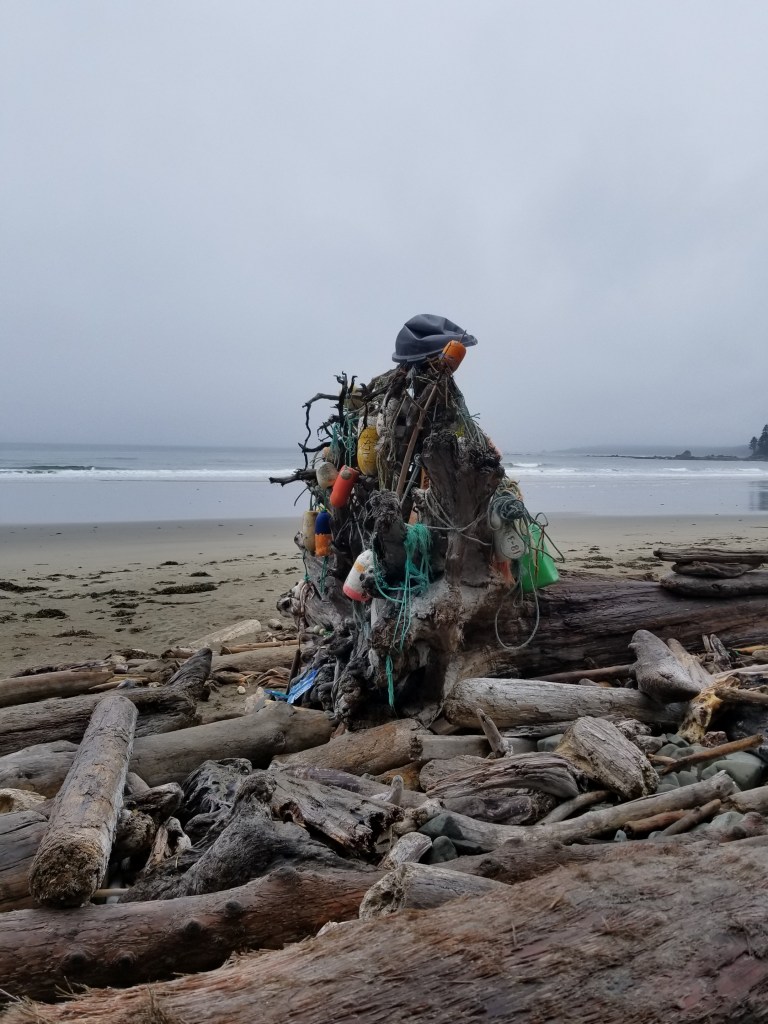
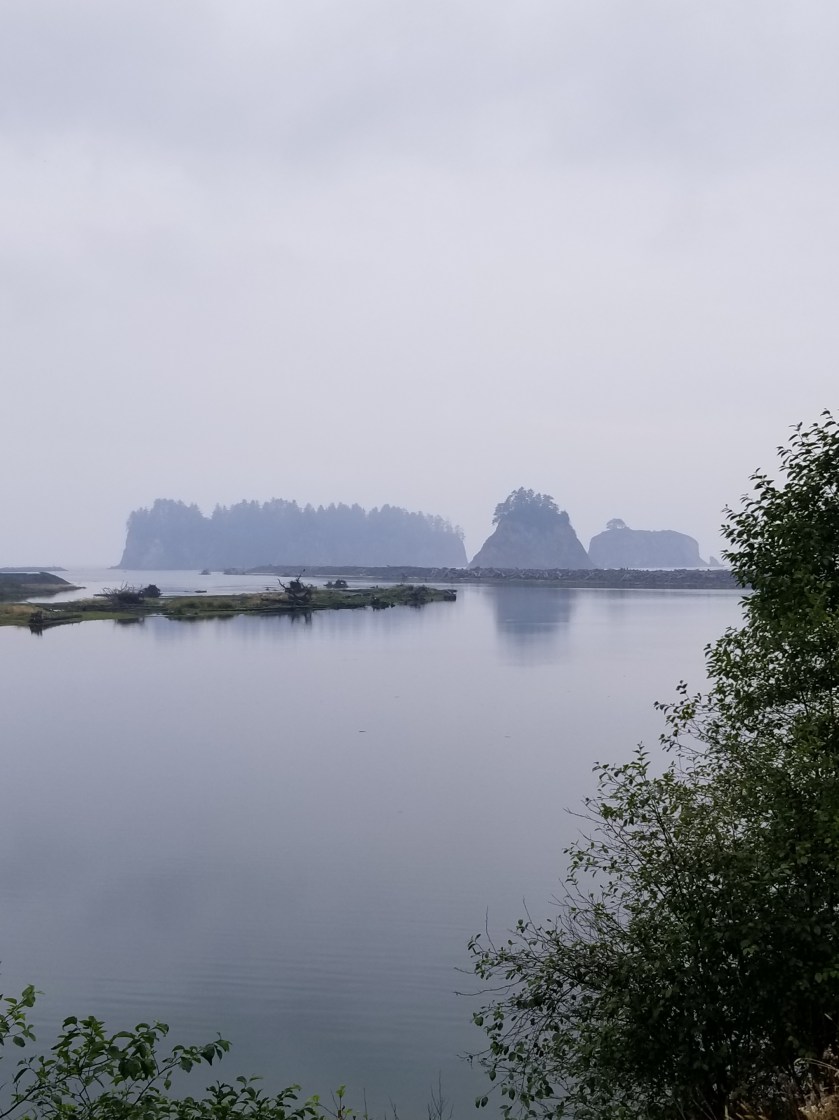
This decoration marked the entrance to my camping spot.Looking up the cove, I could barely see the Yellow Banks.
August 25, 2018. From Forks to a stealth camp between the Chilean Memorial and Cedar Creek campsites.
I enjoyed my last shower and went to the transit station. I was going to take a local bus over a 6 mile stretch of highway with non-existent shoulders. It would drop me off at a corner gas station from which I would walk five plus miles to ONP and Rialto Beach.
The skies were gray and damp, promising rain. The bus stop at the corner station served breakfast. I couldn’t refuse. The only choice was a breakfast burrito. I grabbed my coffee and sat down to wait while they cooked it.
While checking my maps and tide tables, a backpacker came in and asked if I was doing the PNT. He was doing a short coast hike, but recognized the PNT maps from a few years back. His trail name was Tiger Lily.
The breakfast burrito was simply a frozen one they microwaved. Alas, beggars can’t be choosers, so I ate with gusto. And a hell of a lot of salsa.
I refilled my coffee and wandered out to begin hiking down Mora Road. Almost immediately it started drizzling. I got out my umbrella. I must’ve looked like a sissy backpacker with my umbrella in one hand and my coffee in the other.
Not caring what I looked like, I made steady progress west. At times there was no shoulder. Almost always cars gave me ample room. If I could hear a car approaching from behind and see one coming I just stepped off into the bushes. When I reached the ONP boundary, the speed limit mercifully dropped to 25 mph.
I arrived at Rialto Beach. Despite the drizzle and cold, the parking lot was full. I used the faucet to fill up on fresh water. Like most tourist locations, about 70% of the people stayed within 500 feet of their car, so very quickly I was on uncrowded beach.
This beach was mostly sand with driftwood stacked up past the high tide line. The tide was coming in, so I found a sheltered spot, got out rain gear, and with my umbrella made a dry spot where I tried to nap with limited success.
As the tide turned, I packed up and went north towards Hole-in-the-wall. If you’ve never backpacked on a sandy beach, it primarily consists of trying to find the firmest sand. Soft sand saps energy. On rocks, the name of the game is not putting all your weight on the slippery rocks and plants. Plus, have trekking poles or a stick to help with balance. I didn’t want to break my expensive trekking poles on the last couple days so I just found a sturdy stick.
I cleared Hole-in-the-wall easily. I loosely joined three guys hiking north to their campsite, the Chilean Memorial so named for a monument honoring the sailors from a Chilean ship that wrecked off the coast in the 1900s. The guys were from the Seattle area and doing an out-and-back.We navigated some slippery rocks.
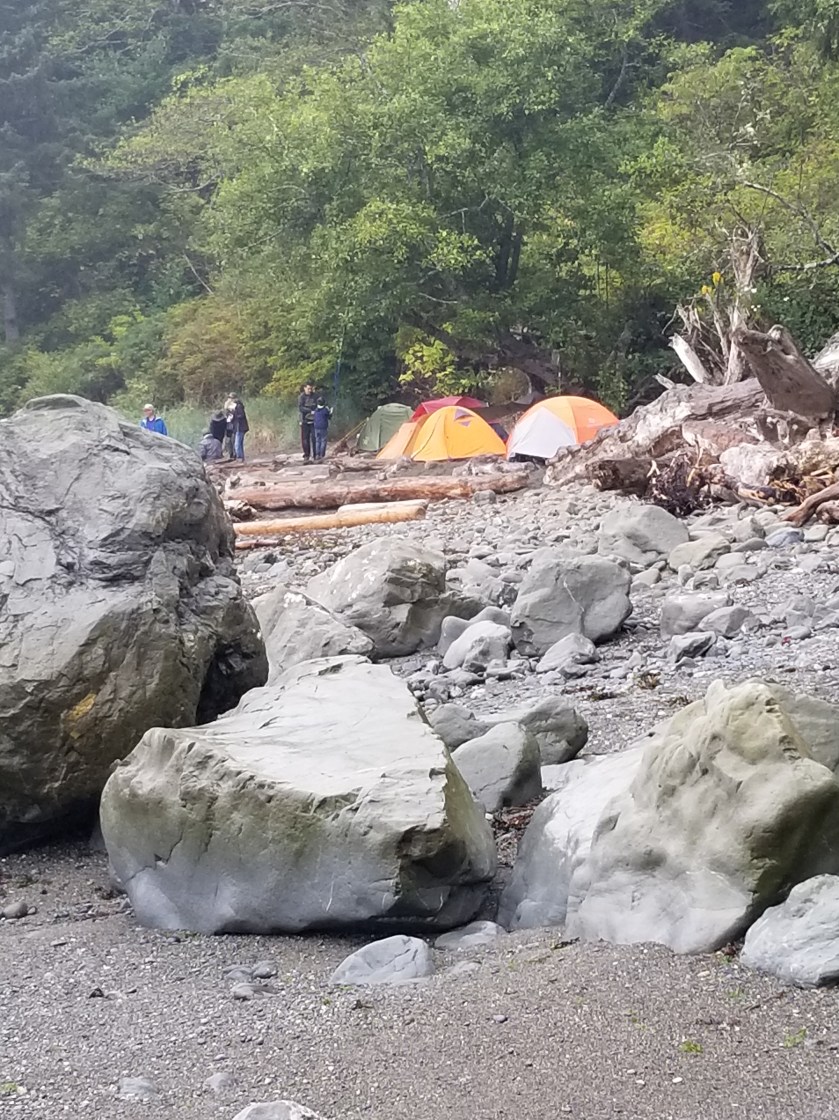
At Chilean Memorial there was a dense tent-city. I was glad I wasn’t camping there. Instead, I was aiming for a stream about three miles north.
Coincidentally, I ran in to Tiger Lilly. We talked for about an hour to let the tide drop further to ease hiking around Cape Johnson. He was a Park Ranger, off duty, and had extensive hiking experience.
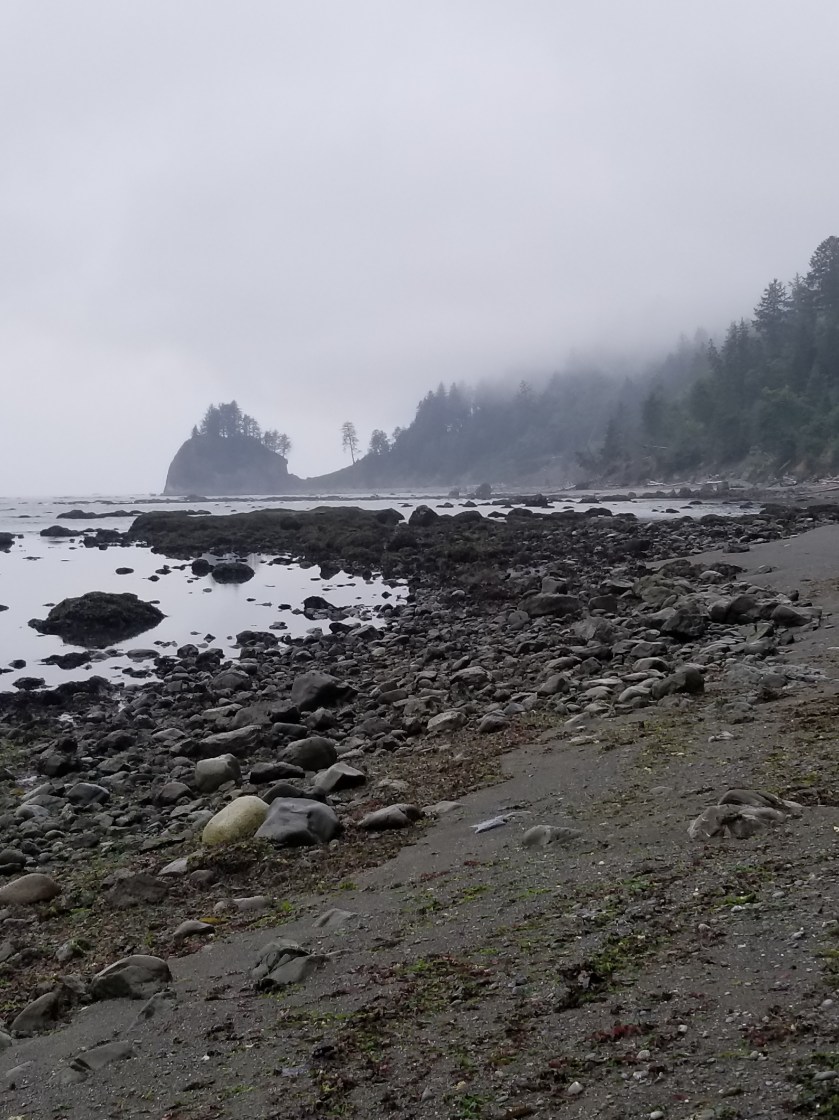
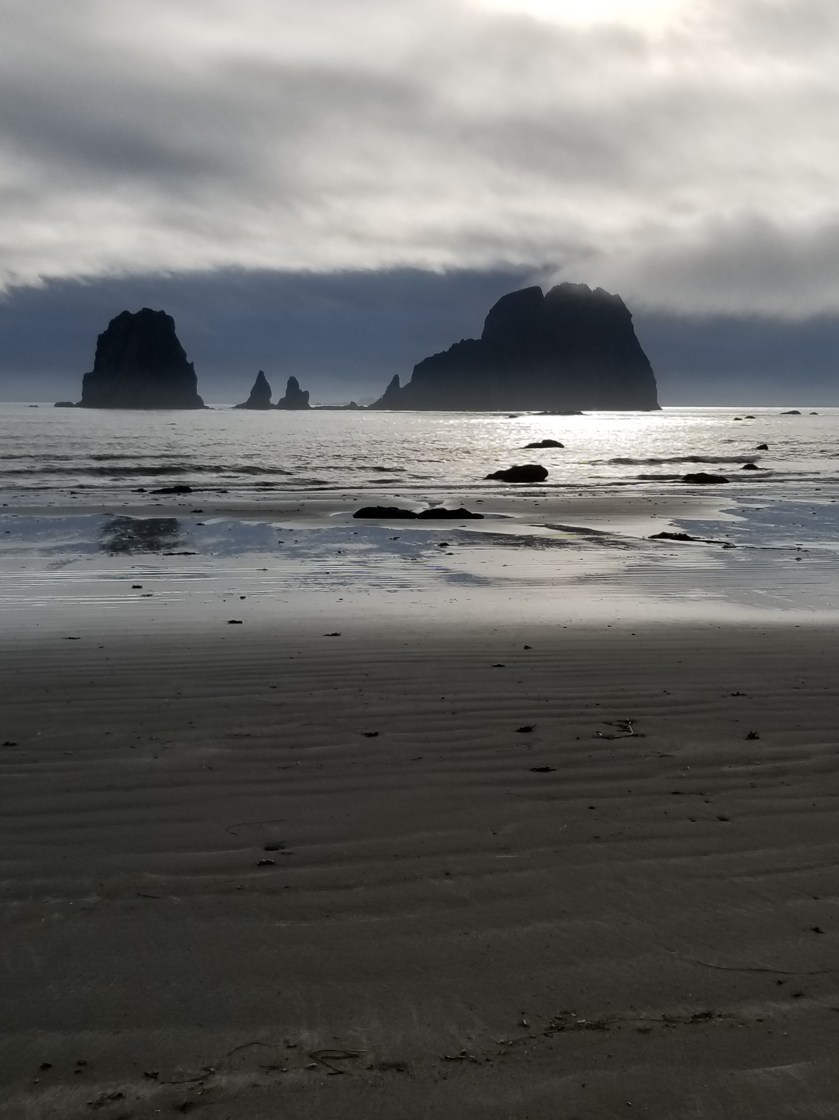
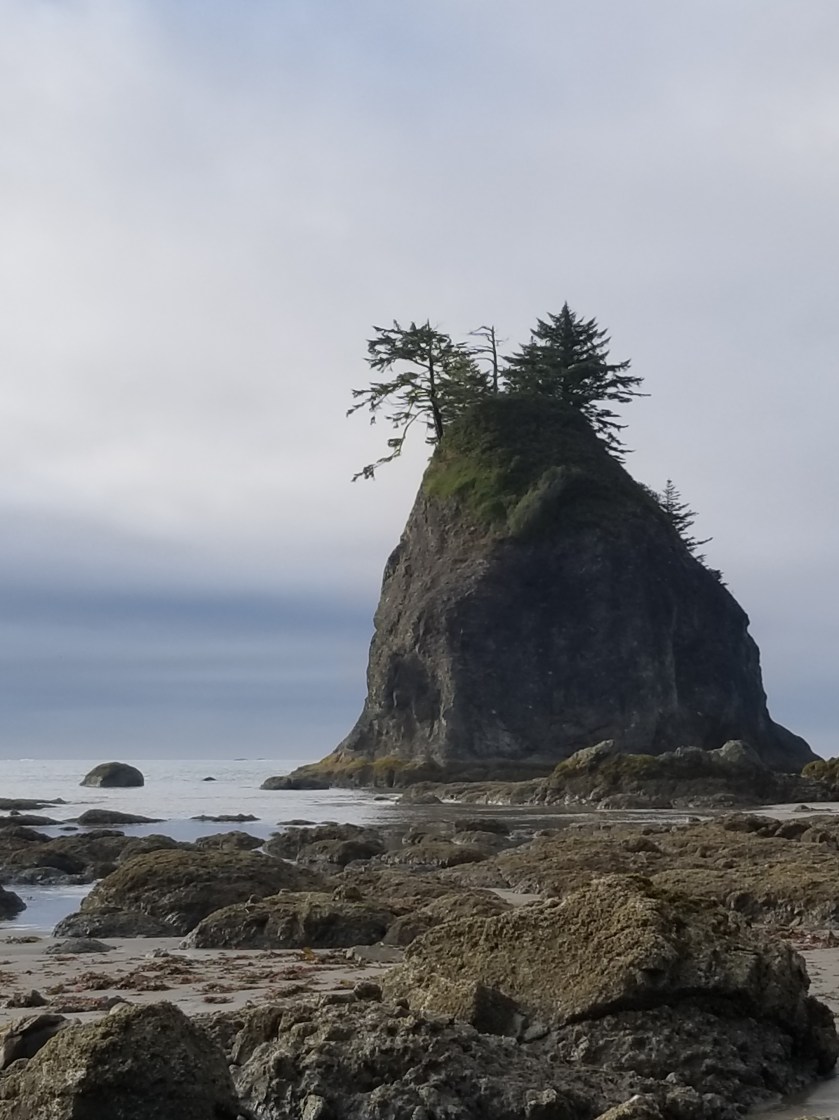
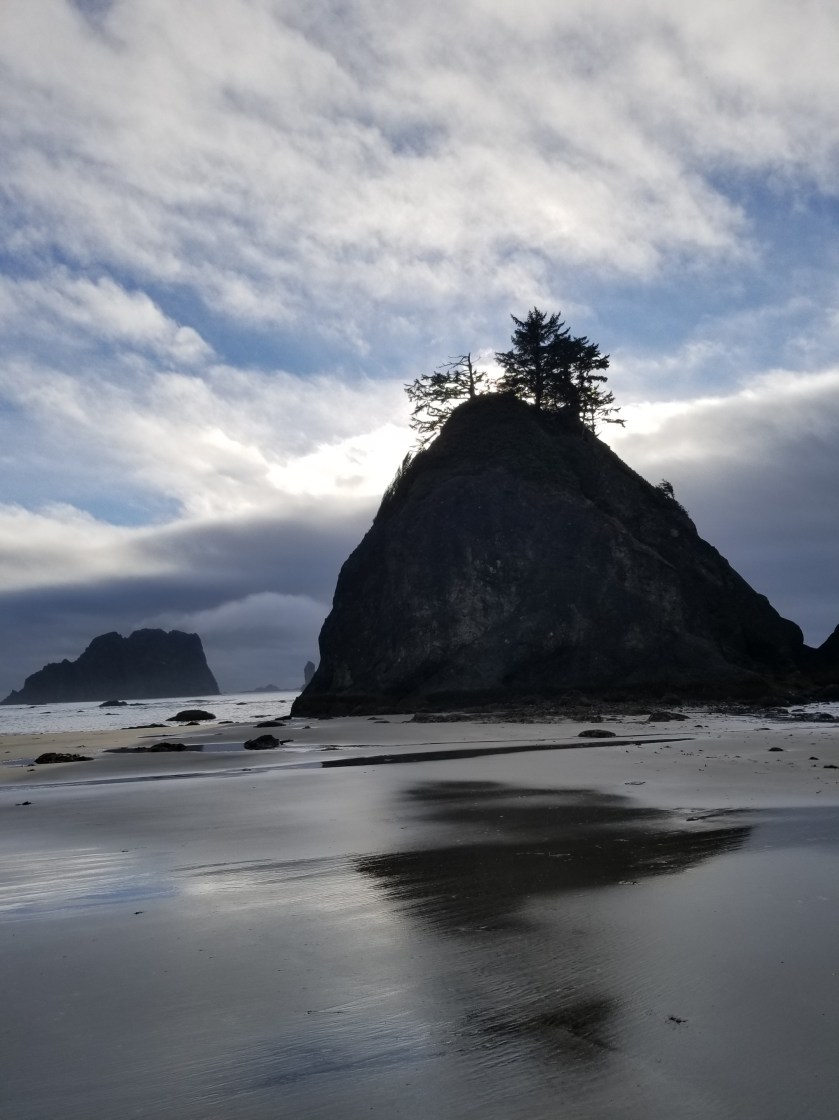
I crossed one headland using the ropes, but most I went around. As the afternoon ground towards evening, the drizzle ended and the sun even poked out. This was especially nice to highlight the various islands near the shore.
Around 7:30 I found a great campsite. It was about 60 feet up a bluff, under a large pine. It even had a fire circle which would’ve been nice.
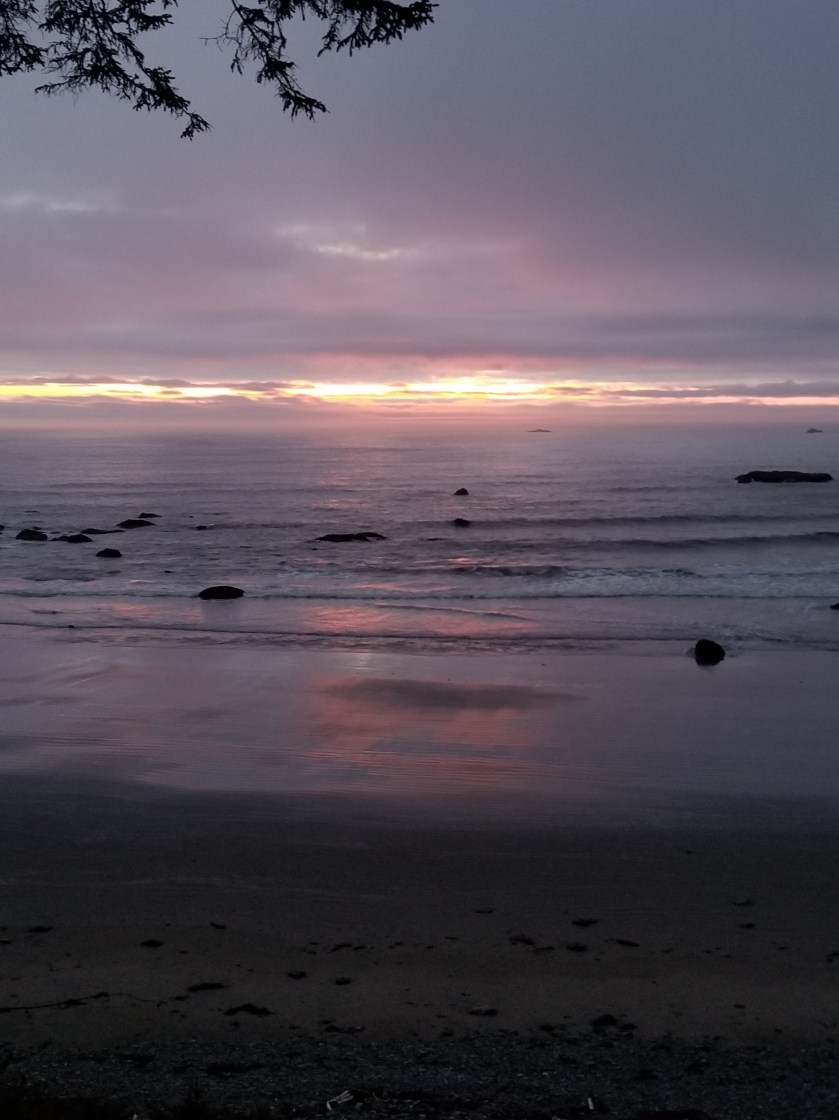
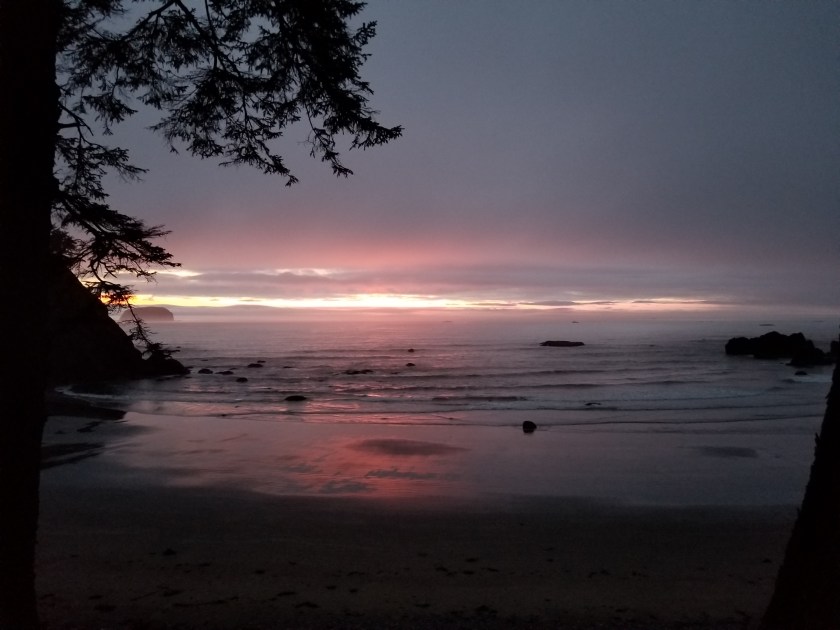
I enjoyed my next to last dinner watching the tide recede towards the setting sun. To my delight, the sun actually pierced the clouds on the horizon giving me a light show before bed.
I put my bear canister in the bushes a distance away. They say it is not bears so much as raccoons that necessitate the canister precautions. It turned out to be a great day.
As I unfolded myself from my cramped sleeping spot, I was psyched. Today was a town / resupply day. A shower. Food on a plate. Sitting on furniture. Hot water.
I woke up a small herd of cow elks when I started. I was unable to get a good photo as they crashed their way through the thick brush.
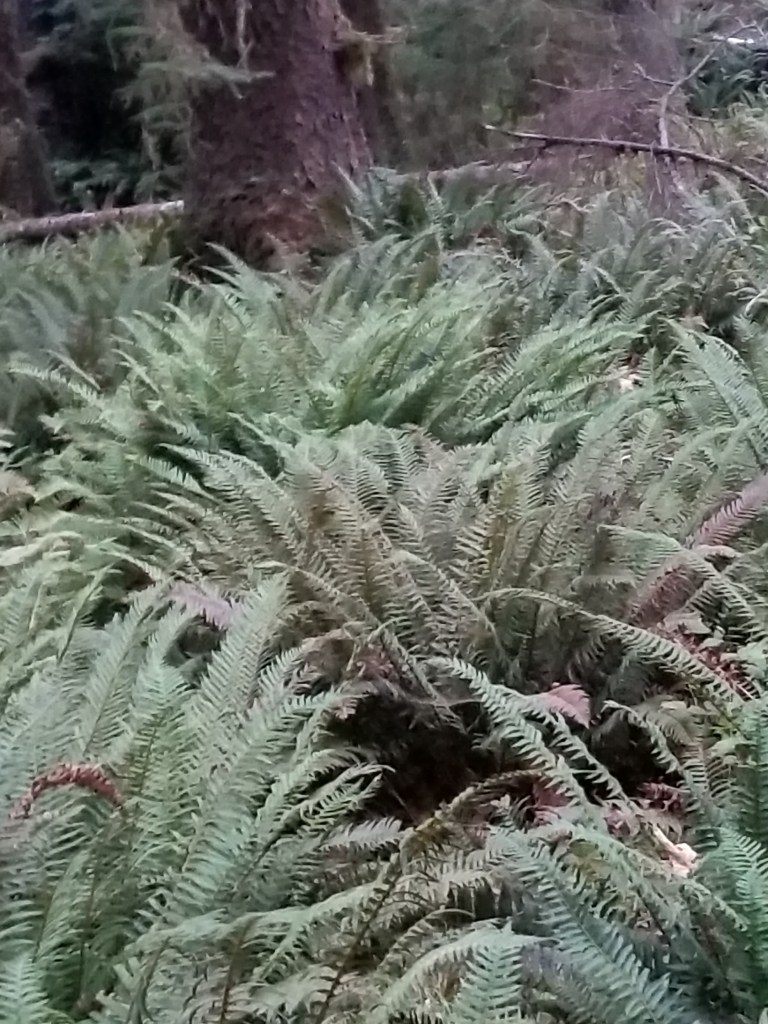
These large ferns dominated the forest floor
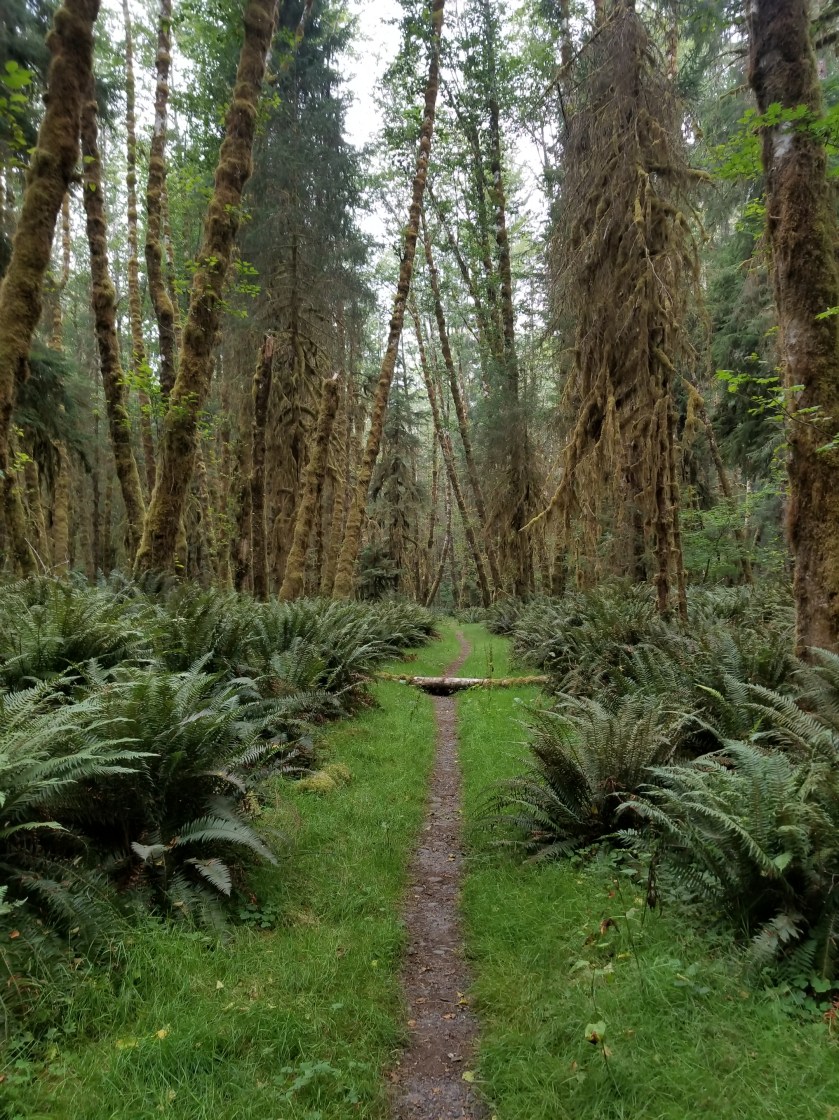
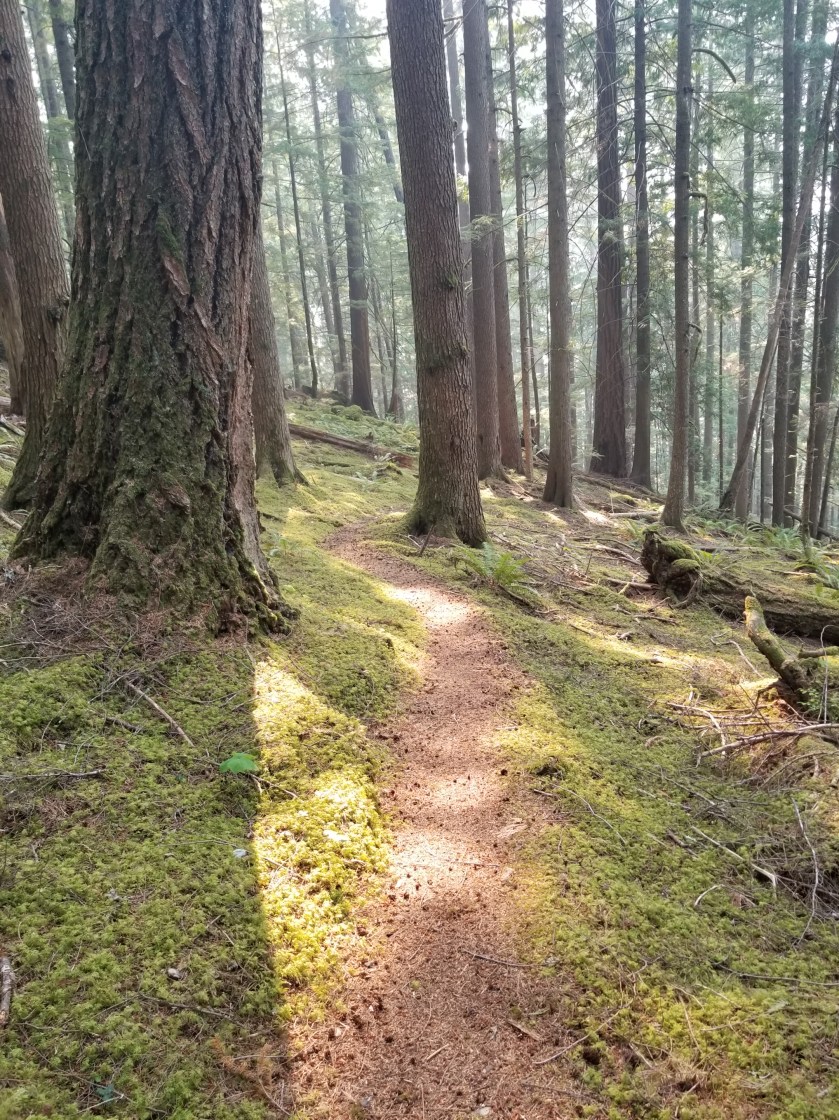
Pretty, nice trail.
The closer I got to the road, the better the trail maintenance. The better the trail maintenance, the faster I went. My morning goal was to reach Bogachiel State Park where I might catch a 10:30 bus to Forks. If I missed that it would be hitching or a paved highway walk.
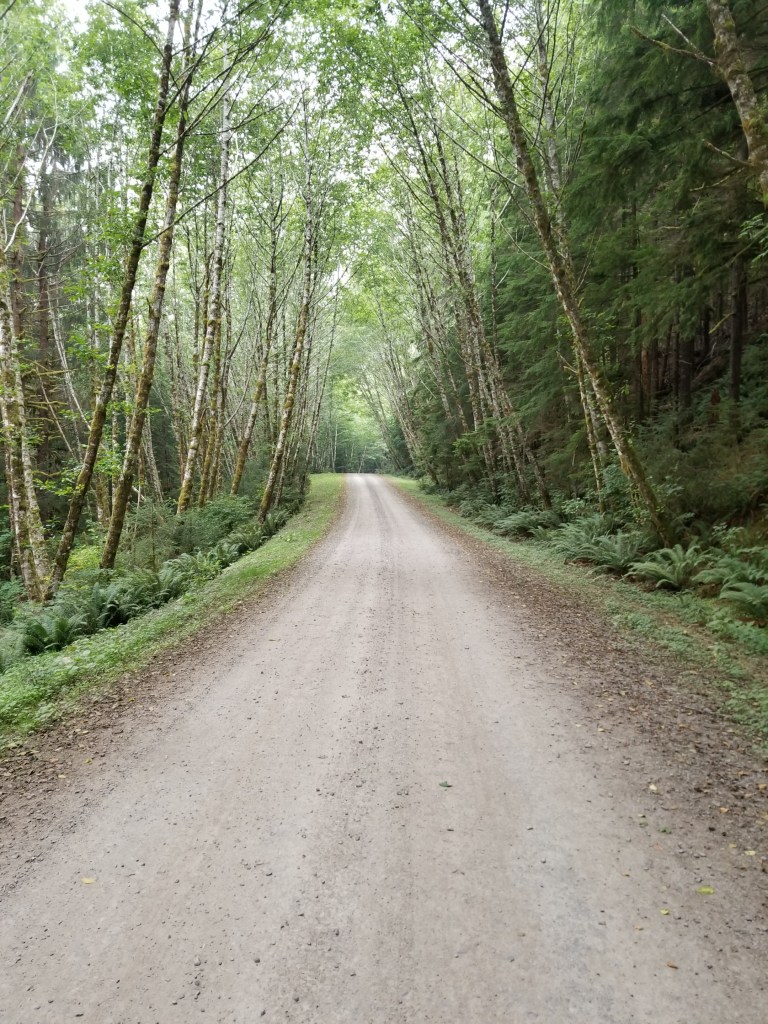
In short order I was off the trail and on to a gravel road. I kicked my speed up another gear. It was overcast and cool, so hiking fast felt good and easy.
If all road walks were like this they would be popular.
Then, I hit the Road Closed sign. I was supposed to take the curiously named Undi Road. It was closed and a new Undi Bypass was indicated. At first I was in denial and tried walking the closed road. However it was truly abandoned and I went back to the bypass. It did not show on any maps, so I had no idea how long it would take. Immediately, however, it was clear it was steep.
I abandoned hope of catching the bus. There were utility crews stringing power lines and the road felt very new. Only a few cars went by. One of them flew by and dusted me big time. It had Minnesota plates. So much for Minnesota nice.
The Bypass ended and I was on blacktop, resolved to hiking into town. Amazingly, a guy who had just come down the Bypass stopped and asked if I wanted a ride. You betcha.
He spent the six miles bitching about local government and the bypass. He was from Hibbing Minnesota. He was a pretty good guy and dropped me off at the wonderfully named Dew Drop Inn.
I couldn’t get in to my room for five hours. So while a shower was out, I managed to get a breakfast and hit the library. Fortunately, I ran in to One Direction just as they were heading out to finish their trip.
Forks is a fading town, losing lumber and holding on to waning tourism related to the Twilight series and sport fishing. I must say the food was bad at every place I ate. Since this was the last resupply town for me, I was disappointed.
I took my final resupply package and got ready for my final leg. It would walk to and then along the coastal portion of ONP, ending at the westernmost point of land for the 48 states. My permit was goofy, so I hatched a plan to spend two (instead of five) nights on the beach. I appreciated the symbolism of starting a hike at the crest of the continental divide and ending at the farthest west point possible. Equally, however, I know how annoying beach walking can get.
I tossed and turned most of the night, perhaps anxious about finishing the PNT.
August 23, 2018. Deer Lake to Bogachiel Campground
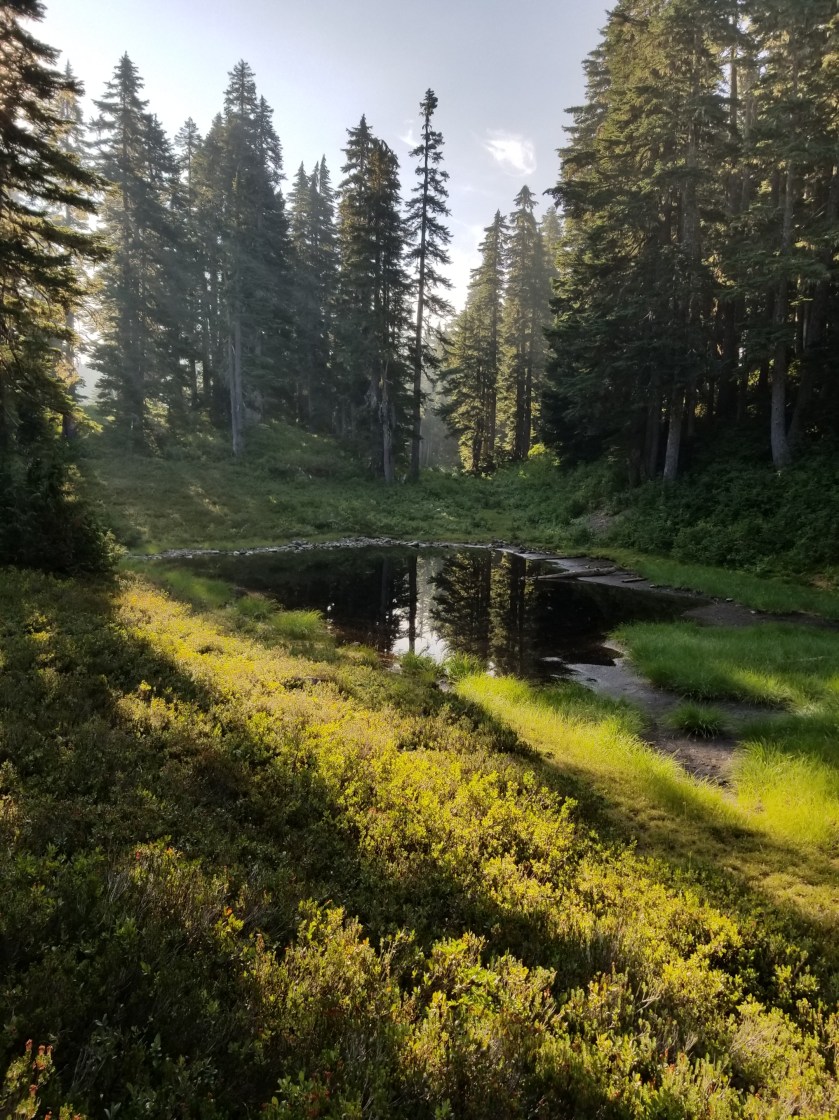
Since I camped in a meadow near a lake, it was inevitable my tent was covered with condensation. It was just a little brisk as I gathered the bear canister and packed.
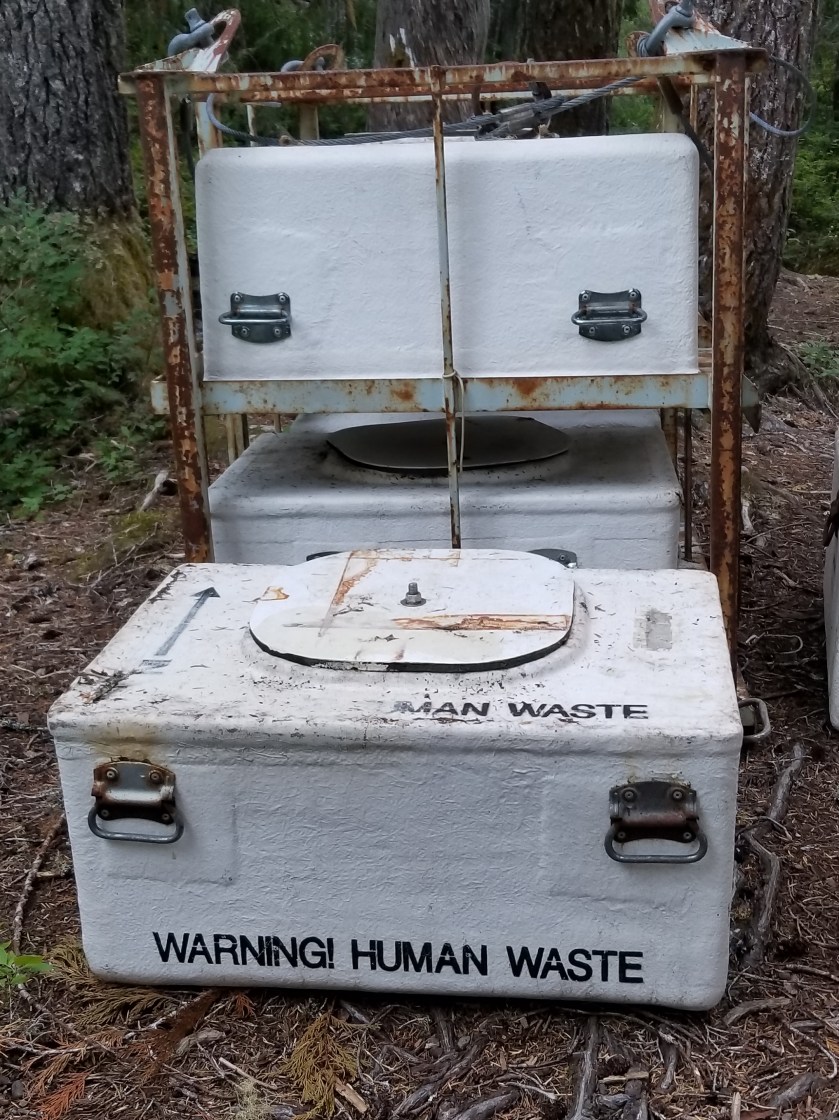
I went out past the toilet. Given the soil composition and number of visitors, the human waste goes into what can only be described as modified coolers. When necessary, a batch of full ones is swapped (via helicopter I presume) with empty ones. The main takeaway for me was to never, ever buy a used cooler.
I started climbing up from Deer Lake via a different trail. It was 6:30, but once I got past the two main camping areas I was pretty assertive with the “Hey bear” mantra. I didn’t want to startle a black bear sleeping on the trail with a huckleberry hangover.
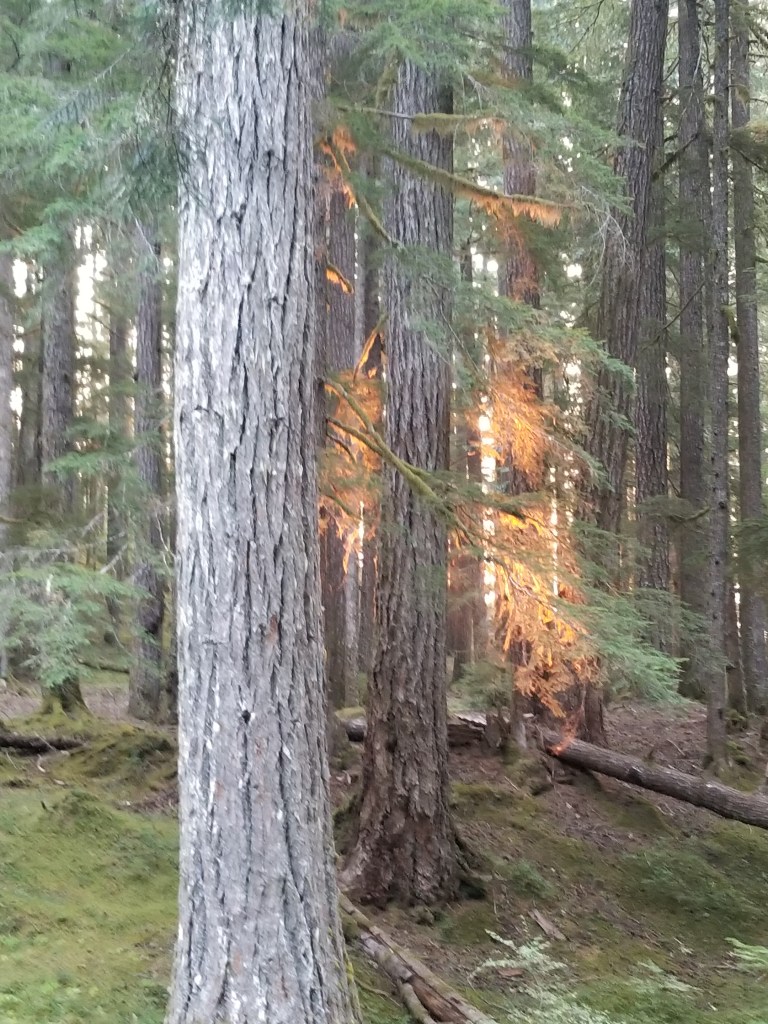
Although the trail was climbing out of the Deer Lake basin, it did so in a gradual manner through pretty country. At the peak, I started walking along a tree covered ridge. It was perfect as far as I was concerned: up high on smooth trail with cool air.
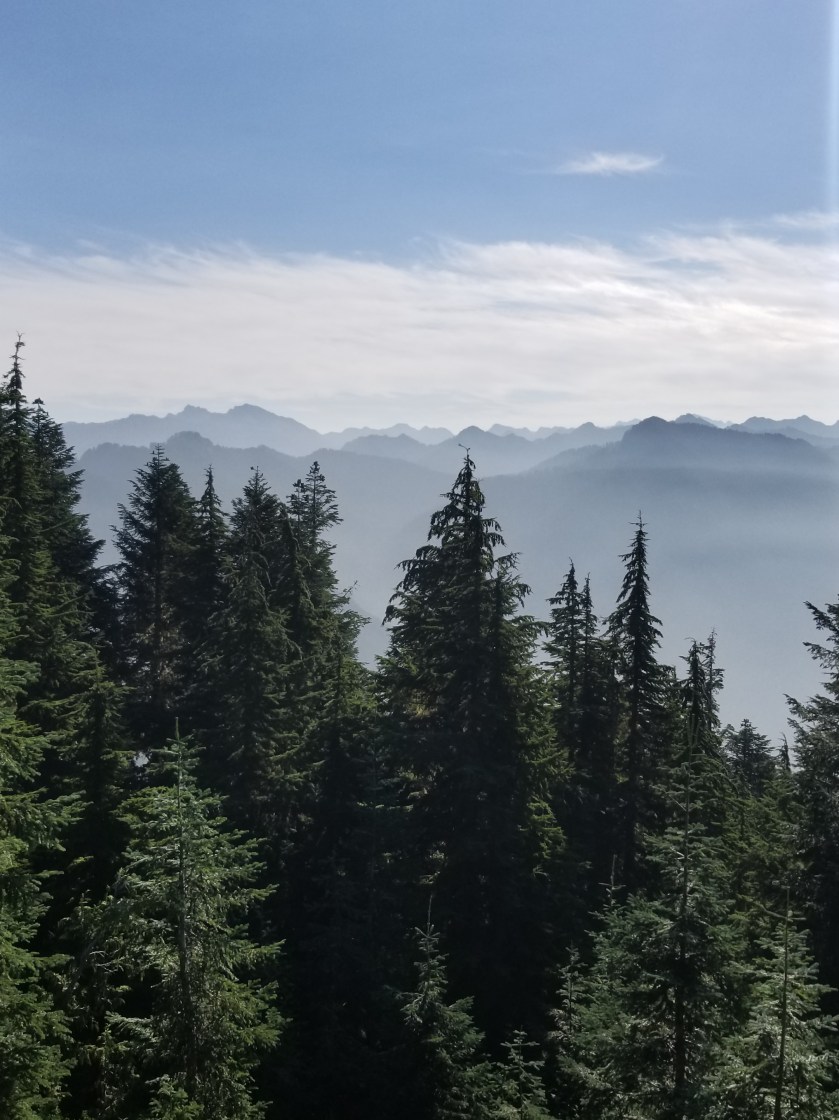
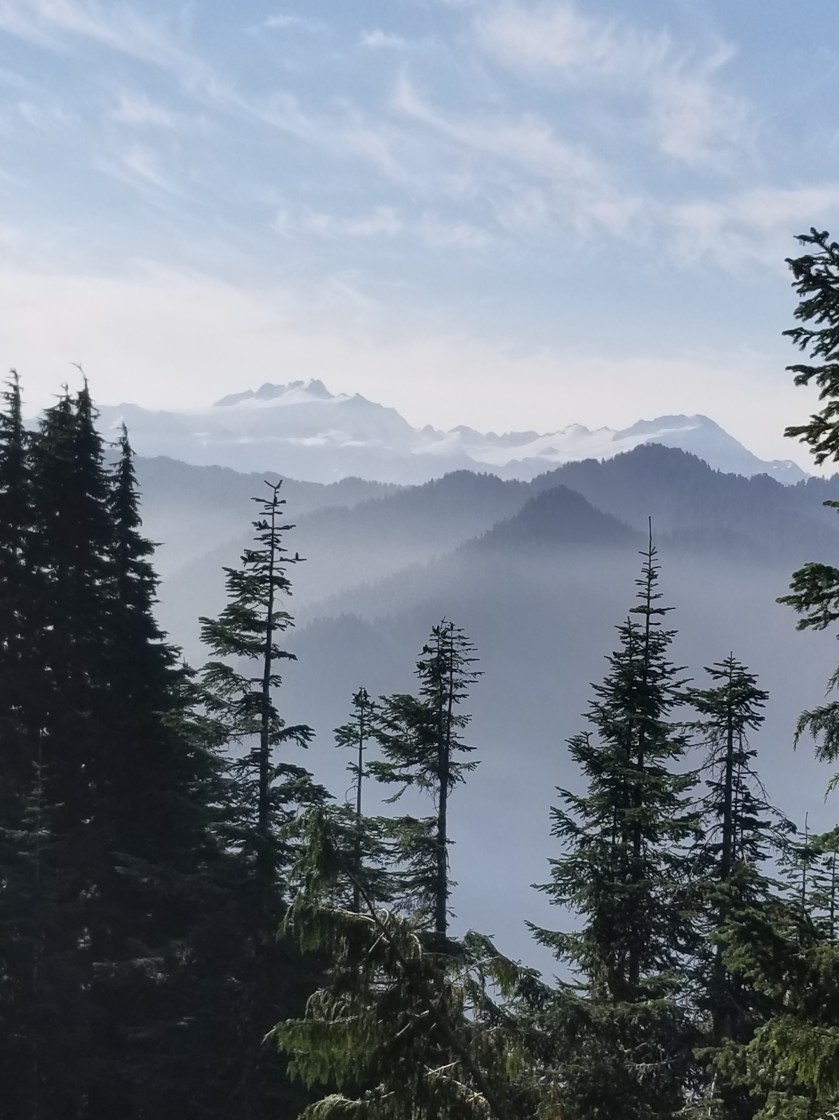
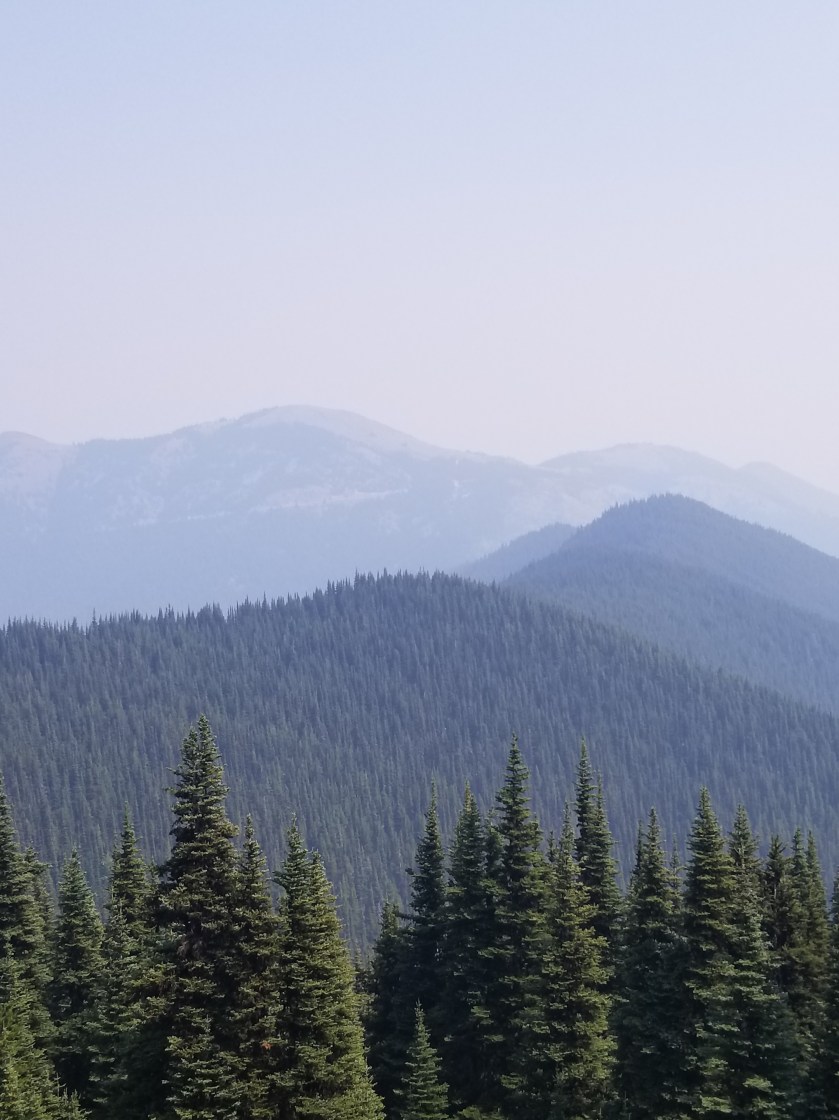
After a few miles, I reached a break in the trees. I was surprised to see that upper level winds had blown away the smoke from some mountain tops given gorgeous views.
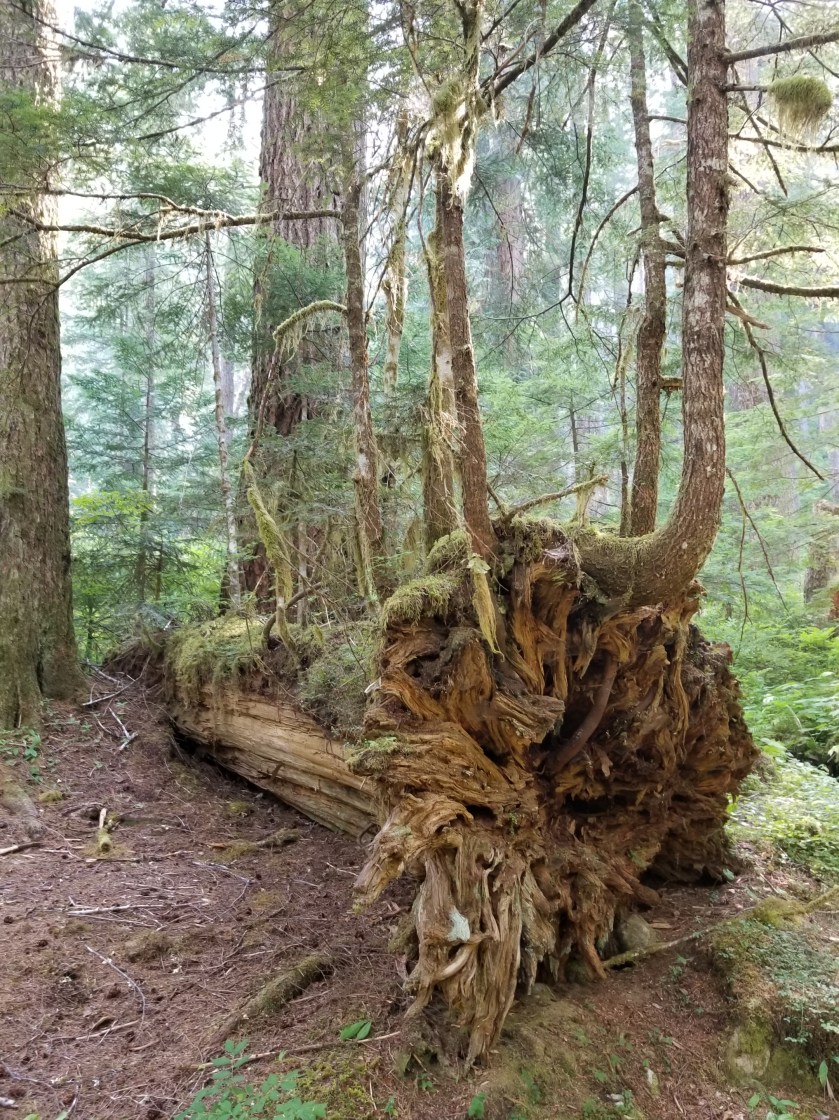
Soon after, the honeymoon was over as the trail descended. The trail turned into a rocky dry creek bed with blow downs. Although the forest was pretty, the condition of the trail detracted from the enjoyment.
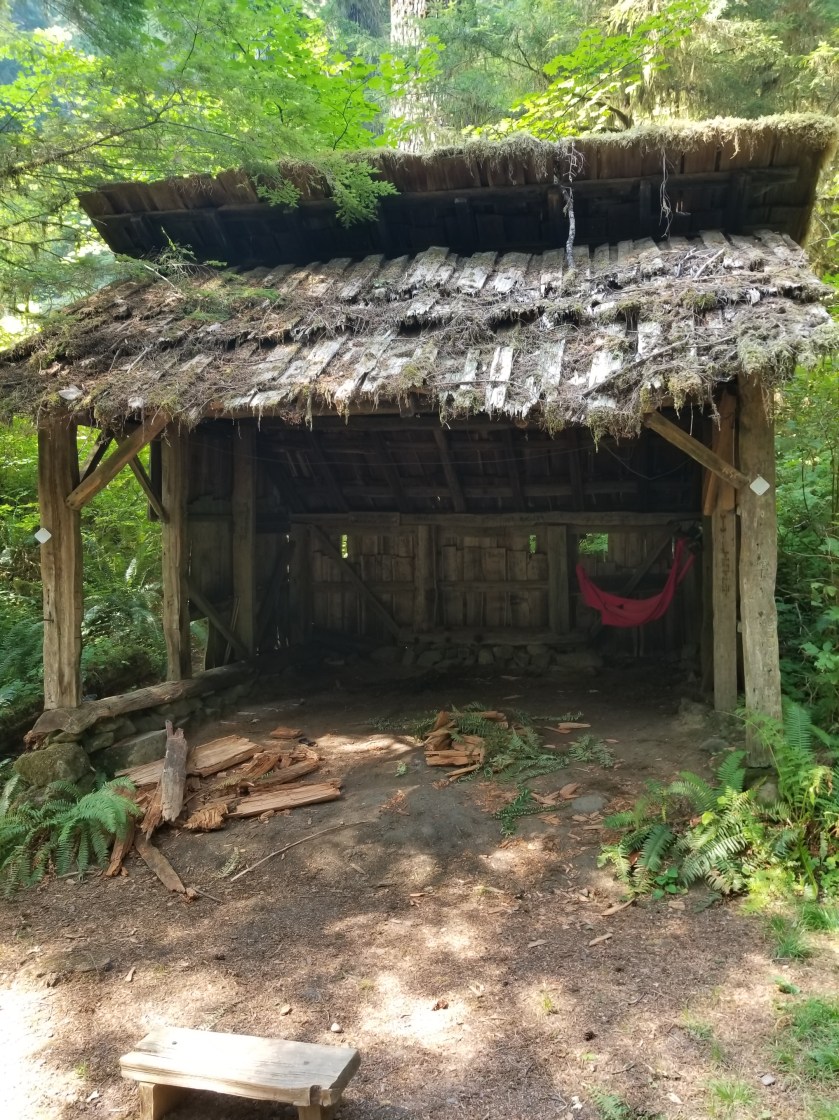
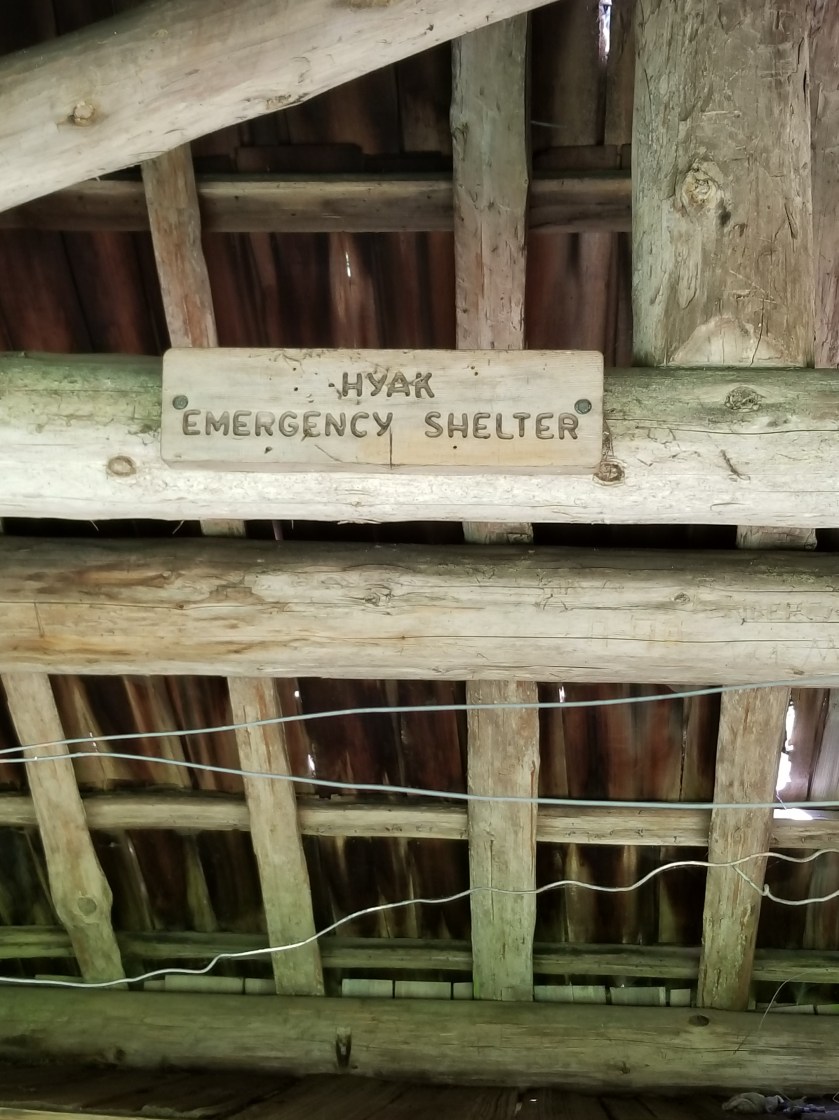
Along this portion of trail, some emergency shelters had been constructed many years ago. I am speculating, but I think they were meant for people unprepared for a snow storm. Essentially, they were three sided lean-tos.
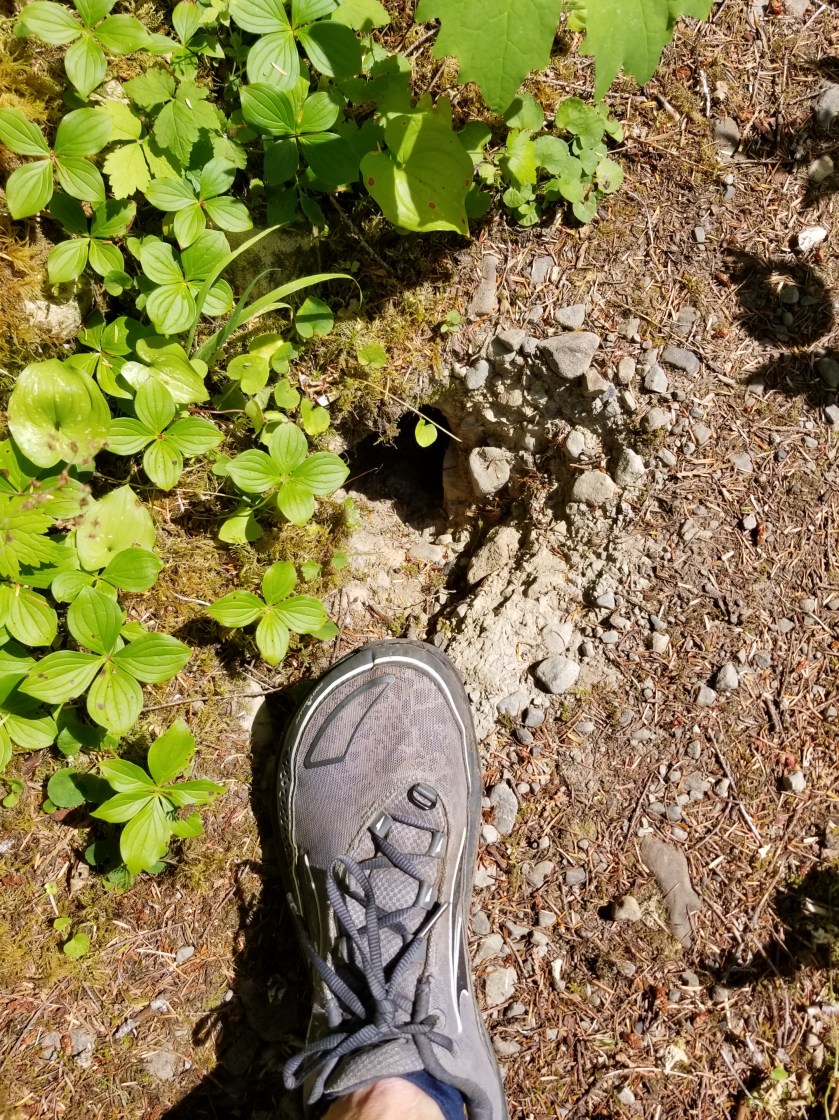
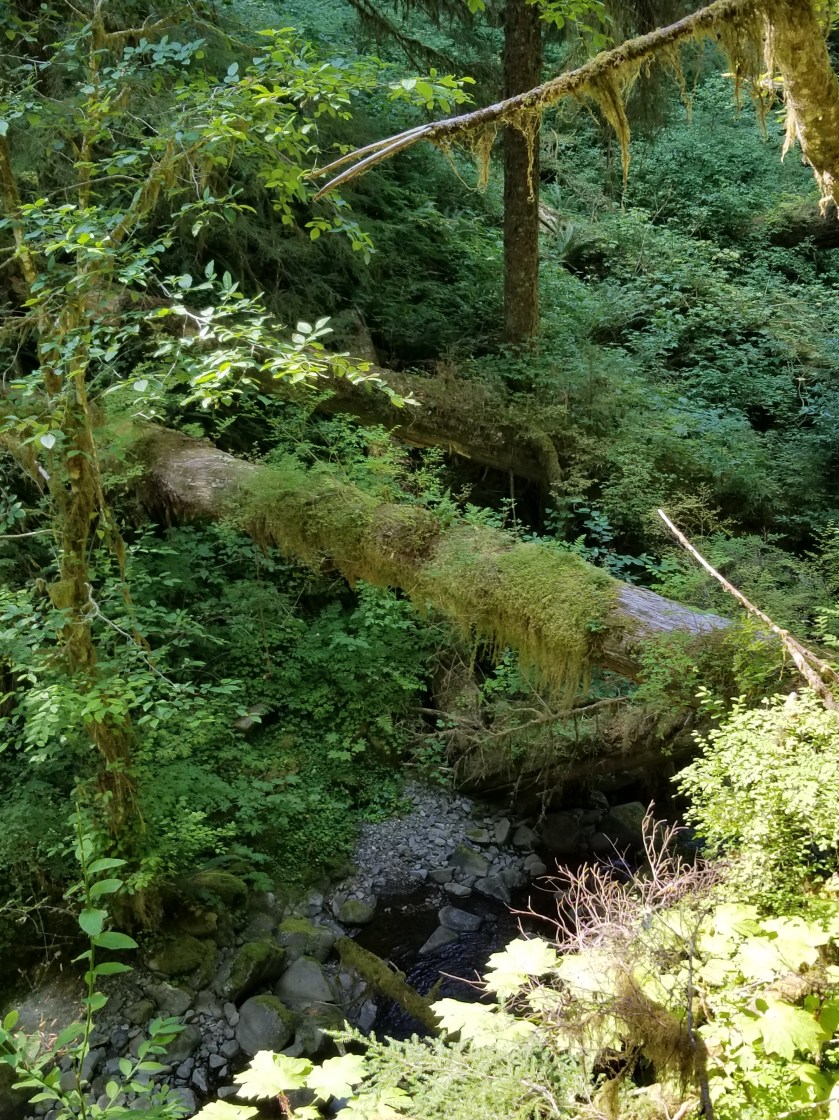
The trail followed the Bogachiel River as it grew in size during its descent. Once the trail and river leveled, portions of the trail were overgrown with plants up to my chest and head. What made it treacherous was the occasional hole dug by a badger (or similar sized creature) that could easily swallow a foot and really mess up an ankle.
I pushed to reach a camp on the map called Bogachiel Camp and Ranger Station. It was a challenge, but I got there. Unfortunately, it was missing just two things: a camp and a ranger station. I walked the area three times and found nothing. Instead, I shoehorned myself into a cramped spot in the dark. It was not ideal, but it was my home for the night.
August 22, 2018. Boulder Creek Campground to Deer Lake
I was feeling my age when I woke up. Thankfully, I only had a 16 mile day scheduled. I’m not a big hot spring guy, but today felt like an exception.
Sunrise through the woods.
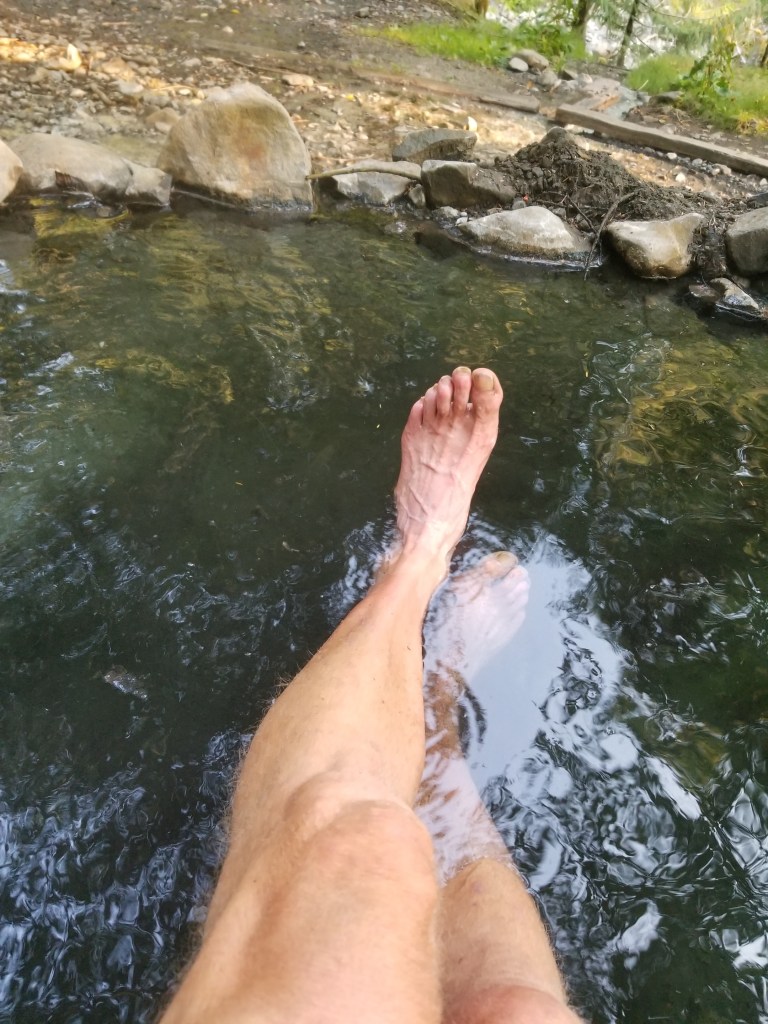
I hiked down to the hot springs. There were about seven. They ranged from shallow foot-soakers to large group- soakers. I chose a moderate sized one. Honestly, it stunk like sulfur and had an inch of mucky material on the bottom which swirled around at the slightest agitation. I lowered my feet in first. After liking the hot water, I sat down. Ten minutes was enough for me. I got out, rinsed off, and left.
Hot spring green slime…Planes, Trains, and Automobiles. John Candy on the plane: “These dogs are barking!”
Coincidentally, I ran in to Not Guilty who had also been camping at the same campground. He was just waking up so we chatted briefly before I took off.
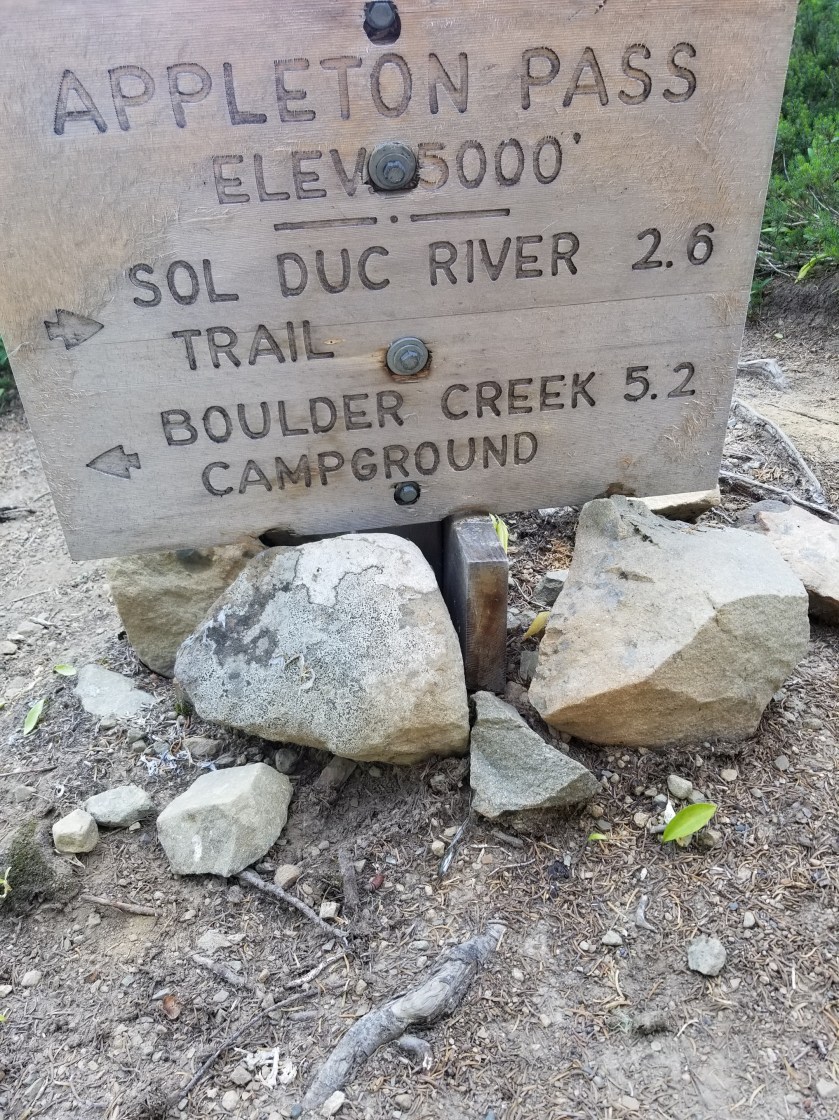
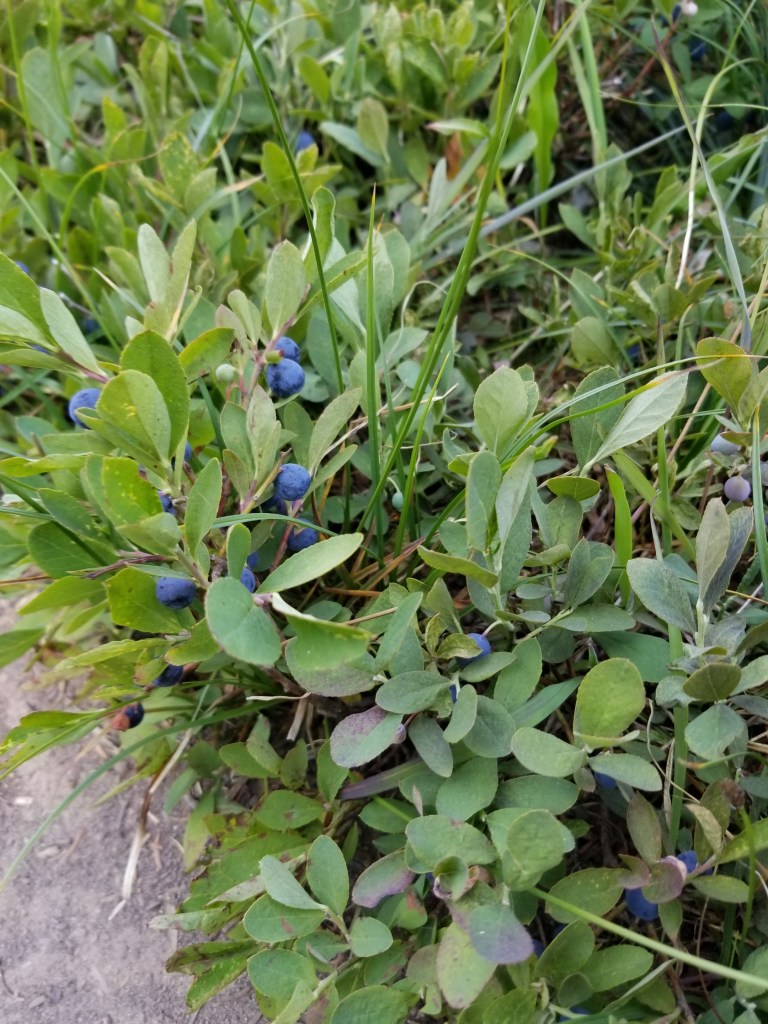
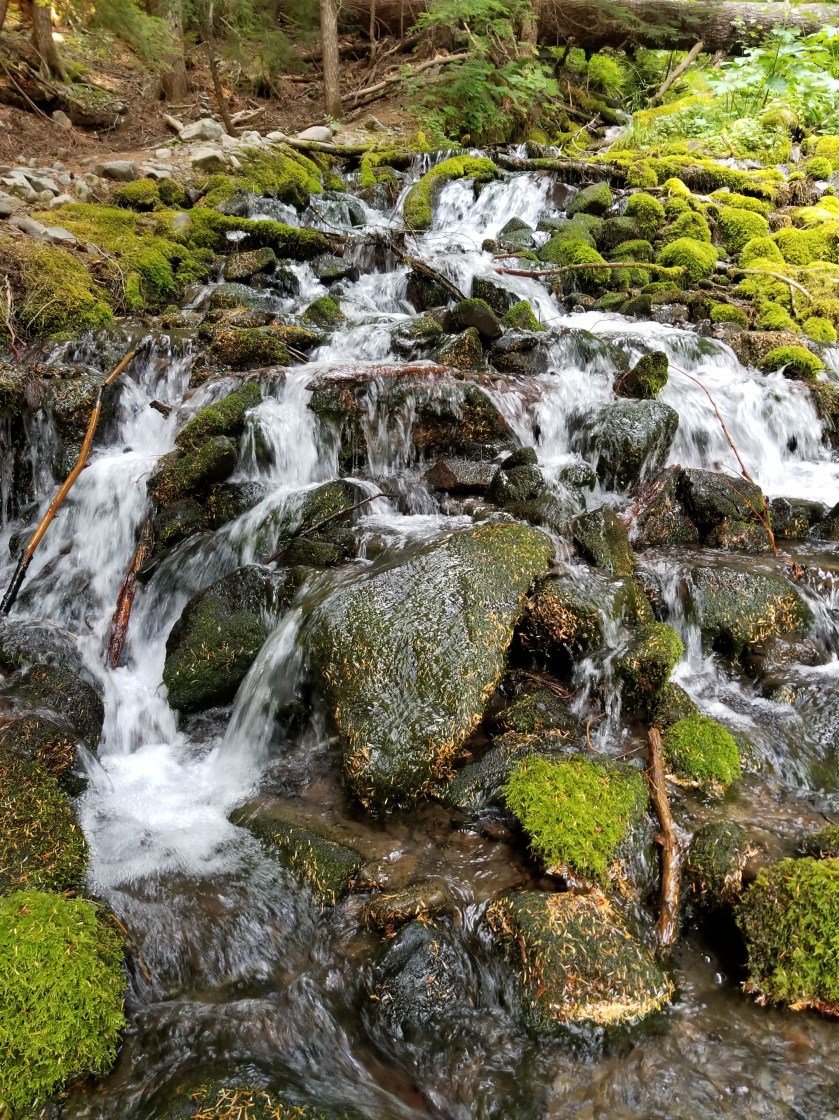
While level in the early going, the “easy” day I was expecting vanished once I started uphill for Appleton Pass. The trail was rocky and steep. There were a few beautiful streams along the way and plentiful huckleberries. However, the switchbacks towards the top were surprisingly hard.
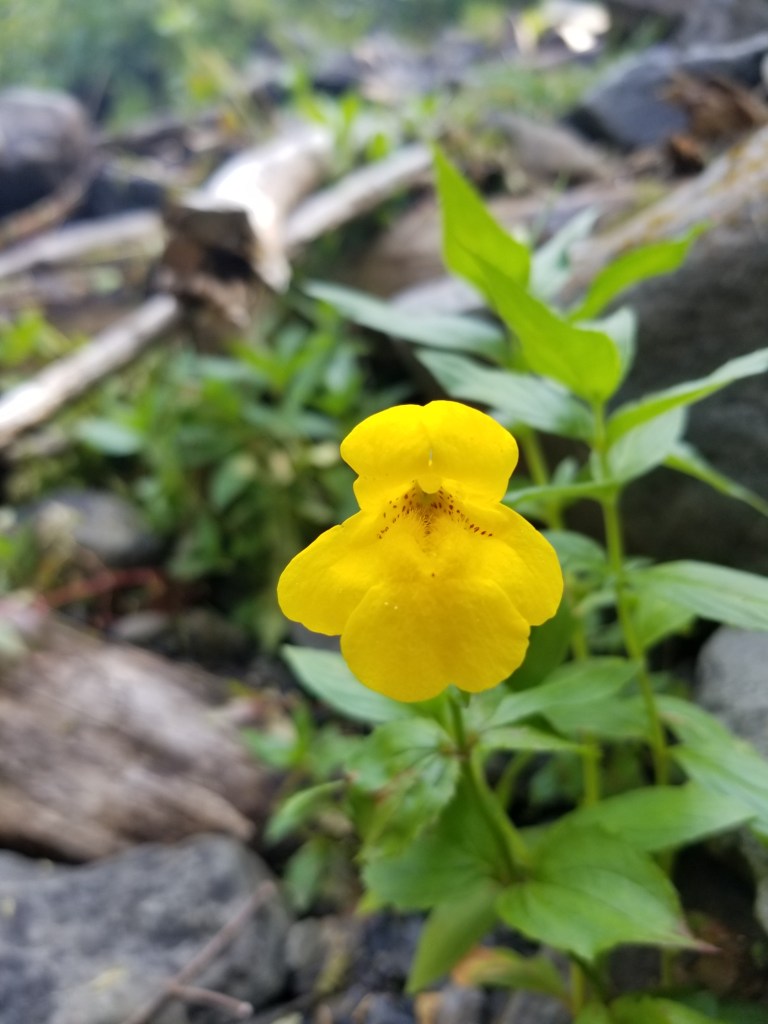
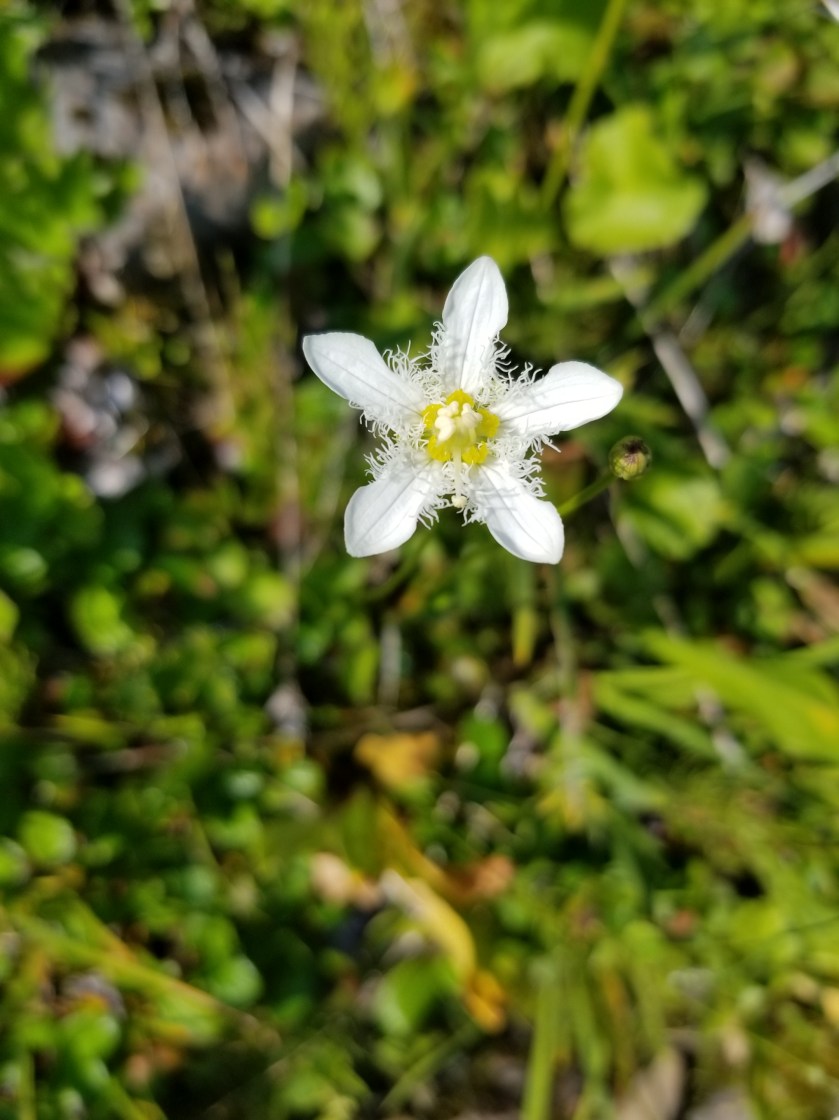
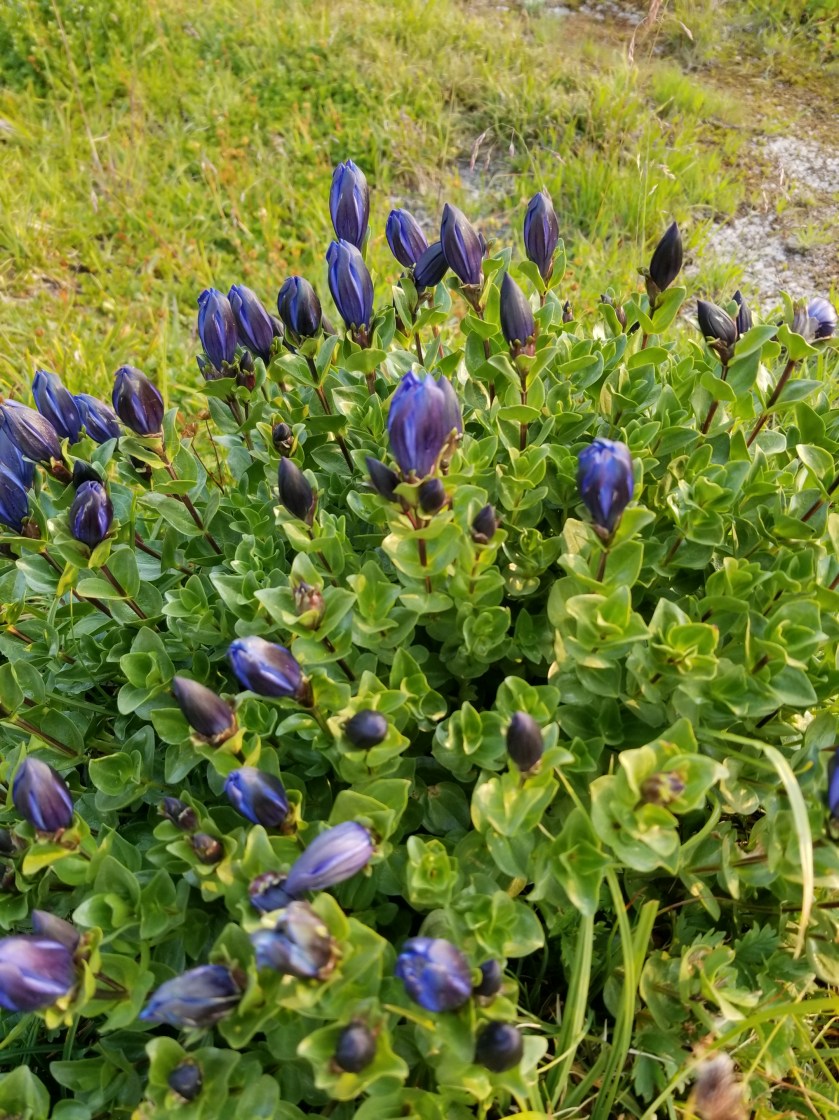
This flower grows only on the banks of cold streams. It looks almost like an orchid.
I
Tons of huckleberries.
I snacked at the peak and descended down a similarly steep trail. My knees protested, reminding me of their sacrifice yesterday.
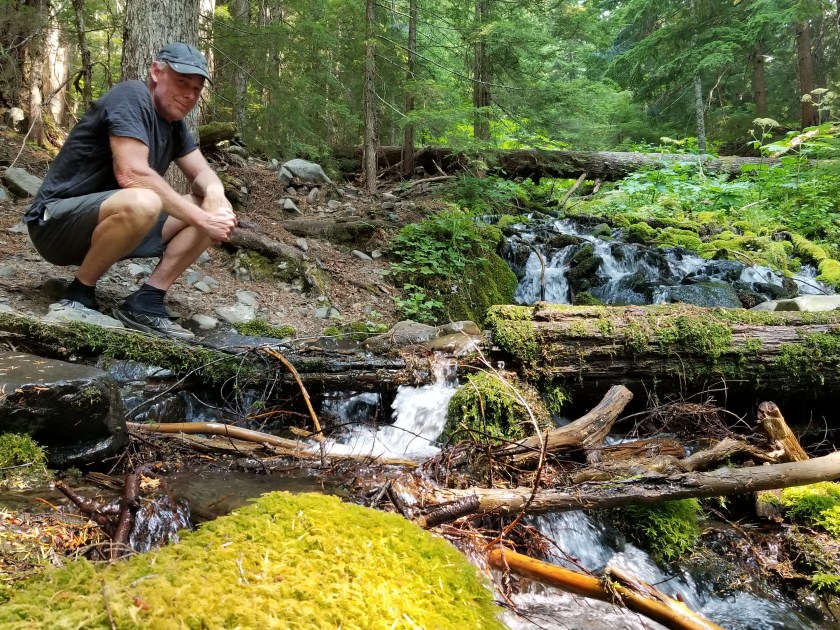
Towards the bottom, it leveled out and had some gorgeous streams.
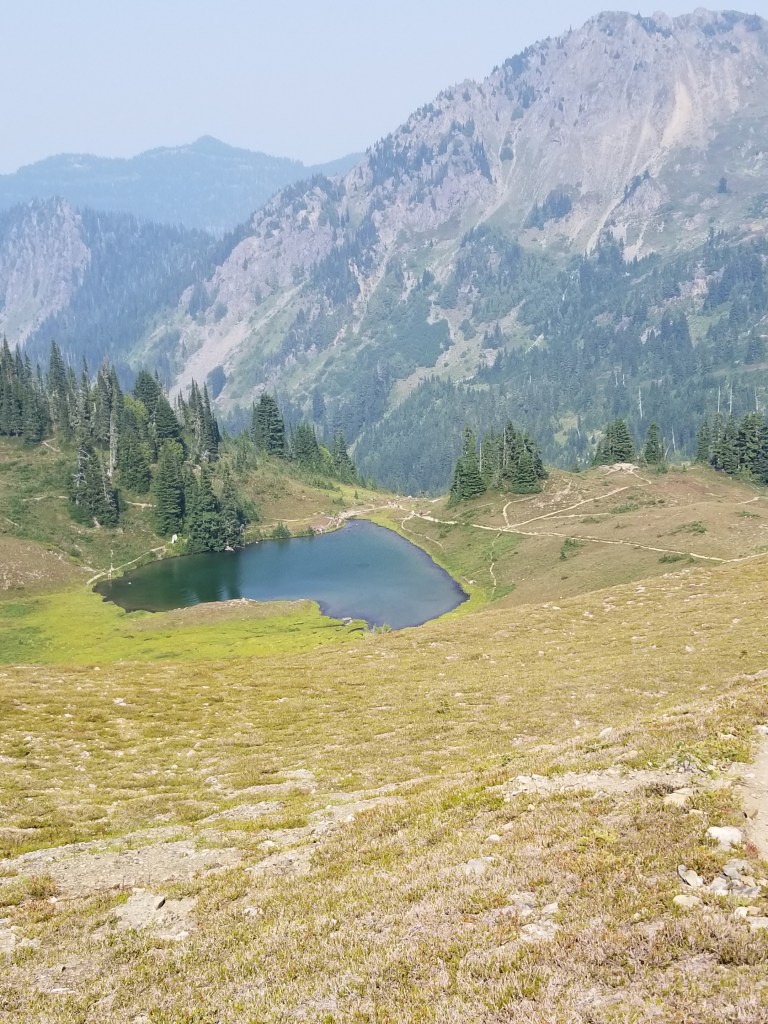
To make up for the down hill, I naturally had to go up along the Sol Duc River. Before getting on the ridgeline to hike the High Divide Trail, I joined about eight other people to get water at Heart Lake. An otherwise unremarkable lake, from above it is perfectly named.
Heart Lake
Once on the High Divide Trail, it was like hiker turnpike. I passed couples, families, groups of college students, you name it. Campsites are strictly controlled in this highly popular seven Lakes Basin. Naturally, I passed a couple camped illegally on the ridge. Further, they were throwing food to some bird or animal. How I wished I had some tuna or peanut butter I could accidentally drop on their tent.
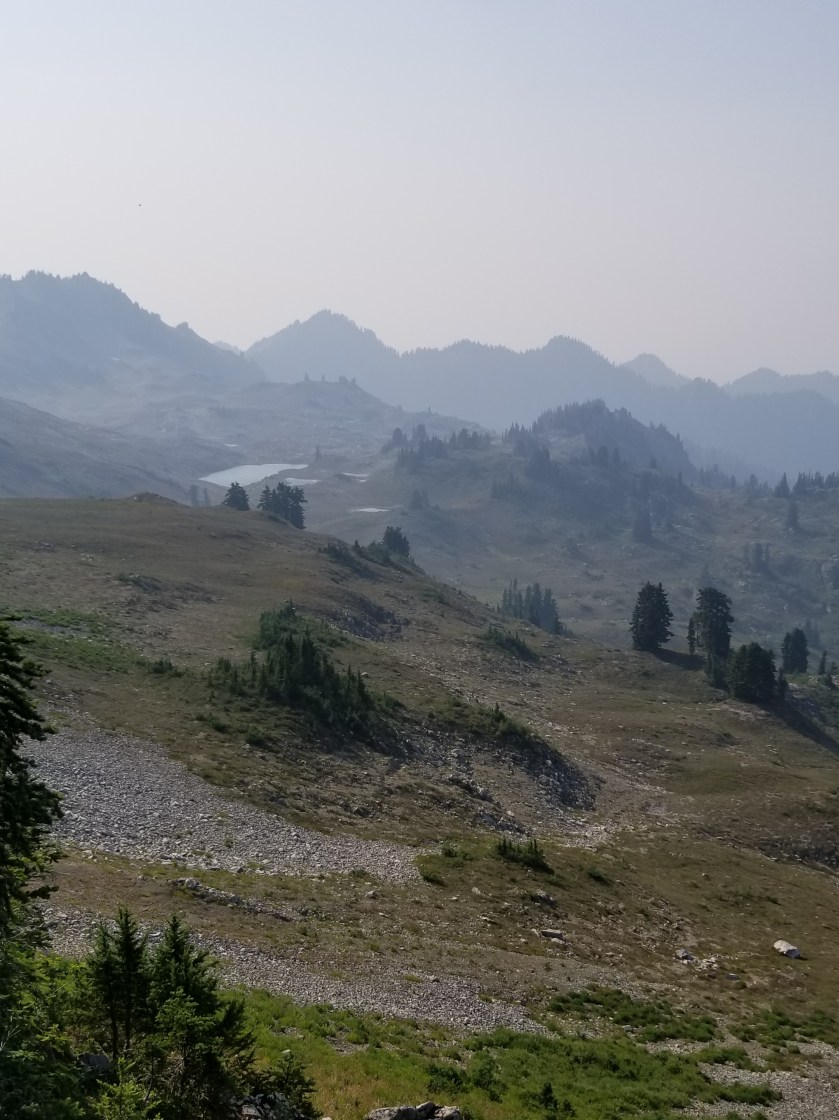
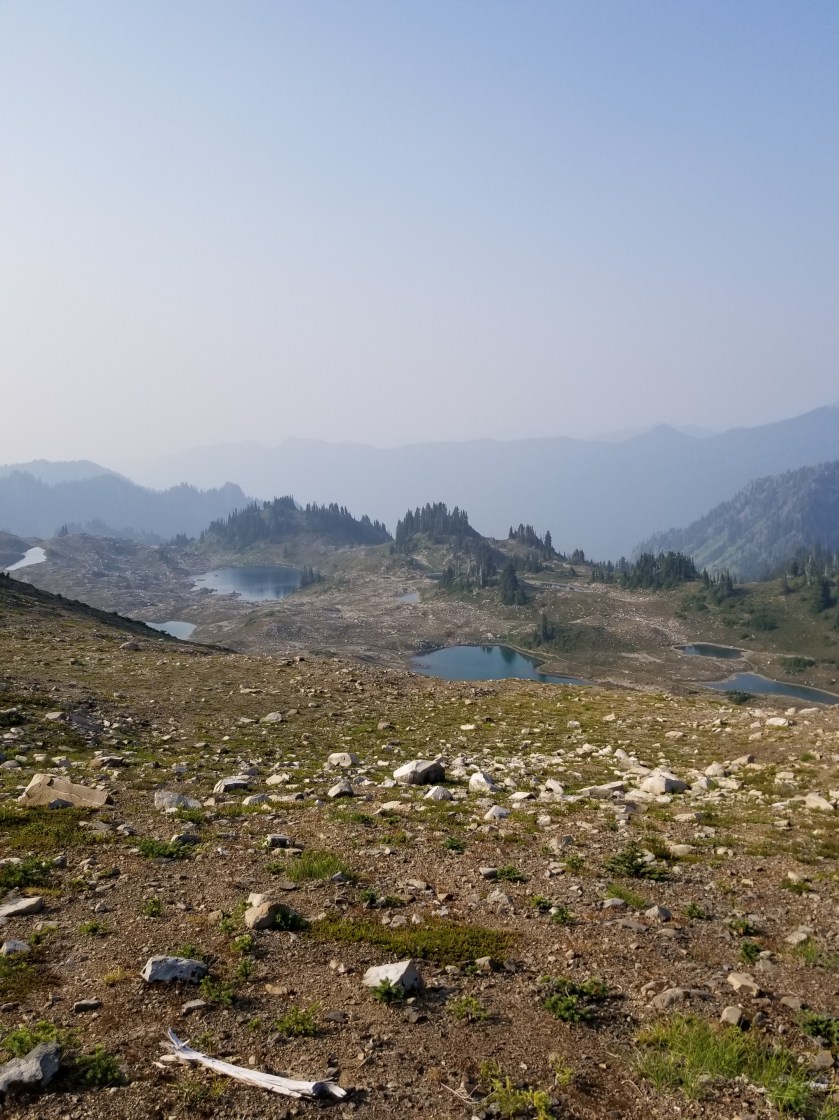
Despite the smoke, I loved the views down in to some of the Seven Lake Basin. I was naturally drawn to the sardonically named Lake Number 8. As the afternoon turned to evening, the crowds evaporated and I enjoyed the ridge walking.
At a critical juncture, I switched to another trail and descended for a good 20 minutes. I then encountered a couple about my age. The wife had braces on both legs but seemed okay. The husband had a huge pack and seemed to creak and groan with every uphill step. I was immediately concerned given the hour, their condition, and the distance they had yet to cover. I asked whether they needed water or electrolytes or food. They said they were ok, but for the next couple days I couldn’t help but wonder how they fared.
Just as the sun was starting to get behind the highest western peaks, I finally dropped down to Deer Lake, my designated campsite. I had heard this area was bear-heavy and it lived up to that reputation.
The first one was a large bear eating it’s way uphill. At first, it looked like my trail would lead me on a collision course. Fortunately, that was not true. I kept talking as I circled 50 or 60 feet above him with thick trees between us.
Next, there was a smaller black bear downhill. I had to talk for about 5 minutes before it looked up from its huckleberries. It gave me an annoyed look.
I was getting nervous as it got darker. I saw my third bear. This one had a gray muzzle like it was old. Again, I compared poorly to huckleberries and it barely acknowledged my existence.
Still on alert, I nonetheless drew a pretty firm conclusion that the multitude of berries greatly outweighed any interest I might generate. Glad to reach Deer Lake, I was eager to eat and get a campsite before total darkness.
At first, the only place I could find open was next to the toilet. Between the flies, smell, and door banging all night, I would rather stealth camp. Fortunately, and again I am not making this up, there was a llama camp. Miraculously, there were no llamas and I had a great, quiet campsite.
After eating my dinner up at the main cluster of campsites, I put my canister about 200 feet from my tent and fell into a deep, relieved sleep. That was the toughest 16 miles I’ve hiked in a long time.
August 21, 2018 Roaring Winds campsite to Boulder Creek Campground
I woke up early knowing this was going to be a tough 27 mile day. I would start above treeline and end up in semi-rainforest. A gross drop in elevation from 6,700 feet above sea level to 360 feet above sea level. I took a moment to thank my knee cartilage for years of dedicated service and bid a fond farewell.
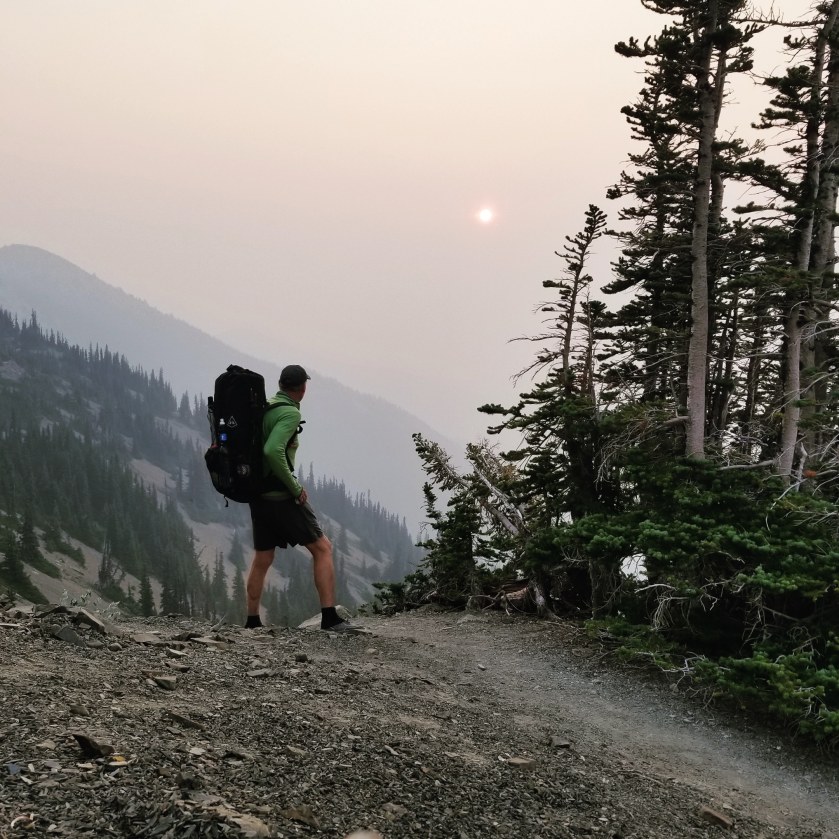
It was smoky still. The sun crept higher looking like a shaded spotlight.
My mandated bear canister took up the top third of my pack.
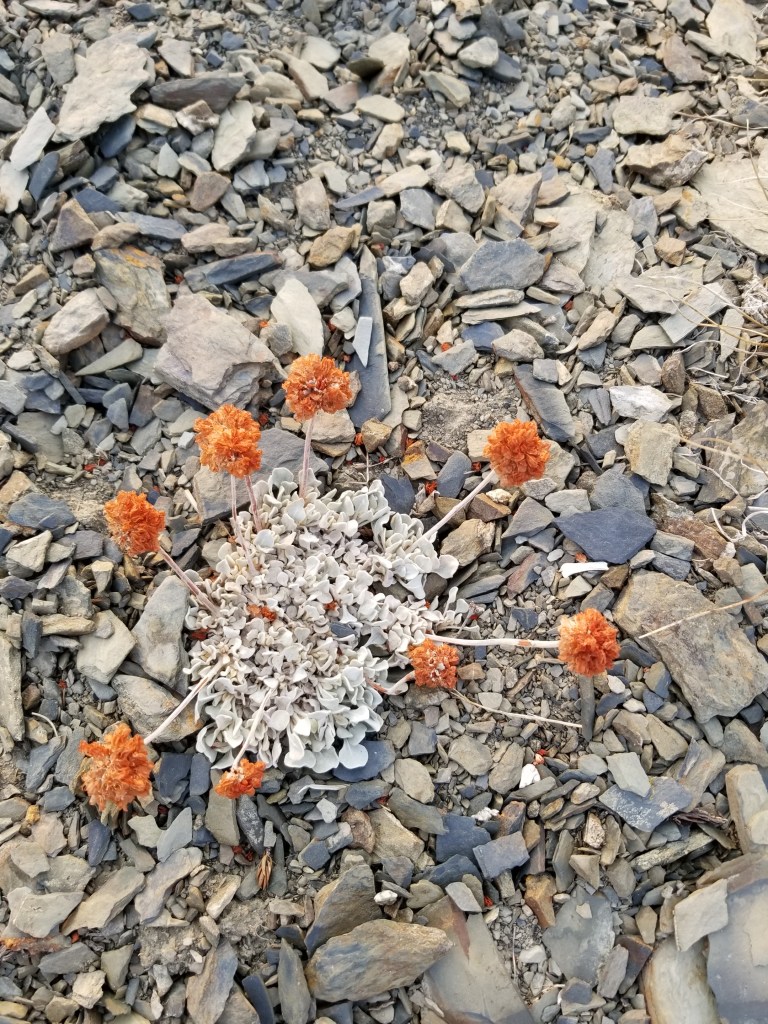
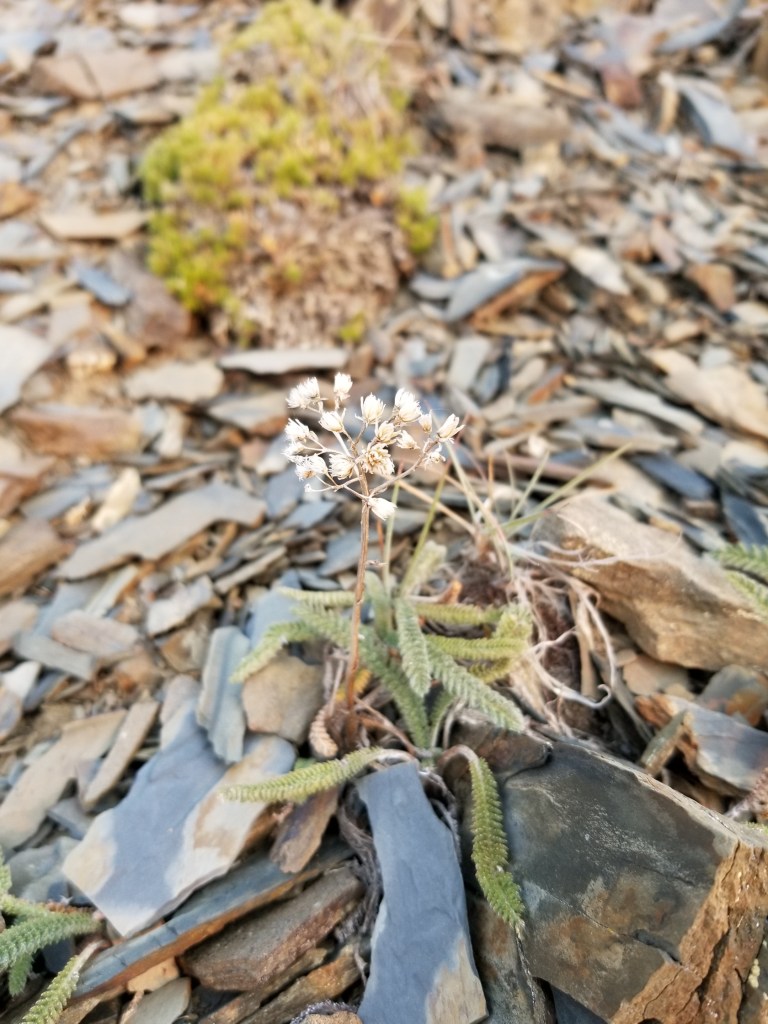
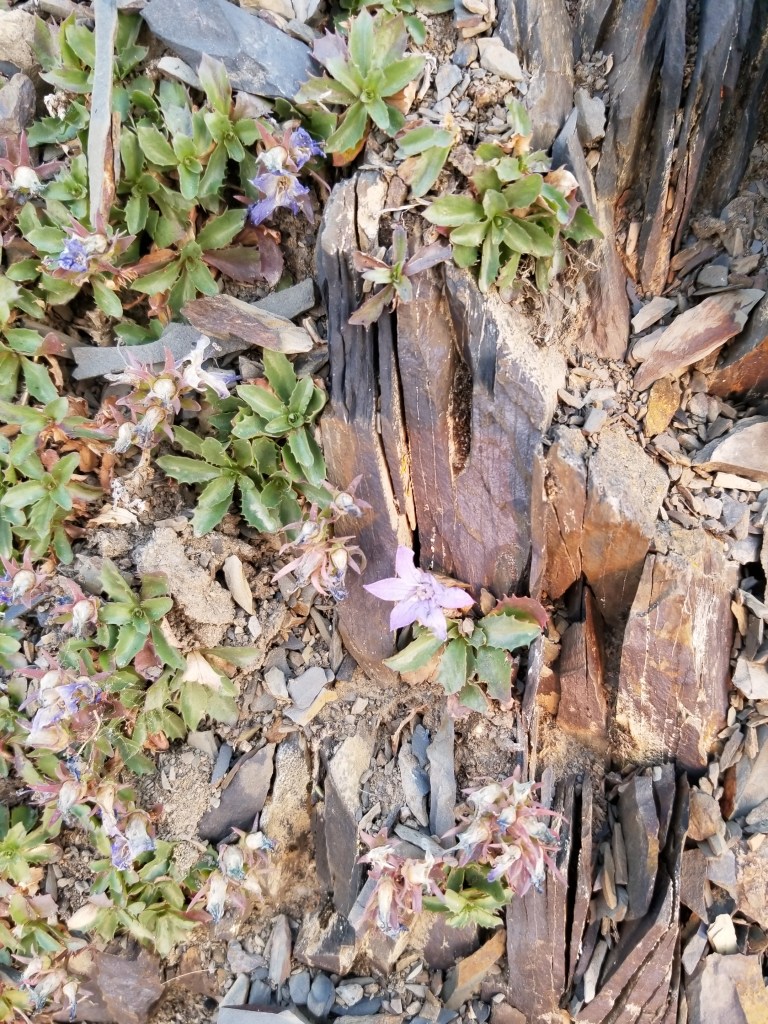
I was well above tree line for most of the morning, but the tough, beautiful, sparse plants provided plenty of interest.
I could not tell whether this was two plants ( orange pine in a white cushion) or one plantAgain, I could not tell if these were two different plants or one.
These toughies appeared to be growing only in rock and crushed rock.
I was also graced with the presence of birds.
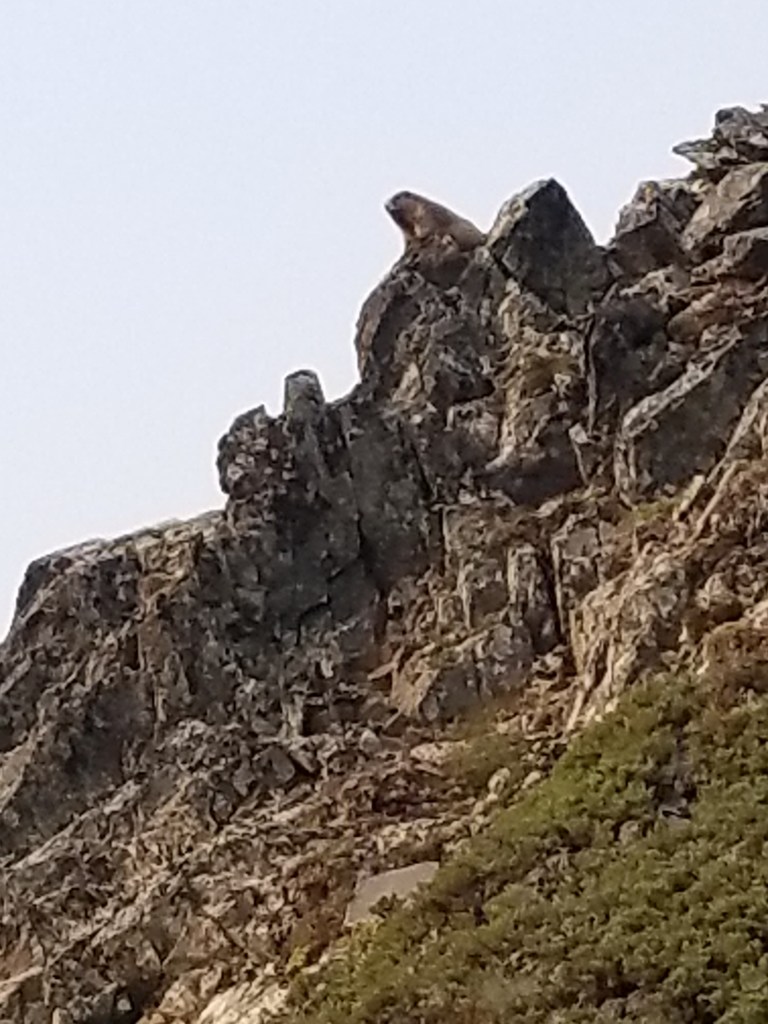
Have I ever mentioned marmots? My morning was marmot heavy.
This lone marmot appeared to be by himself. He called out a warning, but I saw no others.
A bit before noon, I reached the Hurricane Hill Visitors Center.
I feared it would be a tourist zoo as this is the primary driving destination in the park, normally offering gorgeous views after an easy drive. Perversely, the smoke worked in my favor as the huge parking was only 10% full.
When I went inside to the top of two layers, I was immediately able to complete some backpacker chores: find electrical outlet, water, and properly dispose of garbage. While charging, I casually reviewed some exhibits.
Then, I moved over to what seemed the nerve center of the building: Information. When I got to the counter, a gray-haired, uniformed park ranger asked how she could help. I asked “Are there any closures?” (My permit was issued over a week prior and between construction, fires, and, I’m not making this up, Goat Relocation, I knew there was a possibility a portion of my permitted route might be closed.) The blank look in her eyes made it clear I was in for some fun.
“What closures?”
“I was hoping you could tell me. I am backpacking and just wanted to see if there are any road or trail closures I should know about.”
“Oh. If you’re backpacking you need to get a permit. They will know about any closures. ”
“Sorry, I already have a permit issued several days ago, but I just wanted to see if anything has closed recently.”
“You’ll have to talk to the permit people downstairs. We have no information on closures.”
Involuntarily, I stepped back and looked at the sign to make sure it hadn’t said “No Information. ”
Honestly, I tried very hard to ask politely “What information do you have.”
She curtly replied that they help visitors learn about park programs and nearby day hikes they could take. About to ask her what she would do if a day hike route were closed, I thought better of it and left, thanking her for time. I felt empty, without closure.
The best part, though, was when I went downstairs, to the holy land of closure information. It was a gift shop and snack bar! Torn, I couldn’t guess whether trail closure information would most likely come from the fry cook or the lady selling stuffed animals.
I chose the snack booth. I ordered the fish and chips: three pieces of fish and fries for $13. When I got the order, it was two pieces of fish. I asked the person if they were having a two-for-three special. She said “No, its regular price.”
After about a half hour, I had enough and got going. I had a fairly steep downhill, but first I had to go up the popular Hurricane Hill trail. There were many helpful signs explaining the two different trail closures coming up in the next few days.
It was hazy and hot on the open hillside. I opened up my umbrella to create shade. I got a few smirks, but it kept the sun off and let the small breeze through.
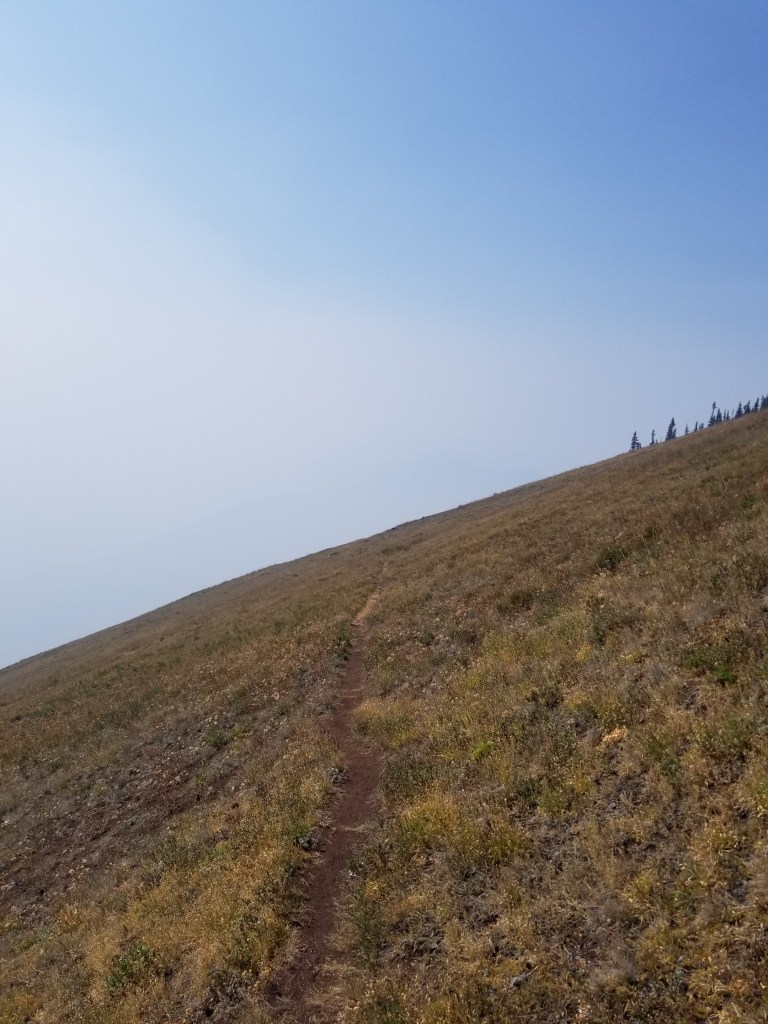
A faint trail leads over the smoky edge.
Eventually, I began my descent. Over the next several hours I walked down from above tree-line to subalpine to grassland, dry ponderosa to rainforest. Early on, it was incredibly steep and I nearly wiped out as I tripped and my top-heavy pack wanted to carry me down.
A
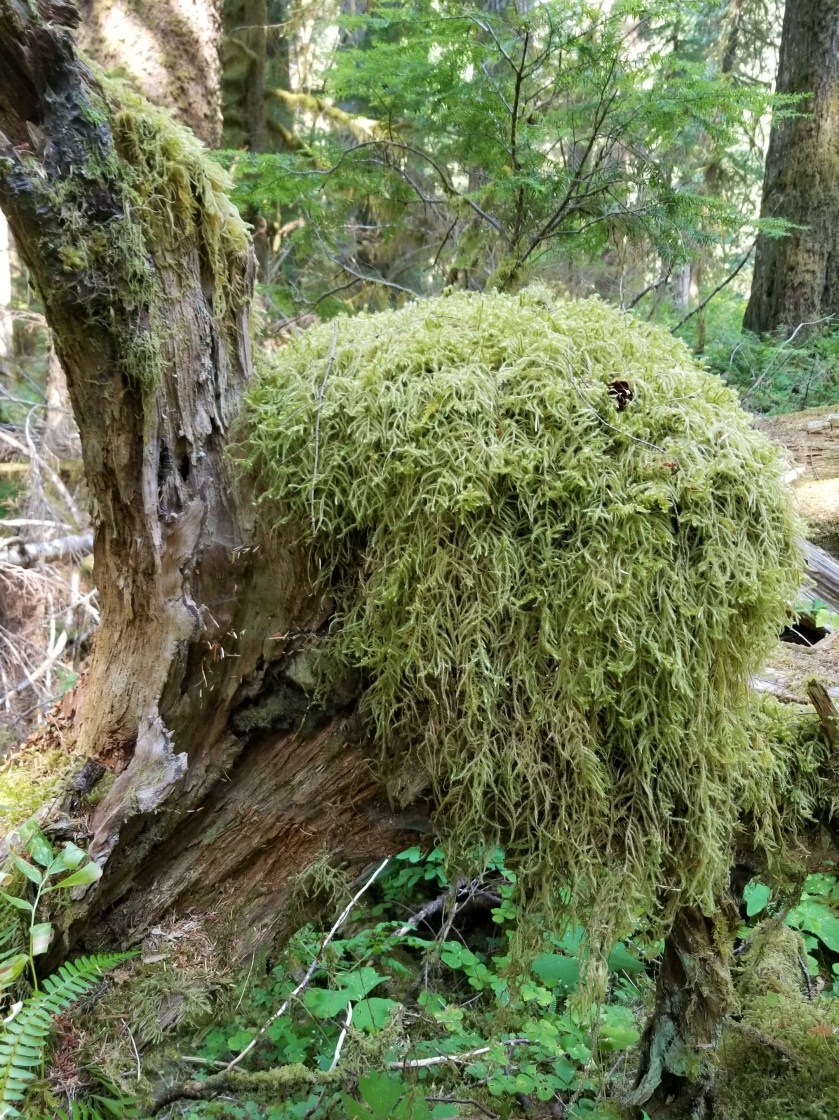
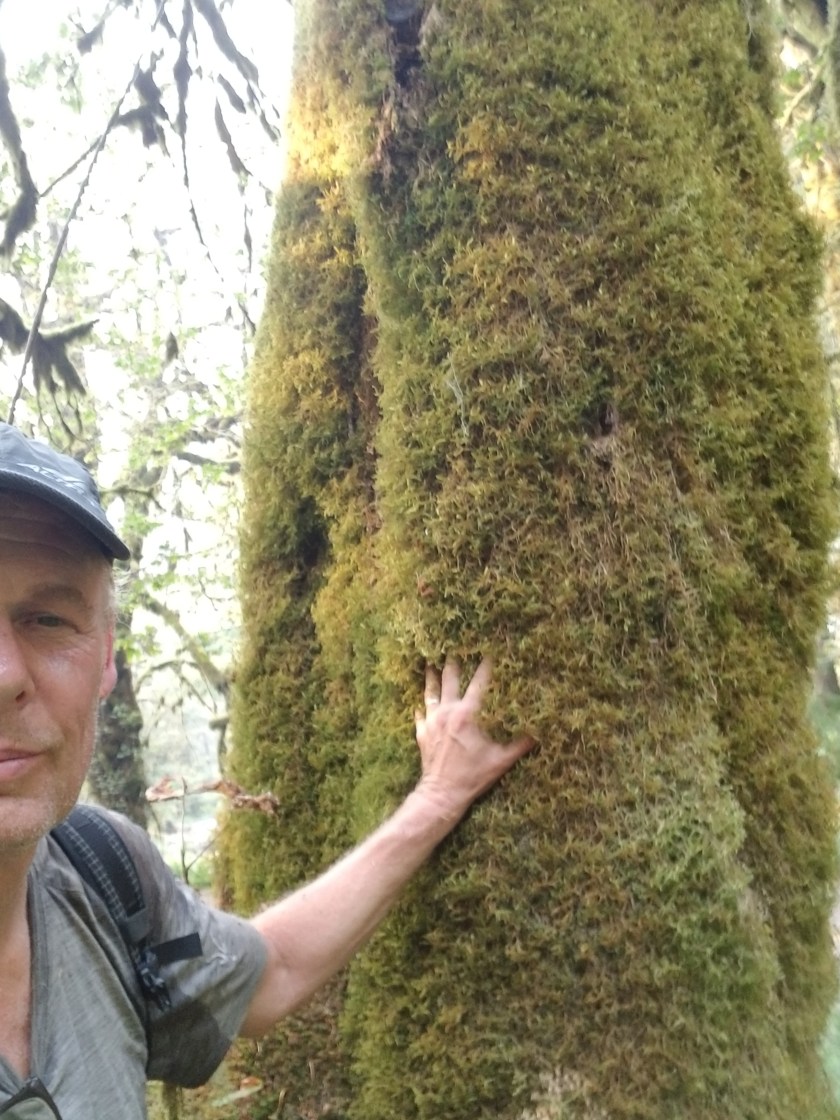
No, I do not have tiny hands! The most covering this tree was deep, reminiscent of a shag carpet from the 70s.
Around 5:00 I reached the bottom. The ONP was in the midst of major renovations, having removed a hydroelectric dam and replacing the roofing on the nearby ranger station. As a result, a major roadway was closed to vehicle traffic. After so many perilous hours on narrow shoulders of busy highways, strolling along a wide paved Avenue through the trees was a beautiful change.
I passed two couples. One was on bike and the others hiked. Both couples were returning from the Olympic Hot Springs.
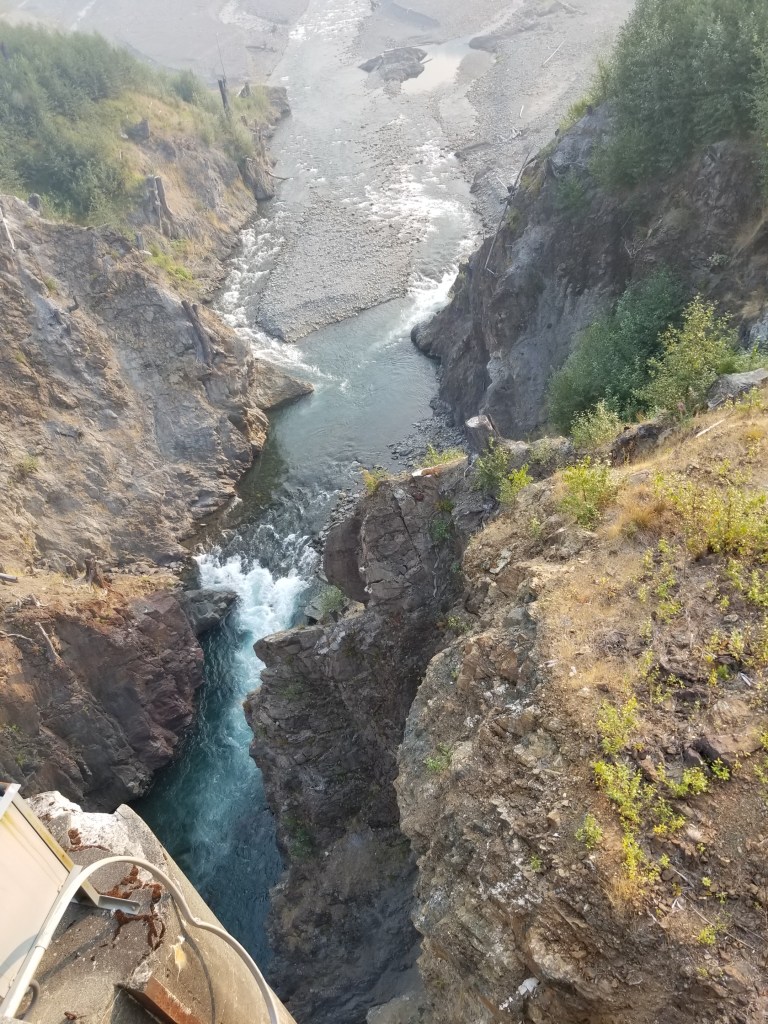
I had a gradual nine mile, 1800 foot elevation gain ahead of me. My knees were sore, but it was simply a matter of grinding out the miles. I did stop to look at the remnants of the dam.
The concrete on the left was part of the removed dam.
I ate dinner as I walked. Finally, about two miles before the hot springs / campsite, the paved road ended and turned to trail. It was close to dark so I got water and took out my headlamp. I’m not a fan of night hiking, so I was walking as fast as I could. Just as it was getting to the point where I couldn’t see 10 feet in front of me, I reached the campground. It was huge. A few years back, vehicles could drive all the way to the hot springs and thus the campground was large.
I hung my food, pitched my tent, and put my creaky bones and sore muscles down to sleep. Just as I was dozing off, a group of female hikers walked past with their headlamps blazing, returning from the springs to their campsite. Finally, after they got their food hung, the campsite was dead still and quiet. At last, my eyes found closure.
August 20, 2018. From Deer Creek Trail Head to Roaring Winds.
I woke up a little groggy. The smoke from the Canadian fires came in strong overnight. A couple times during the night I woke up because of the smell of smoke. You would think my sense of smell would be used to smoke by now.
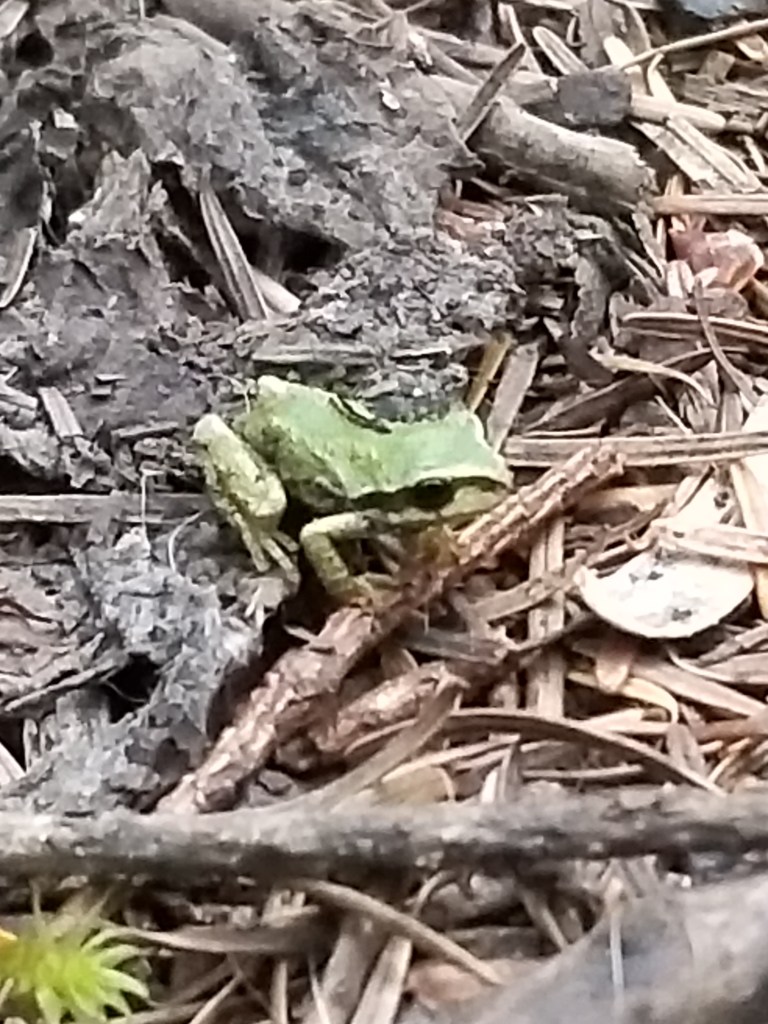
There was a curious little tree peeper that watched me pack. He was so small I might’ve stepped on him if not for the bright color.
This guy was so tiny.
After packing, I started up the Deer Ridge Trail. At first, it was a nice steady climb. While I was messing around with a very weak cell signal, a day hiker came along. His name was Dave and he was a peak bagger. A peak bagger is somebody who sets goals of certain mountain peaks they want to climb. Typically, they try to hike up without the special gear that moutain climbers use. One of the best example is Coloradans striving to climb all peaks in their state 14,000 feet or more above sea level, called 14ers for short.
The sun struggles to shine through the morning smoke.
As the trail steepened and Dave conversed easily while I huffed and puffed, it was clear this 67 year old was in great shape. He was very knowledgeable about almost every Washington mountain I had seen. He lived nearby and even offered a place to stay on my way home if needed. I would consider myself lucky to be like him.
We parted company at the first camp inside ONP, Deer Park. My first and foremost job was to find water. I went to the ranger station to ask, but a sign said “On Patrol”, which I cynically took to mean napping.
I did find beautiful water right at the trailhead. My trail and campsite were all high and dry, so I tanked enough for the rest of the day and tomorrow morning. After filtering, I made a rookie backpacking mistake. Lost in thought, I took some big swigs out of the bottle in my hand. Looking down, I realized I had been drinking out of my “dirty” water bottle which is used to push water through my filter. I hoped I was so high and close to the water source it was safe from giardia and cryptosporidium. Well, I would definitely be the first to know.
As I started on the trail, I noticed some excellent trail work. In particular, the drainage was being done beautifully. In a mile, o met the two gentlemen responsible for the good work. They both were volunteers. I complimented and thanked them.
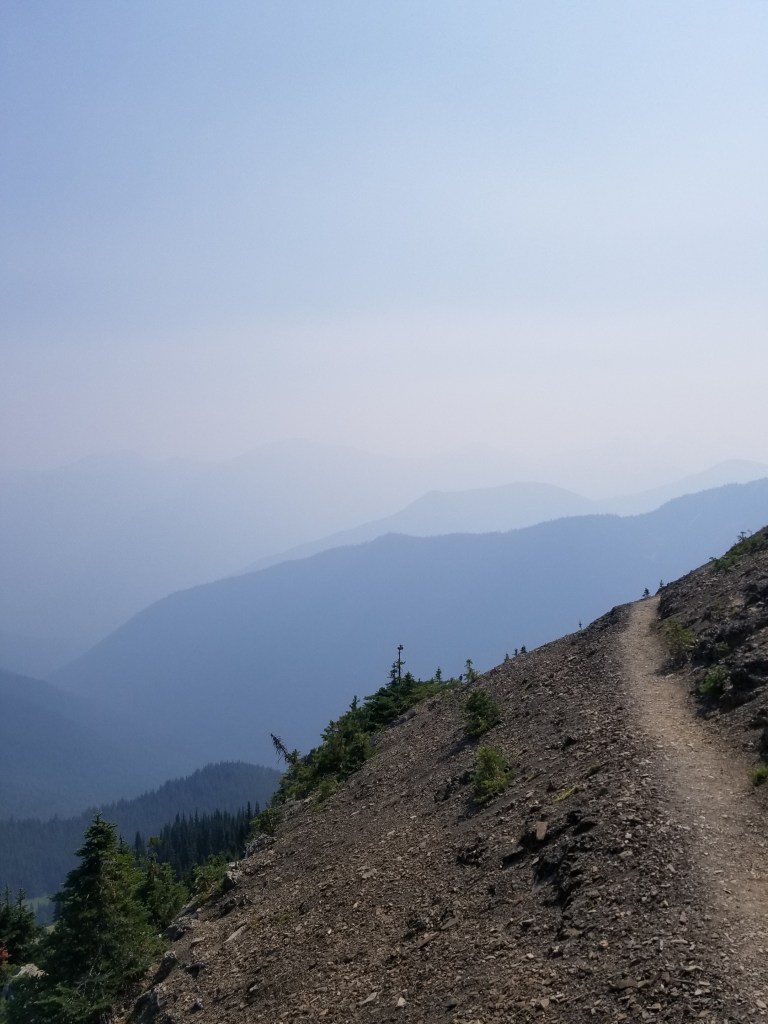
The hike was high and gorgeous even though the valleys were smoke filled. I passed about a dozen hikers, half of them day hikers.
Hazy views
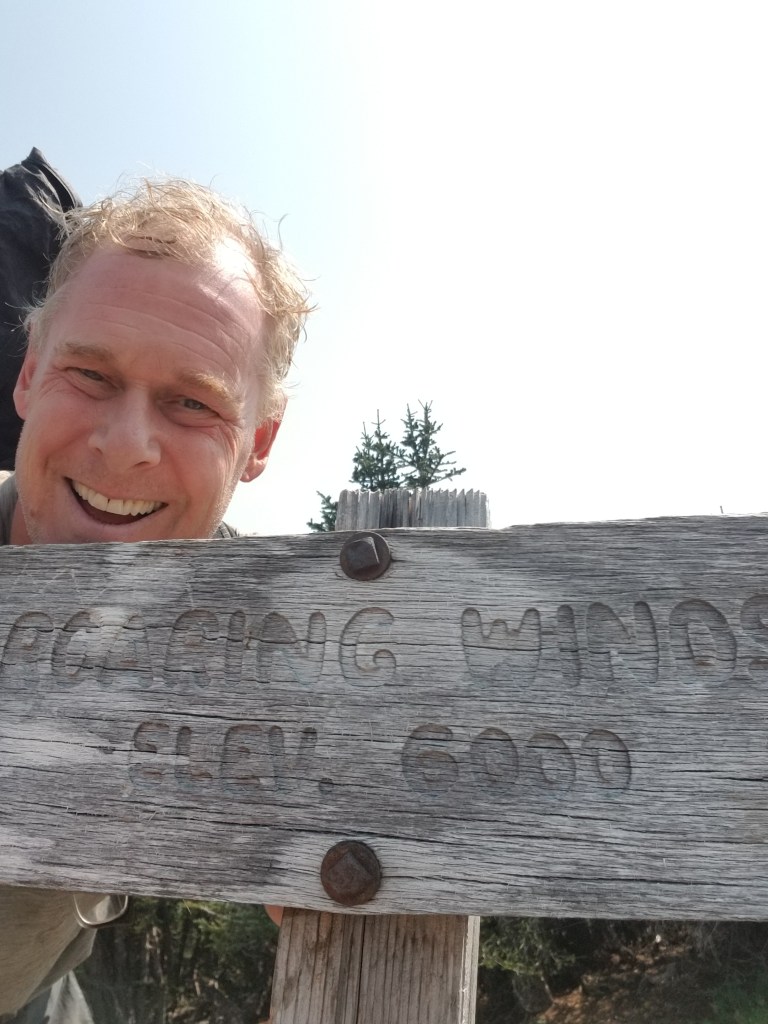
Midafternoon I reached my assigned campsite called Roaring Winds. It was on a saddle between peaks and had a reputation of living up to its name. Nobody was there, so I snapped up the most protected of the four sparse sites.
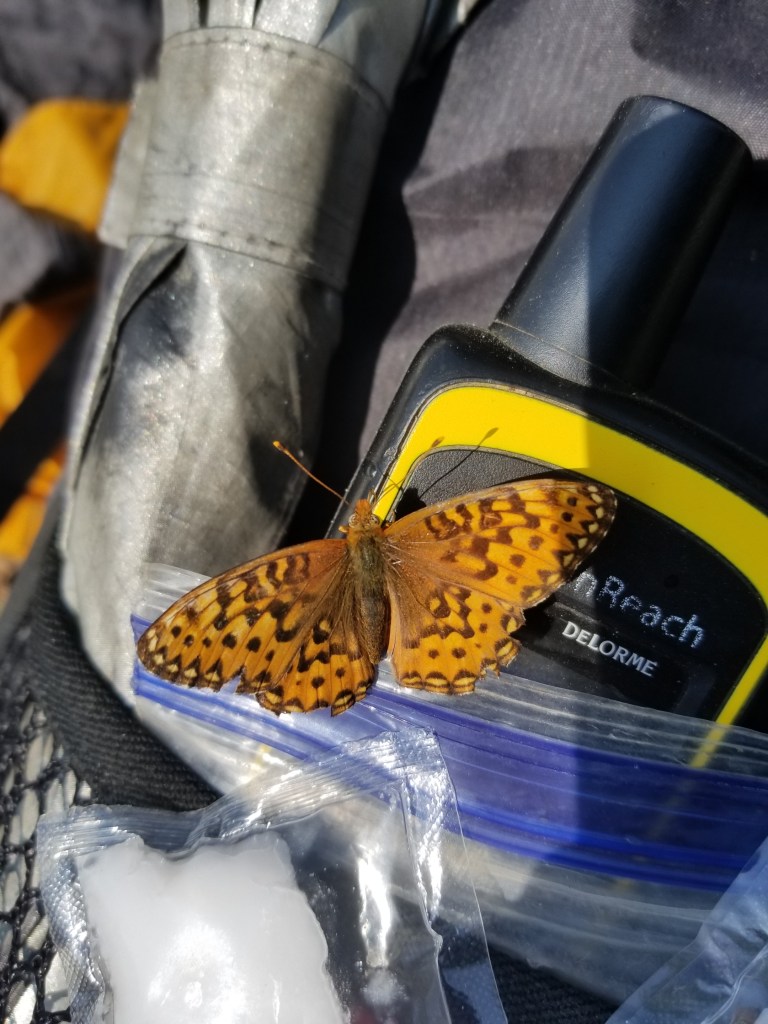
The Roaring Winds messed up my fancy hair.I wasn’t sure whether this butterfly was attracted to the yellow color or wanting to send an SOS.
Wouldn’t you know it, the wind ceased around 5:00. Above, there was a predictable roar of navy jet engines returning to base every 15 minutes. Such a juxtaposition: a quiet, still national park interrupted by the scream of fighter jet engines.
Nobody else showed up at any of the other three sites.
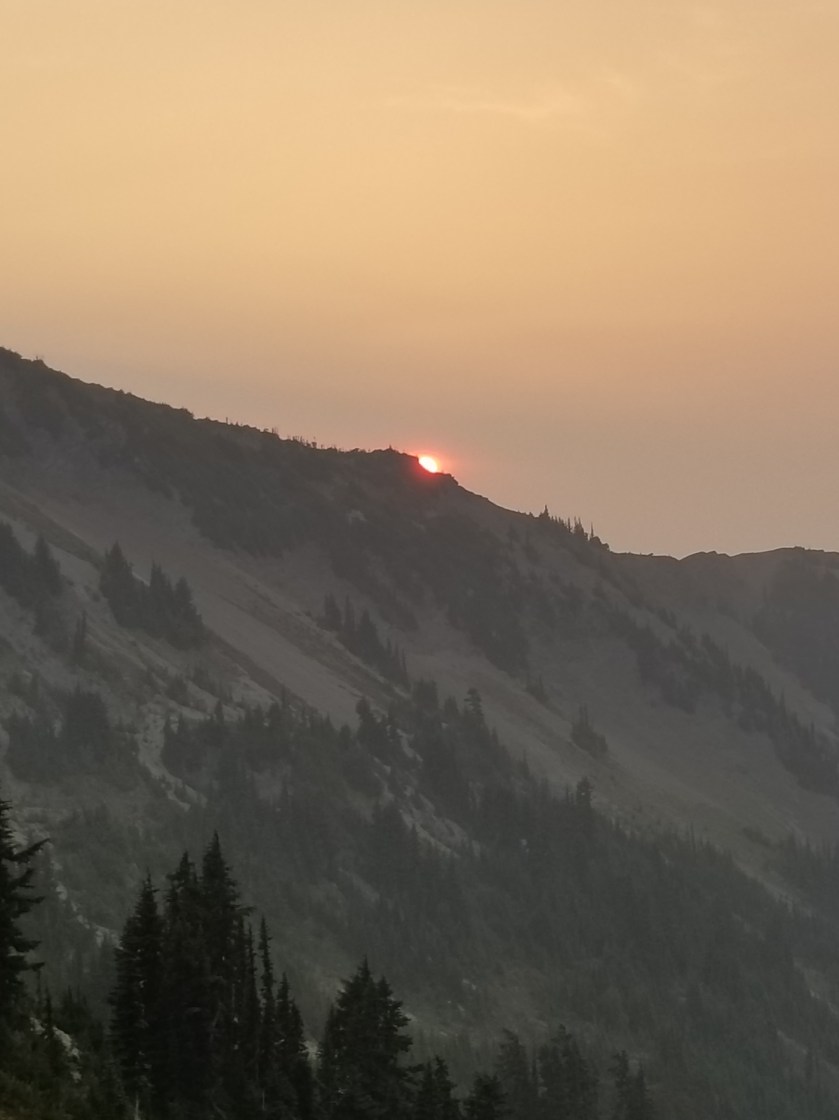
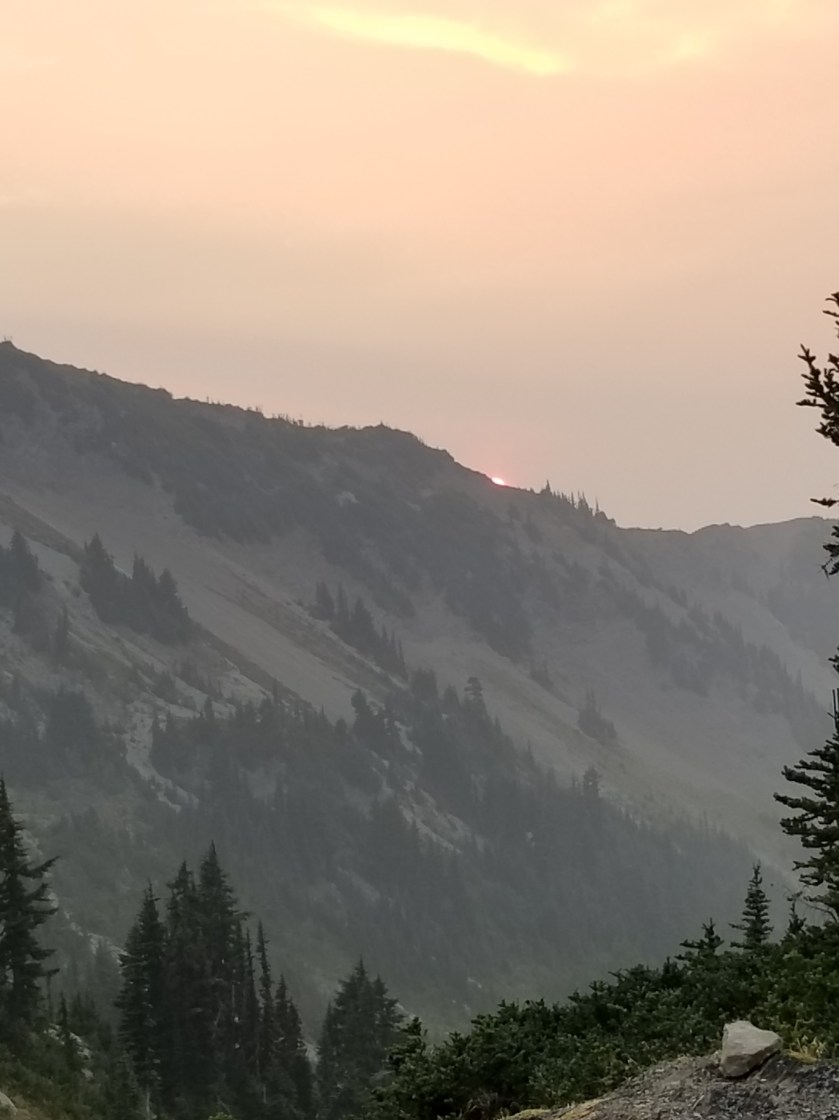
As the sun set over the flank of Obstruction Point, I grabbed a few photos before calling it an early night.
Last night an expletive-filled domestic dispute. Tonight, not even a breeze, let alone a Roaring Wind, to make a sound.









 backpacking over the hill