Days slipping away

I am now in final throes of packing for my 5 month backpacking trip.  As a natural born procrastinator, I am in my element.

Food: Introducing Speltmeal

I am making and sending almost all of my trail meals.  There are roughly 120 of them.  Although I’ll rotate through  about 7 different dinners for variety, breakfast is pretty tough.  I basically have two breakfasts that are quick, easy, and nutritious. (note the absence of the word delicious…)

First up is good old granola.  I found some ancient grains brand that I like at Costco.  I package this with a small zip bag of powdered whole milk.  In the morning, I’ll add water to the small bag, mix, and then add to the granola.  I’ll let that soak while I pack up and then eat the granola while walking (due to my ungraceful nature, I will proceed slowly since doing anything in addition to walking pushes the limits of my abilities).  I keep the whole milk powder separate for two reasons.  First, I want to make sure I can get the powder and water to mix well enough to resemble the texture of real milk.  Second, let’s face it, powdered milk is not the greatest tasting thing in the world and I may get sick of it.

My second breakfast choice is a combination of spelt and rolled oats.  I add in cinnamon, a little sugar, a pinch of both salt and powdered butter. Unlike the Granola, I do add powdered milk to the mix.  I bag portions up and throw in small bags with various treats to break up the monotony.  Examples are freeze dried fruits, chia seeds, or nuts.  At night I open the pouch, take out the treat, add water, and let the “Speltmeal” rehydrate overnight.  In the morning, I’ll add the treats.

Spray versus Spray
I have been testing all my equipment.  It is important to make sure things work and that I know how to use them.  This seems obvious, but my usual instincts are to just go ahead with something and figure it out on the fly.  There can be unfortunate consequences.  Everybody knows what bug spray is, right?  I have this small pump-spray container.   It works better on my thinning hair than a lotion.  Well, on this trip, I am also bringing bear spray in the National Parks as a safety precaution.  However, I need to to emphasize that bug spray and bear spray are quite different.  It turns out bear spray is not applied topically.  (Well, it can be, but it is ineffective against bears and very effective at repelling humans.)

Store Runs
Finally, I have a few last store runs to complete.  I need to get a few small items at REI.  On top of that I need to visit Trader Joe’s for some dried fruit to ship out.  The likelihood that I will enter these two stores with a short, fixed list and emerge with only the items on the list is close to the odds of winning the lottery.
Did squeeze in a quick hike yesterday.

DSC03413
Perfect day for test hike

Winner, Winner Chicken Dinner

This is a classic backpacking meal. If you are not backpacking, it is bad.  Basically a carb bomb with some fat added.

The key is to dehydrate some canned chicken.  Try a few different brands of canned chicken to find one you like.  It is already cooked in the can, so all you have to do is squeeze out as much water as possible and then flake it on to the dehydrator sheet.  About 8 hours at 145 degrees should do the trick.

A second note is that I used Bob’s Red Mill potato flakes which are only potato flakes.  As a result, there are no additional ingredients.   Most boxed mashed potatoes come with added items.

A third note is the I used Simply Organic chicken gravy which had the least amount of added ingredients.  I felt the mainline gravy mixes had ingredient lists which required an advanced degree in chemistry to understand.

Finally, the stuffing is optional.  It really doesn’t really add any significant texture, but there are some flavors.  (Remember to shake up the stuffing to distribute the spices.)

1 cup     potato flakes

1/2 cup   stuffing mix

1/2 cup   dehydrated canned chicken

1/2 tsp   instant chicken gravy

1/2 tsp   chicken broth powder (or bullion)

2 Tbsp   Sour Cream powder

1 Tbsp    whole milk powder

2  Tbsp   butter powder

1/2 tsp  black pepper

Mix all ingredients together.  Will fit in a quart sized ziplock.  Note:  I put the dehydrated chicken in a small snack sized zip-close bag to reduce the chance of the meat going bad and contaminating the whole meal.  Also, I put all of this in a quart sized mylar bag (with an oxygen absorber) and heat sealed it.  Some of the meals I made are not going to be eaten for 5 months so I proceeded with caution.  If it was just for a week or two, I would personally keep it in a ziploc (note: I am not a doctor or food scientist)

At camp, rehydrate with boiled water.  The chicken will take the longest to rehydrate (about 10 minutes).  You’ll probably want to have a little extra hot water handy because the potato flakes are greedy.

Add spices if you like.  I find that the gravy powder, broth, stuffing, and even the chicken  had enough salt.  By my calculations, this recipe has 725 Calories, 37 grams fat, 72 g carbs, and 41 g protein.  I averaged about 6.5 ounces, so it yields only about 110 calories ber ounce.  You can go crazy with add-ins.  One could put in an ounce of extra virgin olive oil (evoo) to bump up the calories/fat.  Or those fake bacon bits or some powdered cheese.

One last tip involving mashed potatoes:  Every couple of weeks I’ll resupply with a snack sized baggie of potato flakes.  They are handy to add to a meal that is too soupy.  Plus, they can be a quick easy meal in a pinch.

DSC03430

Basic Gear

Some people are curious about the equipment I use.  Here are some simple answers.

Shelter

I use a tent. The new materials available are amazing.  This one is made with a material called cuben fiber (although it will be branded as “Dyneema” in the future).  The material was originally used in sails for competitive sailing.  It is extremely strong, lightweight, water-repellent, and expensive. The specific product I have is a Zpacks Altraplex.  I liked it because it is generally built for taller folks.   It uses a hiking pole as a key support and has a large screened entry.  In summary, it is roomy, weighs less than 18 ounces, is designed to manage condensation, and has a nice combination of slick backpacking features.  The only downside is that it costs more than many elective surgeries.

I have used a tarp in the past.  It is the ultimate lightweight shelter.  However, between the bugs and mice, I just couldn’t bring myself to use a tarp on this trip.  Of course, my hands down best choice is cowboy camping (just sleeping under the stars with no shelter) which I will hope to do as often as conditions permit.

DSC03419

Sleeping

I use an inflatable air mattress and a “mummy” style sleeping bag.  The bag is filled with water proofed goose down and purportedly rated to be comfortable down to 15 degrees farenheit.  Did you know there are sleeping bag temperature ratings?  I bet 90% of the people who share a bed with another person know that undoubtedly the rating must be wrong.  Would you and your spouse agree on a temperature where the bed coverings are just right?  Aside from eye-of-the-beholder issues, who temperature rates sleeping bags professionally?  I imagine a meat locker where the tester is inside in a sleeping bag and his or her colleagues are on the outside adjusting the temperature setting.  Think of the level of trust the tester must have in the folks on the outside.  I would imagine the folks on the outside must not like pranks nor be easily distracted.

Returning to the topic, my sleeping bag is long enough to suit me and wide enough in the shoulders to avoid claustrophobic feelings.  The name mummy describes the design that has an incorporated hood that can be drawn tight or left loose.  The bags are designed to contour your body.  There are two drawbacks to mummy bags.  The first drawback relates only to side sleepers like me. You can try to be one with the bag and end up on top of the side zipper half the time; or you turn within the bag and end up with your face mashed half in the side of the hood and one ear poking out of the opening.   A second peculiarity of mummy bags is that your ears are muffled inside the bag.  If you have an active imagination about night sounds, this can lead to a lot of hood-on / hood-off moments throughout the night as you try to discern between the sound of wind versus an impending wildlife encounter.

A growing trend among backpackers is to use a down quilt.  The rationale is that a quilt does not have a zipper or a hood.  Therefore it reduces weight and avoids the potential equipment failure associated with a busted zipper.  Moreover, it can be easily shaped to cover and uncover as needed.  One simply wears a hat or cap at night to keep the head warm.  My bag is still relatively new, but when it fades I might try a quilt.  As long as there aren’t bugs crawling around, it makes a lot of sense.

Cooking
That mental image of a cast iron dutch oven sputtering over an open fire pit is dated.  Due to fire dangers, scarcity of wood on popular trails, a move to “Leave No Trace” principles, and, frankly, the actions of idiots, open fires are rare.  The majority of backpackers use some type of stove to cook.  There are three main types of fuels.  The most common two are alcohol or pressurized gas in a canister.  A third type is a  solid fuel in the form of “esbit” tablets.  More rare is a miniature wood burning stove where small sticks are the fuel. Obviously, if your meal plans revolve around heat, then fuel is your Achilles heel.  Gas and tablet people need to bring enough but avoid carrying too much.    Likewise, wood stoves require combustible wood (and an absence of burn restrictions during fire season).  The reward for the successful stove strategy is a warm meal, a hot beverage, and a last-resort method to sterilizing water.

Well, you might not believe it, but there is a fairly passionate split in the backpacking world.  Many “ultralight” backpackers have switched to “stoveless” cooking.  This involves bringing a watertight container (usually plastic) and simply adding filtered  water to dry ingredients and let it hydrate over several hours.  For example, around noon one would finish the lunch they had prepared that morning and then add water to the dinner ingredients and put this in their pack so that everything is ready to eat in the evening.   Proponents argue that they do not need to bring a stove or fuel and thus save weight.  Detractors are limited to those few people who have an imagination and can visualize mushy food at the ambient air temperature.

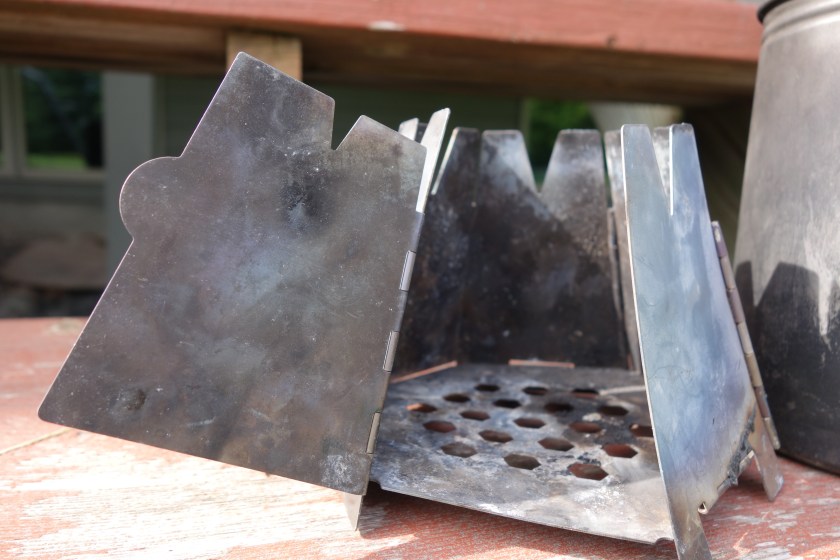
I use a hybrid system.  I have a small folding titanium stove.  It is designed to burn wood, but I carry one or two Esbit tablets just in case wood is too damp to burn.  I cook in a titanium pot that has a screw top lid with a rubber gasket.  I store my cooking stuff in the pot. If conditions are not bad (about 90% of the time), I simply start a fire in my stove, boil water, pour it in my dehydrated meal bag and wait about 10 minutes.  When the weather is bad or there are burn restrictions, I’ll dump the dehydrated meal in my titanium pot and let it rehydrate slowly.  To me, this gives me the complete flexibility to have a warm meal, go stoveless when necessary, and not lug around fuel.  (Both the pot and the stove are made by a company called “Vargo.”)
DSC03421

Training

Summary of training efforts before I begin the CDT

Last time I went backpacking for an extended period of time, I had a difficult time.  Since I am starting in Glacier National Park and then slipping in to the Bob Marshall Wilderness, I need to be in top shape right away.  Last time I thought I was in shape, but I am taking no chances now.

Previously, I relied on the classic gym gear that was available at my local Anytime Fitness:  Treadmill, stairmaster, bikes.  Also, I added bike rides and training backpacking hikes.  I learned the hard way this was not enough.  There were two shortcomings.  First, I live in the Midwest, so I train at around 1,000 feet above sea level which does not help with the altitude of the CDT.  Second, I trained according to what I thought was enough time, but the distance between water sources does not care about time.

This time, I am training a bit differently.  The biggest difference has been  adding in running.  I have always disliked running for running’s sake.  I can trace back early signs of this to coaches who meted out running drills as punishment for poor performance.  Likewise, in high school, the basketball coach required us to do cross-country if we weren’t doing football.  As an adult, I also spent 27 years smoking instead of running.

I started running last fall.  I started small and have challenged myself.  The first challenge was to get myself in shape so that I could enter a half marathon for which my wife had trained.  I finished and gained confidence I could maintain an elevated heart rate for a period of time.

Since then, I have run a 25k trail run and another half-marathon.  These events have helped me stay motivated until I start backpacking.  I am under no delusion that I am fast.  Indeed, the last half marathon placed me almost exactly in the middle of the field.  It is tough being older and watching younger folks pass you by.  There is still some of that latent alpha male stuff which makes me want to sprint, but then I catch myself and recall this is just training.

As an aside, organized races are quite interesting.  There are electronics that keep track of your time and pace.  Then, the results are parsed down in to smaller subsets so you can compare yourself to similarly situated runners.  For example, the last race I was in had me listed as “MAST” which I took to be the euphemism used to describe senior age runners.  Imagine my surprise when in fact it meant mastodon which incorporated not just my age, but my girth as well.  I quickly got over the embarrassment when I realized that I was a relatively swift mastodon.

I have been doing longer runs on the horse trails around some of the parks.  This helps with the ankles and feet getting used to uneven surfaces.  I hope to get in a few more long ones (20+ miles) before I get on the Amtrak train to Glacier.

So, while running has helped my cardiovascular and endurance, I still can’t do anything about elevation.  I did hike/run the mountains in Arizona when I visited my mother a couple of weeks ago.  Other than that, I do intend to spend a few days at Glacier just hiking open trails to get some exposure to higher elevations.

Time will tell whether the training has been sufficient to help me backpack over the hill.

Quintils

                                                             Calories    Fat(g)   Carbs (g)   Protein (g)

1 cup      dehydrated cooked lentils        678          2              115            50

1 cup       dehydrated cooked quinoa       626         10             109            24

2 Tbsp    Chia seeds                                     120          9                10              6

1/2 cup    Freeze dried veggies                   n/c          n/c           n/c            n/c

1 1/2  tsp   Creole seasoning                       n/c          n/c           n/c            n/c

2 tsps        freeze dried garlic (to taste)   n/c          n/c           n/c            n/c

1 Tbsp        EVOO                                        248          28                 0              0

Total                                        1,672          49            234            80   = 363g

                                                                                  13%            64%        22%

Mix first 6 ingredients

Seal in a quart sized bag

Boil at least 2 cups water

Add 1 1/2 cups boiled water to bag.  Add EVOO.  Mix well

Seal and let rehydrate for 10 to 15 minutes. (Can be cold soaked, too)

Spicy Lentils

Spicy Lentils Calories Fat(g) Carbs (g) Protein (g)
1 cup dehydrated cooked lentils

678

2

115

50

3/4 cup couscous whole grain

325.5

0.5

67

11

1/4 cup dehydrated veggies

40

0 8

2

1/2 Tbsp Creole spice

0

0 0

0

1 tsp ginger powder

0

0 0

0

1/2 cup sunflower seeds (and/or pumpkin)

134.5

12 4.5

5

1 ounce EVOO

248

28 0 0

1426

42.5 194.5 68

305

14% 64%

22%

Mix all dry ingredients
(or put seeds in a sandwich bag if you want more crunch)
Put all of the above (except EVOO) in a quart size bag.
At camp, boil 2 cups or more water, remove seeds.
Add 1 1/2 cups boiled water to bag.
Add EVOO.
Stir, seal, and let hydrate for 10 minutes.
Test for doneness, adding more water or EVOO if desired.
Stir in nuts.