Crowds to Solitude to Crowds

August 9, 2018. Base of Mount Baker to Park Creek Campground

Truly a bizarre night of sleeping. I slept very deeply, but more than once cars whipped by on the nearby gravel road, causing me to start awake, but then immediately fall asleep again.

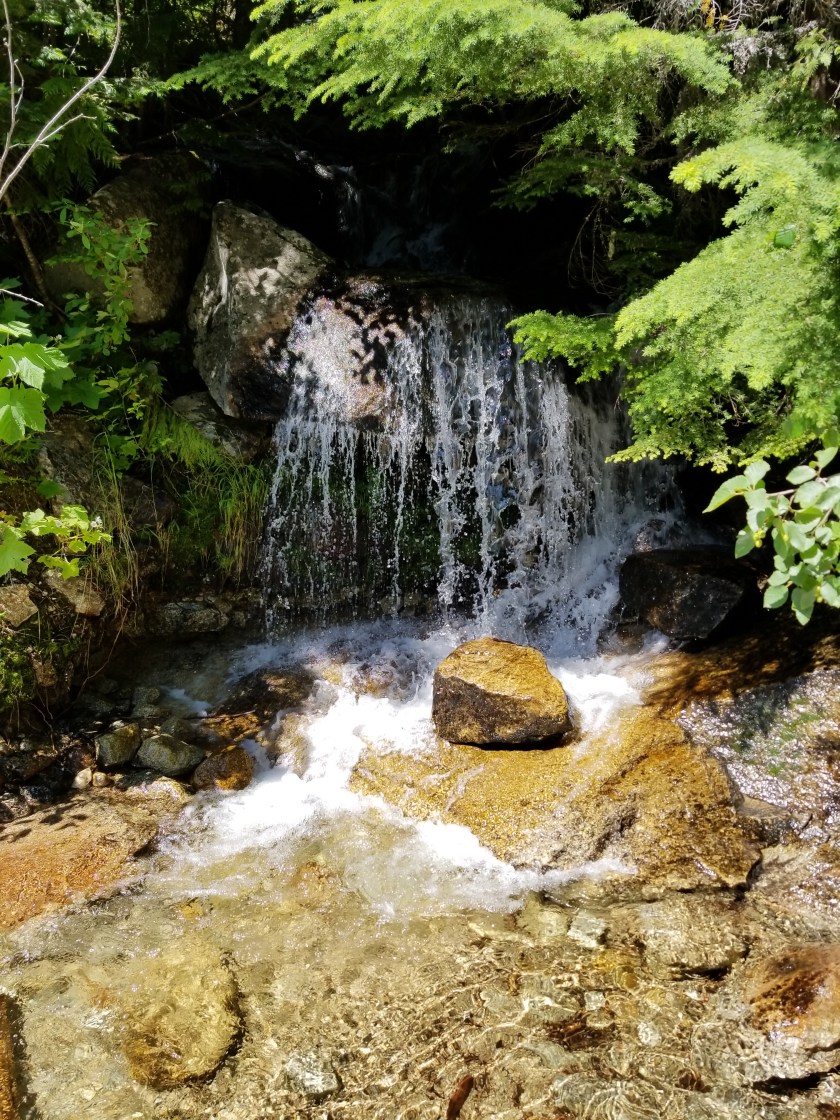
I got hiking around 5:30. The two-lane highway was reported to be dangerous with narrow shoulders, curves, and tourists watching the views, not the road. Almost immediately the road crossed a spring-fed stream, so I poured out my bad old water and drank a lot of the fresh clean water. The old water from last night had been “enhanced’ by adding some Crystal Light to it. I am now certain the Strawberry Kiwi Rust flavor combination will never work.

There was almost no traffic on the way up. After about an hour, views started appearing through the trees. I passed a ski resort and finally reached a large area of buildings and parking lots. While it was geared for mostly winter visitors, there was a fair amount of activity. As I walked through, I kept my eyes peeled for an outlet. Most of my batteries were low. Fortunately, as I passed the ski patrol building I noticed on the front by the road it had a covered outlet. When I tested it, it was live. So, I took about 45 minutes to charge my phone and “brick” battery.
May need the umbrella…
Foxglove grows wild.

My next stop was to get on a trail. This area was designed for people to get out of their cars and hike for a half hour. The trail was clear and clean. It led up to a trail junction that led to a famous overlook called artists point. As I filtered some water near the trail, a couple went by with their two dogs not on leashes.

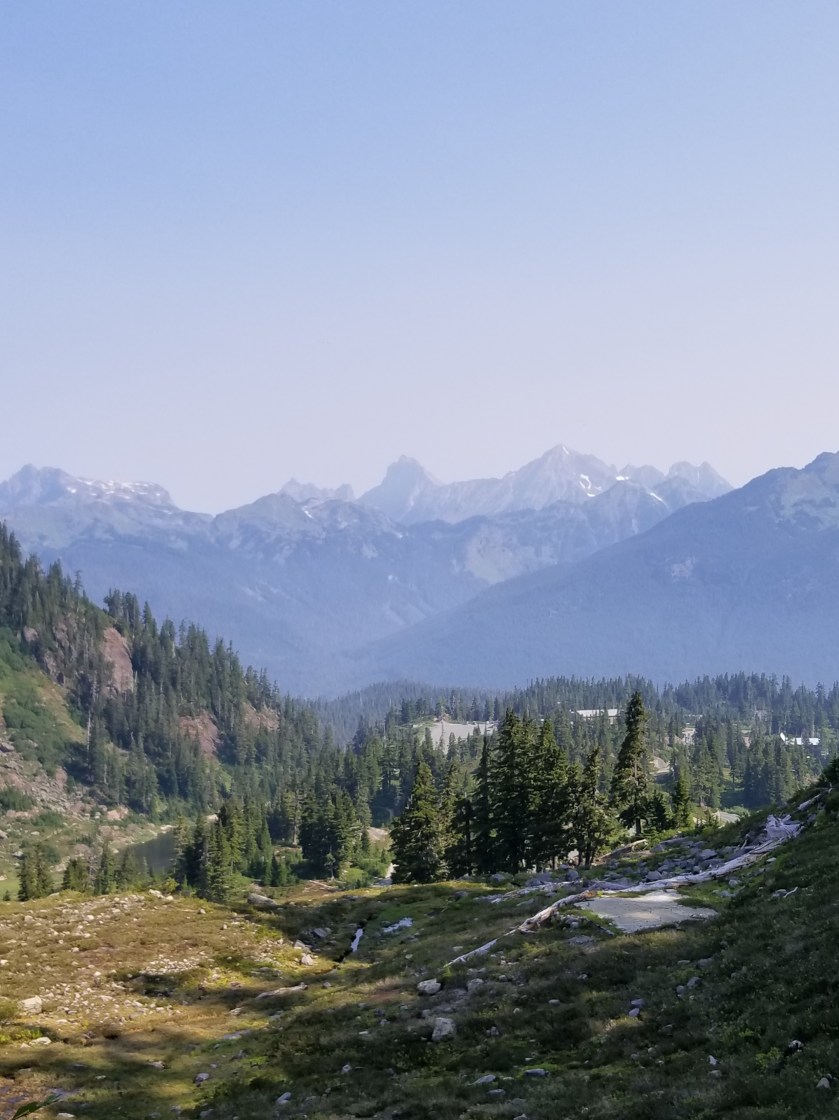
At the juncture, there was another parking lot that was full. It led to a popular location Lake Ann. I checked the trail register and the usual characters were still two days ahead. Just as I was leaving, another couple walked up with their dog not on a leash.

The trail to Lake Ann was populated and fairly easy. Just when I was going to need to pass through a gaggle of hikers surrounding a stream crossing, my journey veered away to the Swift Creek trail. It was classic PNT. One moment lots of people on a well defined trail, the next walking down a barely discernible path in a meadow.

The map made it look like the trail paralleled the creek and then gradually descended to cross it. At first the map was accurate, but after about an hour, the trail started going uphill. I was concerned and checked my GPS location. I was about 300 feet above where the trail was drawn on the map. However, I had not seen any junctions and I could sometimes see footprints going the same way, so I stuck with it. Eventually the trail did descend, but it sure didn’t match the map.
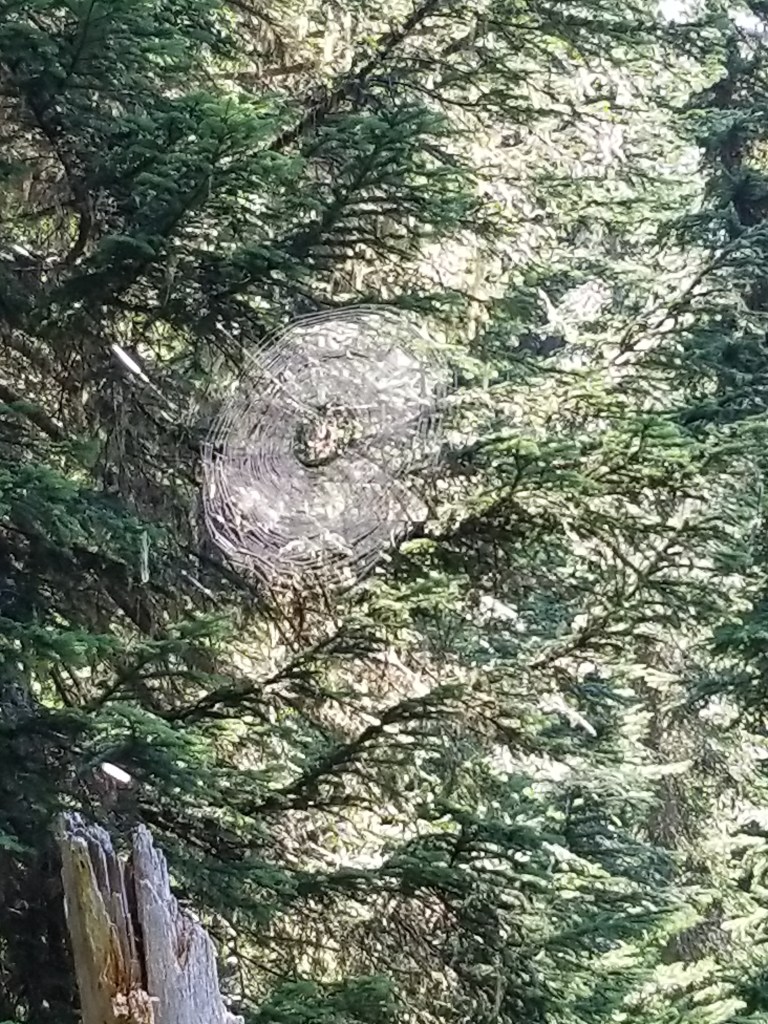
They look a lot better than they taste.
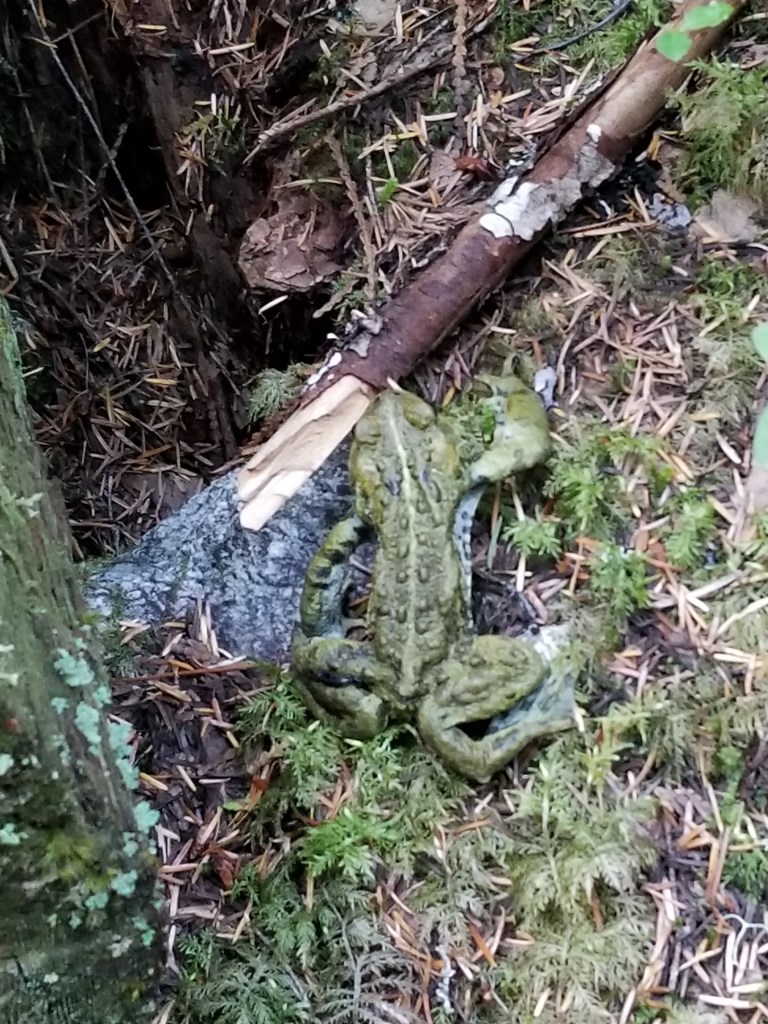
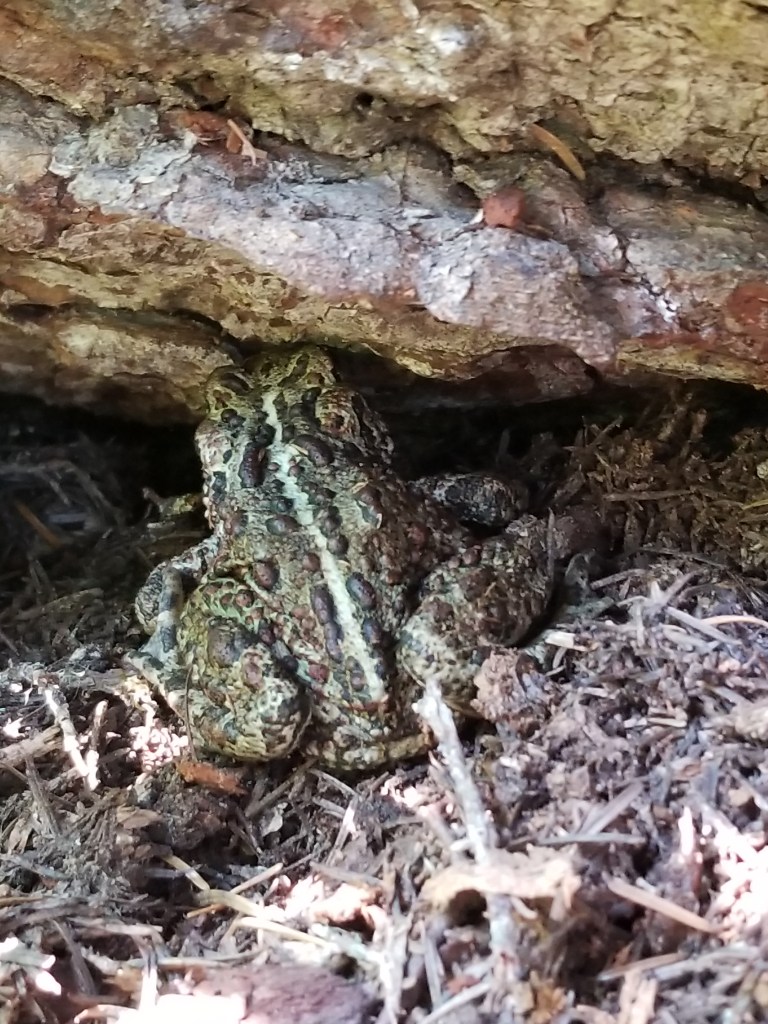
This fella refused to face the camera. Great camouflage, though.

There had been several references to Swift Creek being dangerous to ford. Steep canyons combined with snowmelt can create this situation. When I finally got to the crossing, the creek was good sized, but not intimidating. A twist was that somebody had installed a zip-line that was about 7 feet above two parallel cables that all crossed the stream. Somebody had flung a towel over the top (zip) cable and seemingly crossed (or tried crossing) hanging on to the towel and tightrope walking their way across. No thank you. I just went down stream about 50 feet, found a slight widening in the stream and moved across. It was cold and it was fast, but the water barely reached them hem of my shorts. It took less than a minute. It reminded me of the Grand Enchantment Trail where there was a lot of hysteria about crossing the Rio Grande, but when I did it, it was super easy.

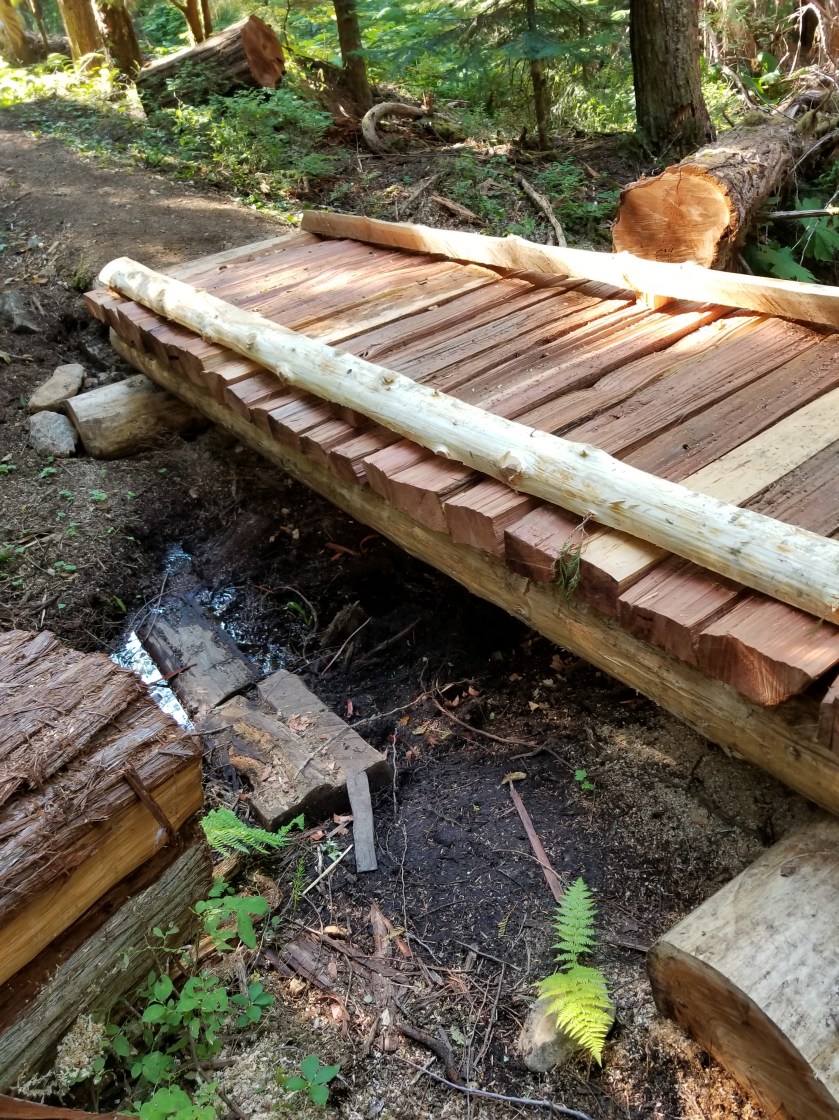
I still had another river crossing ahead. This one was on a creatively made bridge. Apparently each spring local volunteers come out and create the bridge. It was pretty good work.
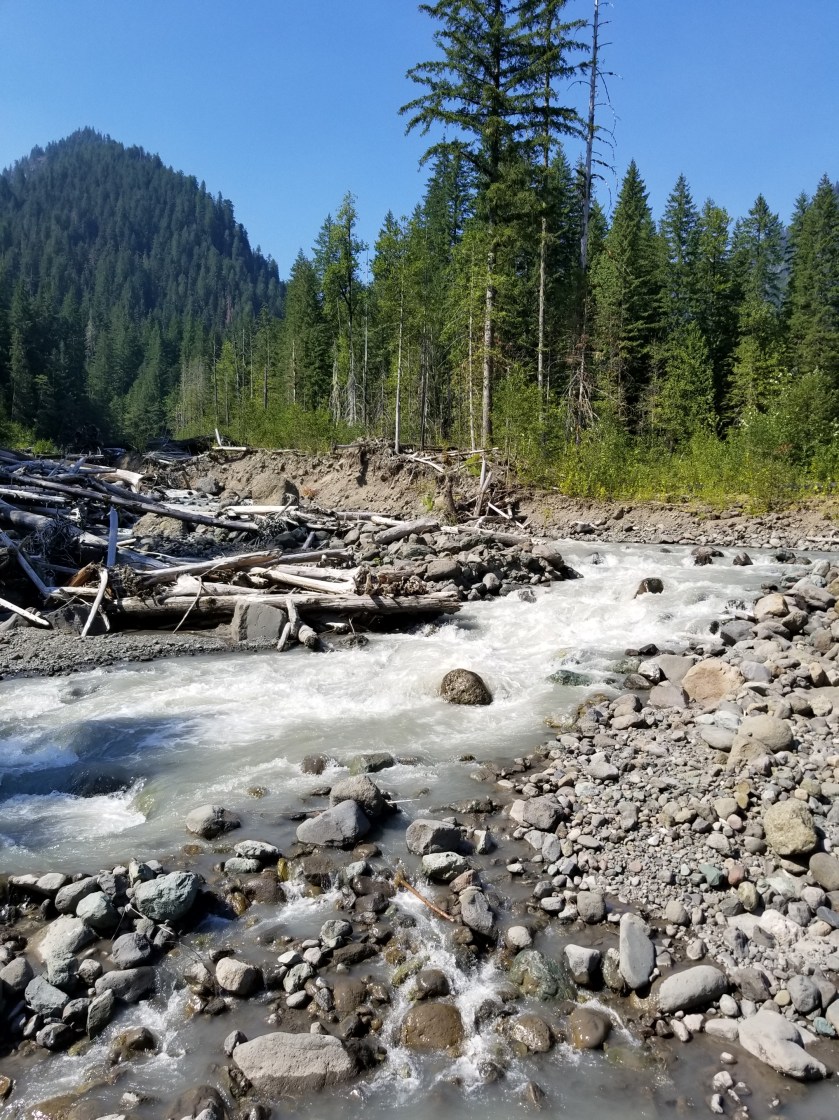
Notice how silty the water has become from snowmelt.

I skipped the Baker Hot Springs and crunched down the abandoned forest road that was the trail. At the trailhead, there was a car campground. I walked through it and was pleasantly surprised to find a vacant spot. I dropped off my pack and ran down to purchase the camp spot. Walking back, I noticed that the three consecutive spots leading to my spot were occupied by a family. I guess they were going for a compound look. The had cats, dogs, bikes, pickup trucks, RVs, a boat, and an ATV.

After a little light drinking at the site next to mine, they did head off to bed at a reasonable hour. I had pitched my tent near the stream so the white noise of the creek would offset car campground noises.

This family highlighted an economic subset of our country that may not be highly visible to the average person, but is very clear on these backpacking trips. Specifically, there is a class of people that invest heavily in assets that depreciate. I cannot count the number of modest homes I have passed where the yard is covered with a late model pick-up, a boat, ATV, and/or an RV. If it is all new, then there is easily $5,000 to $10,000 of value just wasting away each year. Heaven forbid they bough on credit. I always am curious what these people have in their three digit plans(401 and 529). Obviously there is some pleasure derived, but adding up licenses, insurance, maintenance and these items are a real economic drain.

I discovered I had managed to place my tent on a fine set of tree roots, I was too tried to do anything except scoot around until I was able to lay down in an intuitive yoga position that avoided touching a root but was guaranteed to make me stiff tomorrow.
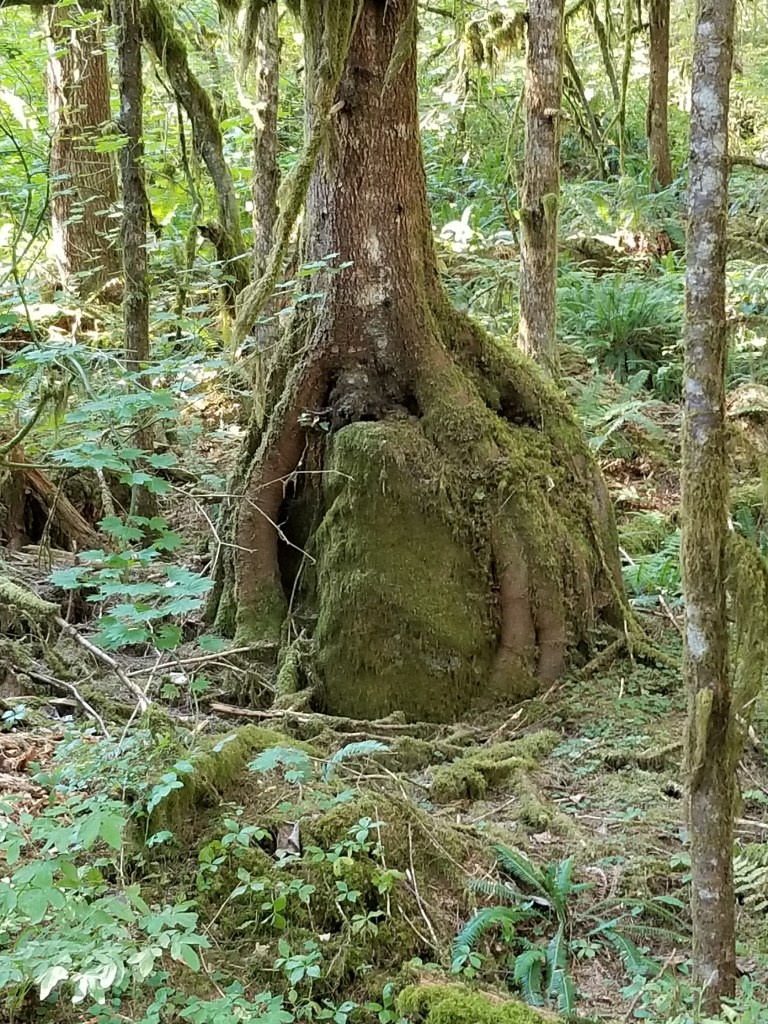
This tree was determined to grow even though it started life on top of a rock.
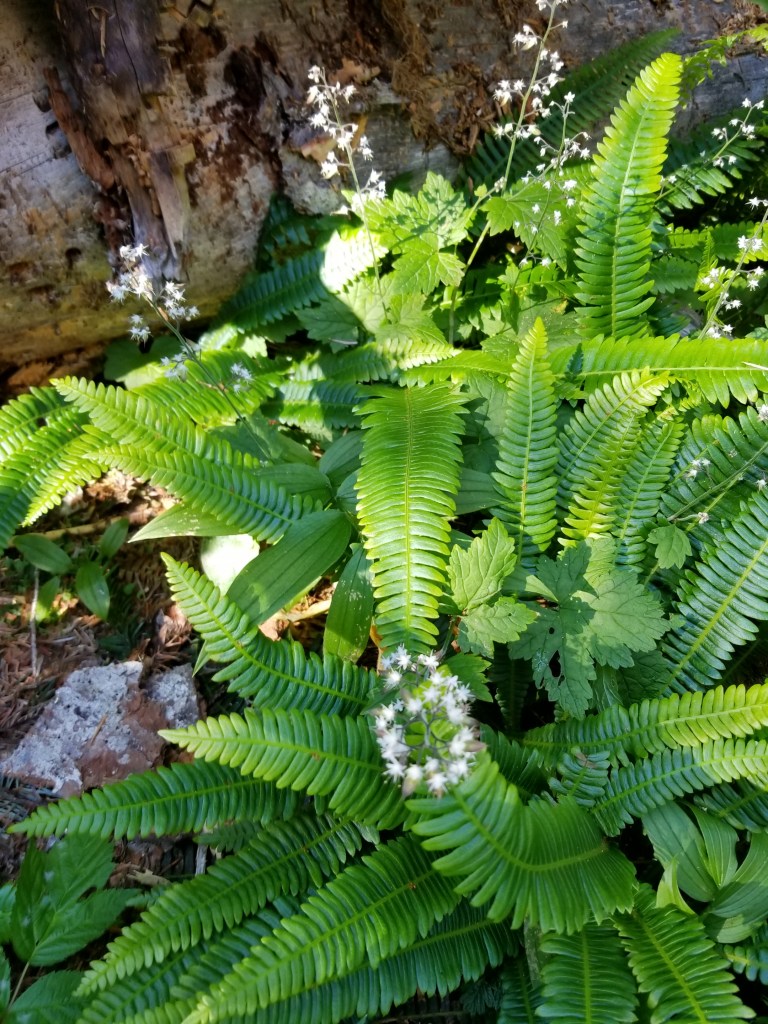
Among small ferns, a white flower that looks like baby’s breath is quite attractive.

Continue reading “Crowds to Solitude to Crowds”

At the Base of Mount Baker

August 8, 2018. From Whatcom Pass to Mount Baker.

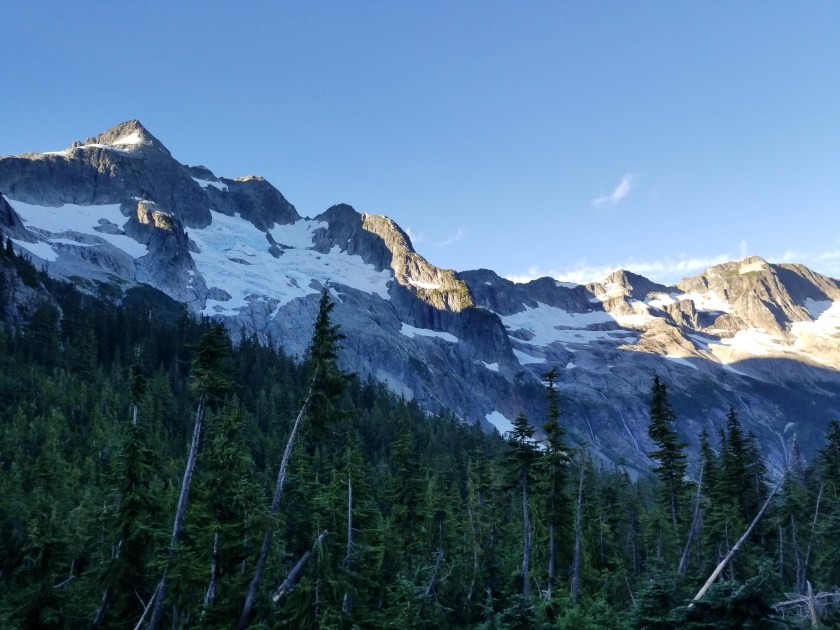
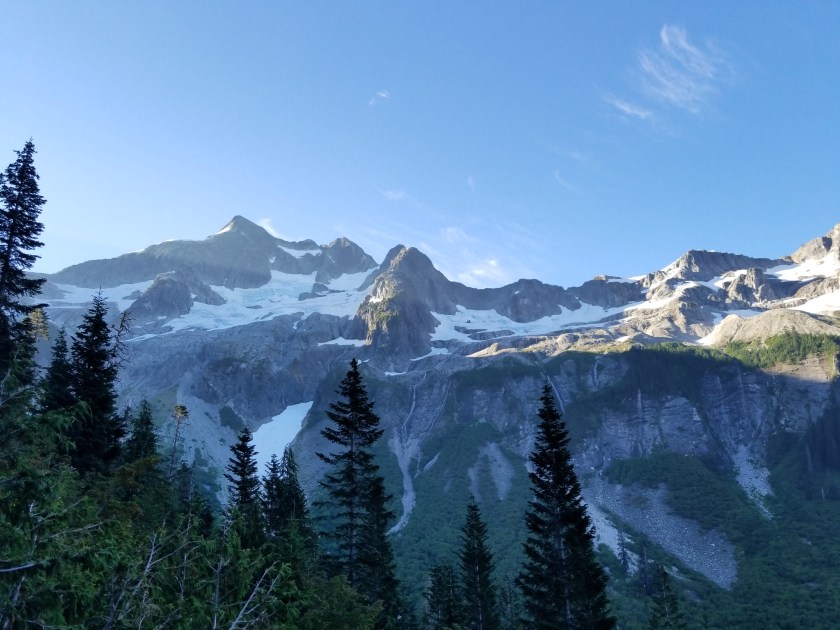
I was the first one up. Got my food and took off downhill. The glaciers on this side of the Pass were bigger. I wish the sun was higher to bring out the beautiful blue of the ice that is at the center of the glaciers.

The air had cleared and I was cruising downhill. I knew I had a long day ahead of me as I needed to get to the base of the Mount Baker highway.

After breakfasting on several spider webs, I stopped and had some trail mix. I was brushing my teeth near a stream and a couple showed up. They were out for few days. Just as they were leaving, a group of five ladies came by. They just said “hi” and passed by.

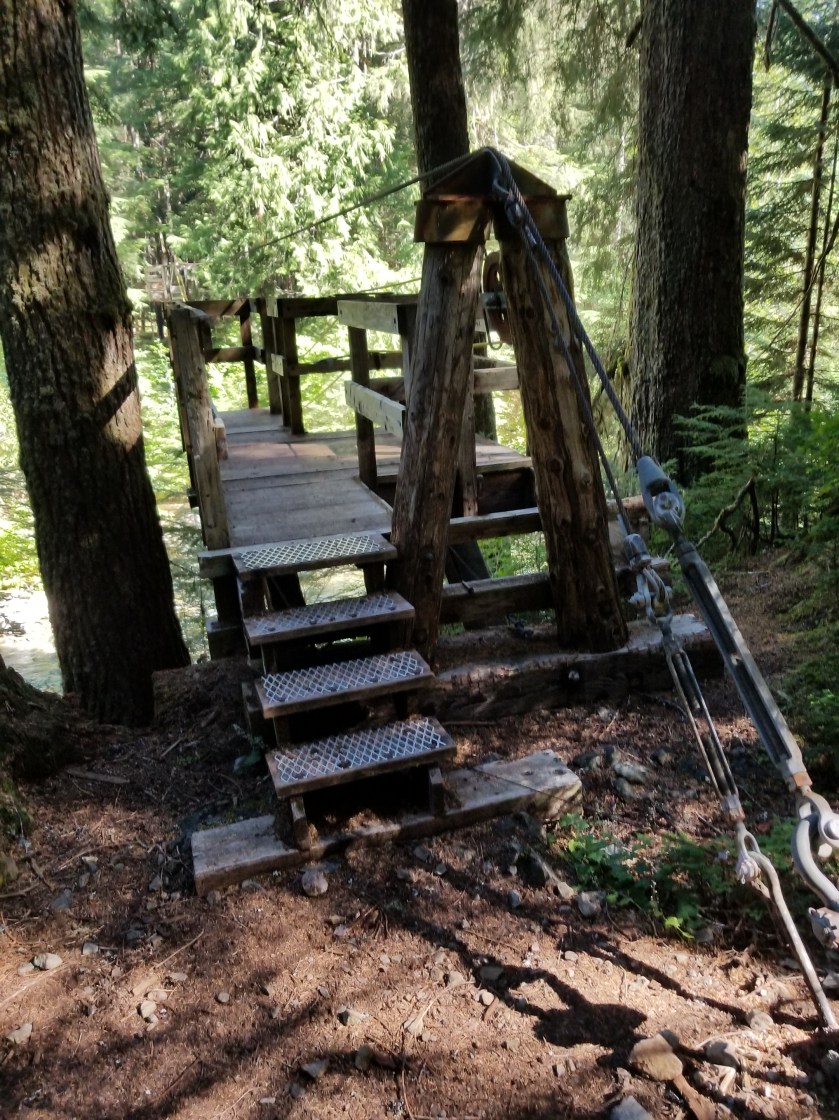
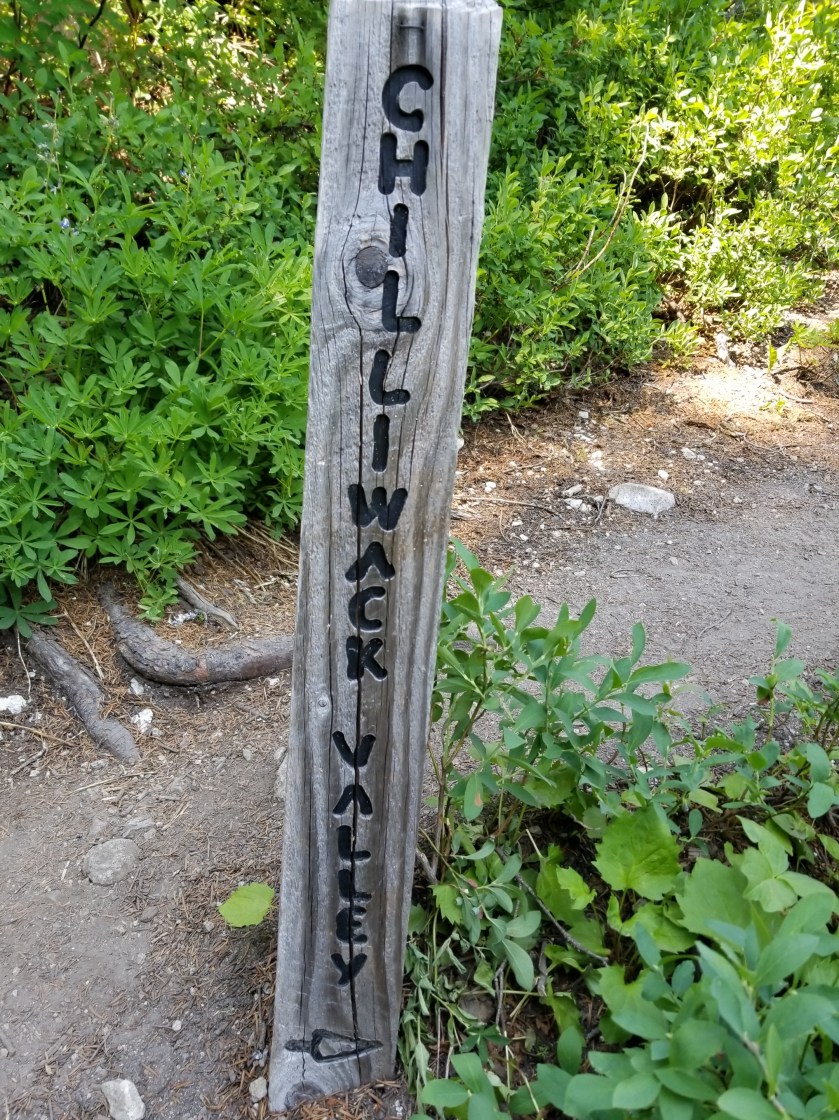
Later, I came to the famous cable car over a river with the improbable name of Chilliwack. The cable car is a two seat basket. You get in and pull yourself across.

I couldn’t figure out how to video the trip across. About halfway across, I did stop and notice how frayed the pulling rope was. Definitely a unique way of crossing a stream.

At the other side a mother with two kids and her dad had differing levels of enthusiasm about the ride ahead. Mom was far less enthusiastic than the little boy.

As the day wore on and I approached a popular trailhead, there were scores of people, all shapes and sizes and ages. One couple I met at the apex of Hennegan Pass. They had full packs and some climbing gear. They knew about the PNT and offered me rides since they lived right near the trail in Alger. Really nice folks.

I continued a long, shadeless grind downhill. For the first time in weeks, I broke out the umbrella for shade. It was wonderful. Not sure why I have such a Mary Poppins complex against using it more often.

I reached the trailhead and began a long walk on a gradually declining gravel road. One car did offer me a ride, but I declined.

I went past a cordoned off area that had a few dozen bee hives right beside the road. Not sure what the bees were pollinating, but I didn’t want another sting and went by swiftly.

The evening was warm and windless. I had a freak event happen. I was just walking along and about 100 feet into the forest, a good-sized dead tree just snapped and fell straight over. Random.

I finally reached a developed forest service campground at the bottom of the climb up the Mount Baker highway. It was called Silver Fir. All the places were taken. I looked at places to stealth camp, but didn’t see anything good. Then, I used their handpump to get water. I filled up my three liter platypus bag, but the water looked a bit off.

I crossed the highway to a lot used by the highway department. It also had some snowshoeing routes for winter. I went down a gravel road and after a quarter mile saw a small clearing where I could fit my tent.

I ate as it darkened and got into my tent. The water I obtained from the campground was so rusty it made me wonder how long it had been since my tetanus shot.

It was one of those nights where I don’t even remember putting my head down before I was fast asleep.

Massive Trees

August 7, 2018. From Big Beaver Camp to Whatcom Pass.

I was glad to get moving in the morning. I could smell the smoke in the air and feel the building heat.

Fortunately, most of my morning would be spent gradually heading upstream along Big Beaver Creek.

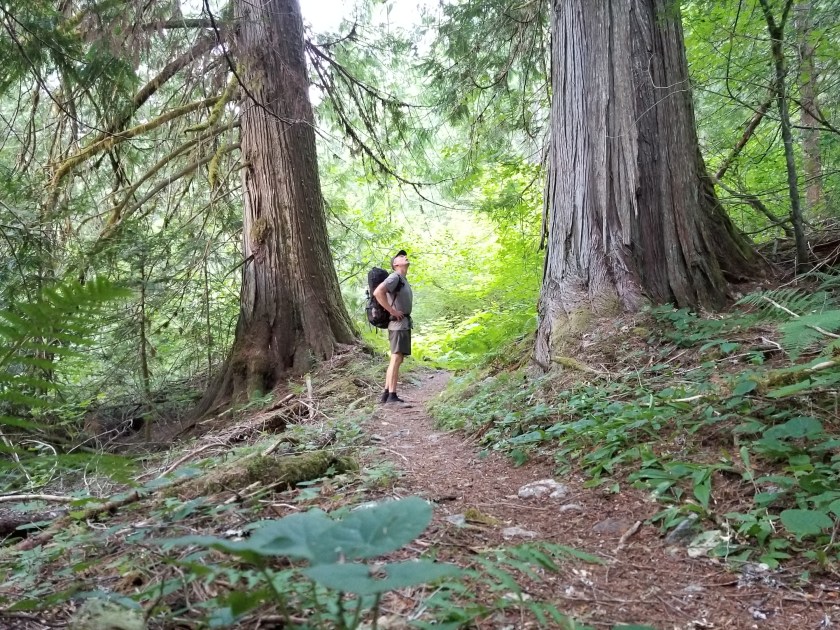
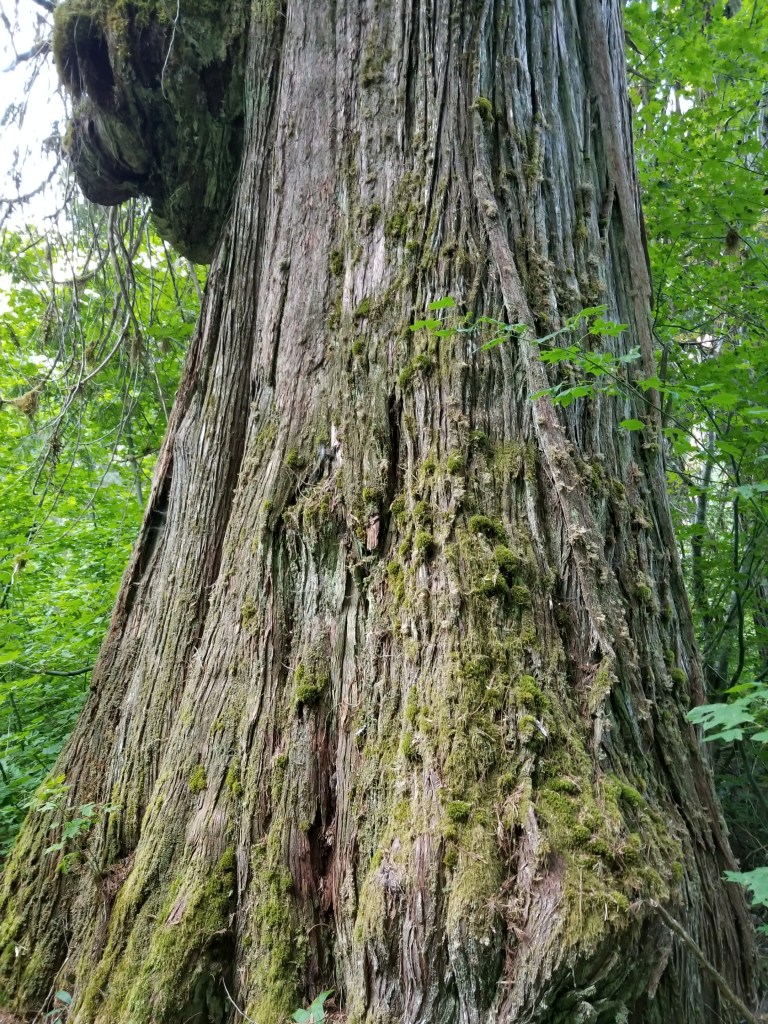
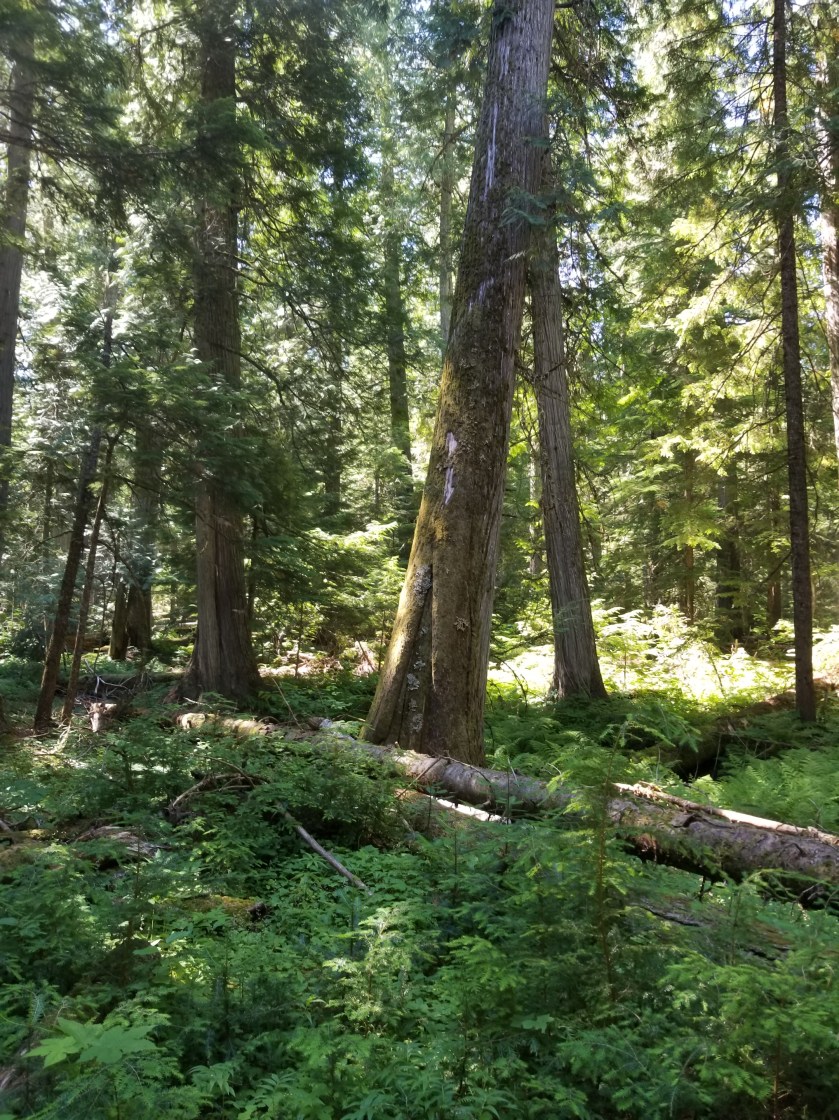
There were two immediately striking features in the morning. First, the bluish, opaque stream colored by the grit from snowmelt. Second the huge cedars and western hemlock. Massive trunks supported a canopy of branches a hundred feet up.

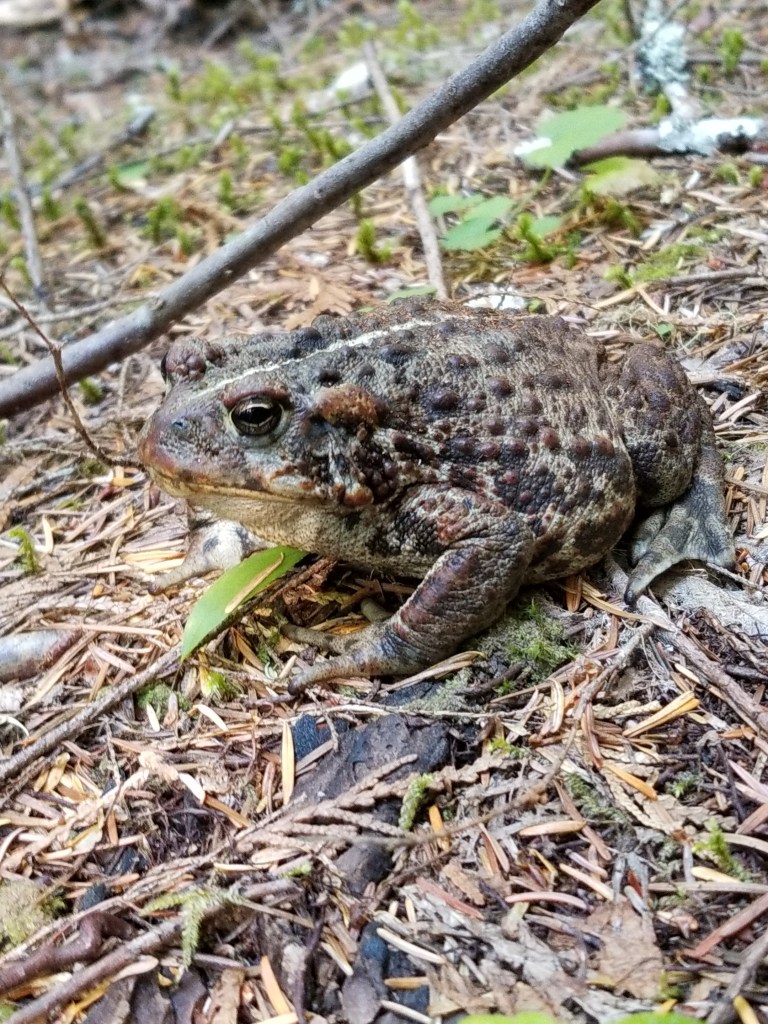
This environment was good for toads and their offspring. When I first saw the forest floor moving, I thought it large ants.

This skinny guy was hard to see.
This one was not so hard to see.

The trees were interesting. Their size meant they truly blocked out sunlight from plants below. It struck me how little life there was. Hardly any songbirds, scarcely a sign of deer or squirrels. Cedars and hemlocks produce tiny cones and consume all light. In poignant contrast, the mosquitoes were large, numerous, and happy to see me.
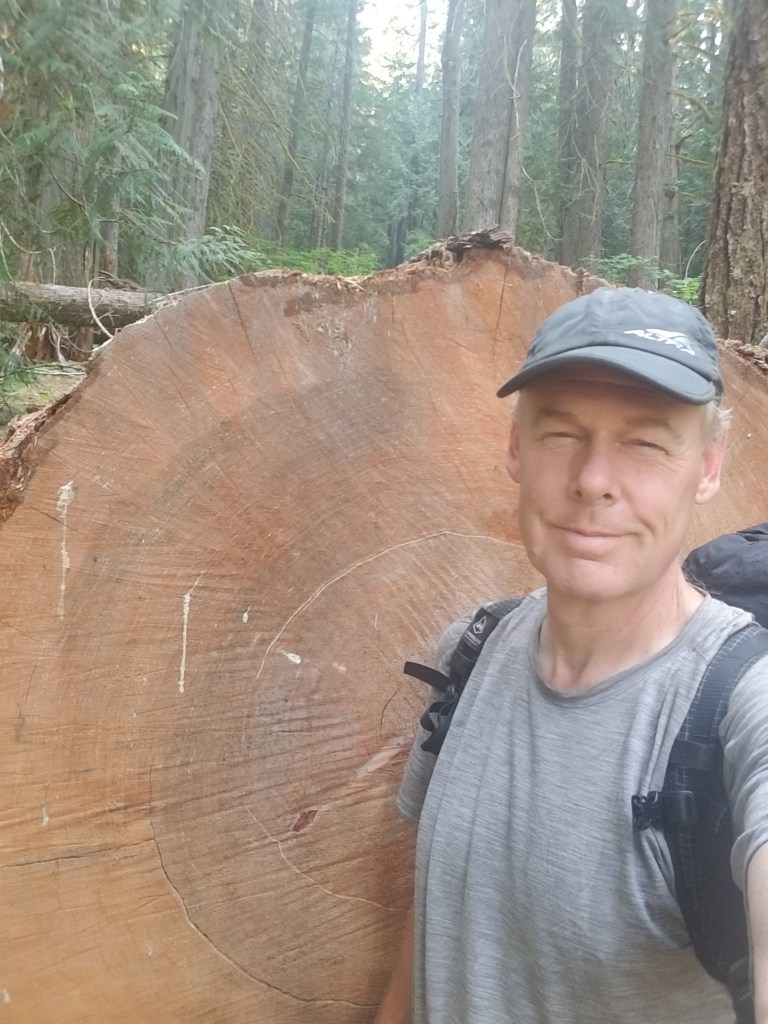
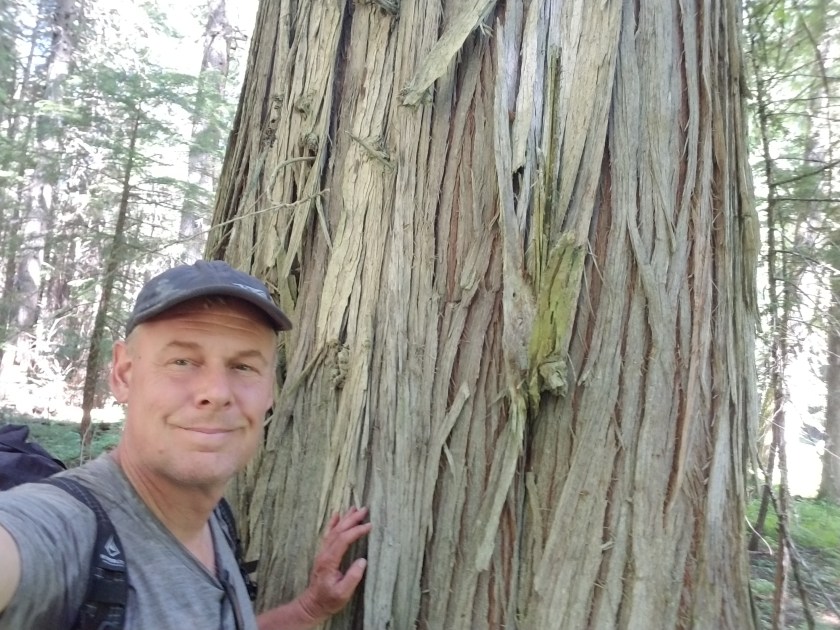
This cedar had to be 20+ feet in circumference.
Quick, who is older?

Due to the absence of wildlife and wind, the cathedral-like forest was hushed, like when you walk into a large empty church. If you stopped, there was an overwhelming sense of space and silence (except for the tinny buzz of mosquitoes).

When light penetrated, it would occasionally reveal an intricate spider web. Try as I might, I cannot get a satisfactory picture of a spider web.

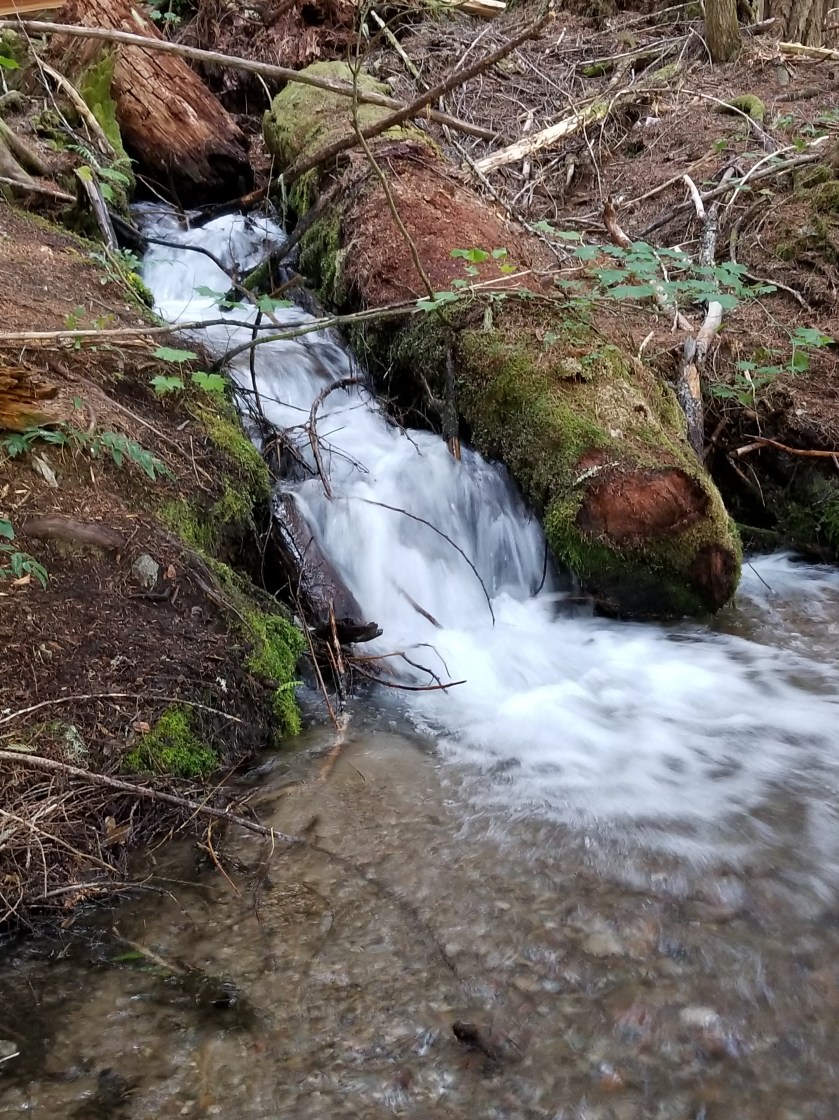
I found a charming stream and got some water that was not silty.

Later, I met a group of two guys and one lady, all young and in a hurry. Selfishly, I was hopeful they had been hiking a while and therefore had cleared all the spiderwebs on the trail. No such luck. Just after I passed the next campground, the webs started again.

A bit later, I met another two-men, one-woman group. They were from South Carolina, up for a friend’s wedding. Fun people.

I climbed over a ridge from Big Beaver Creek and dropped steeply into the next valley with the unimaginative name of Little Beaver Creek. No idea what the would’ve done if there was a medium sized beaver.

Subtly, the flies began to dominate the mosquitoes. Less quick to bite, their size and relentlessness made them more irritating.

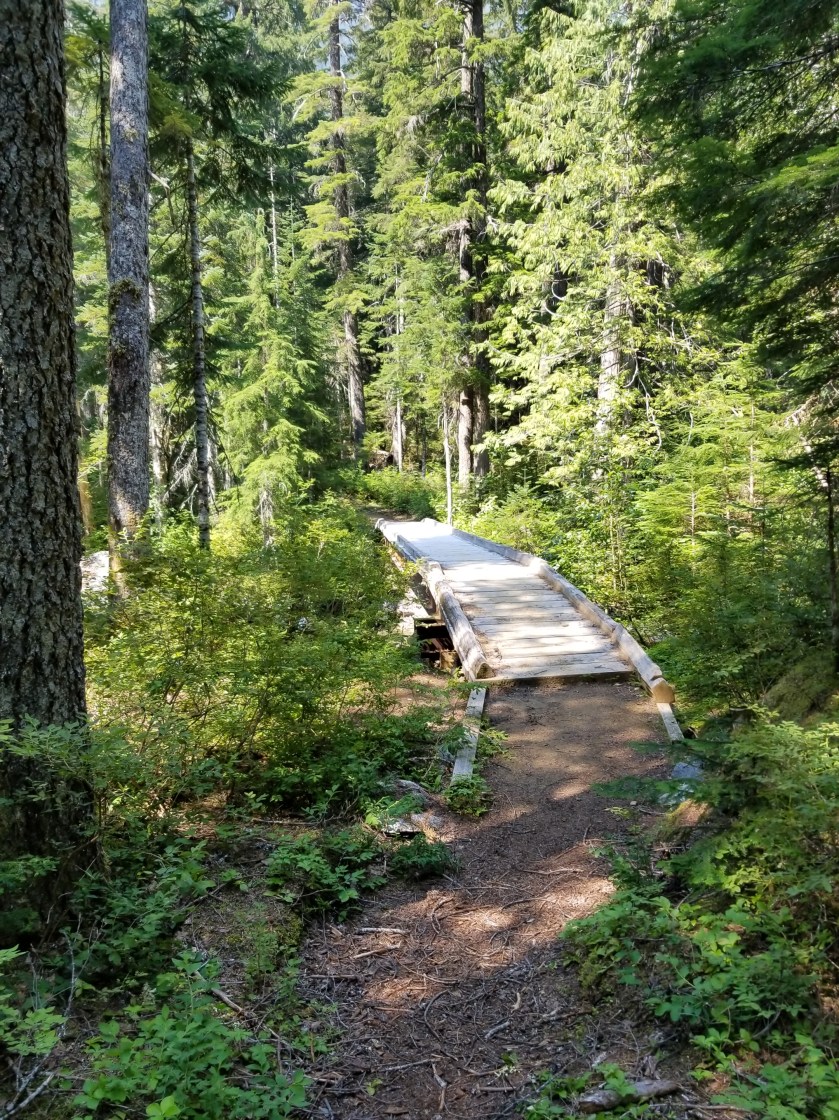
One thing about federal parks or recreation areas: they do bridges right.

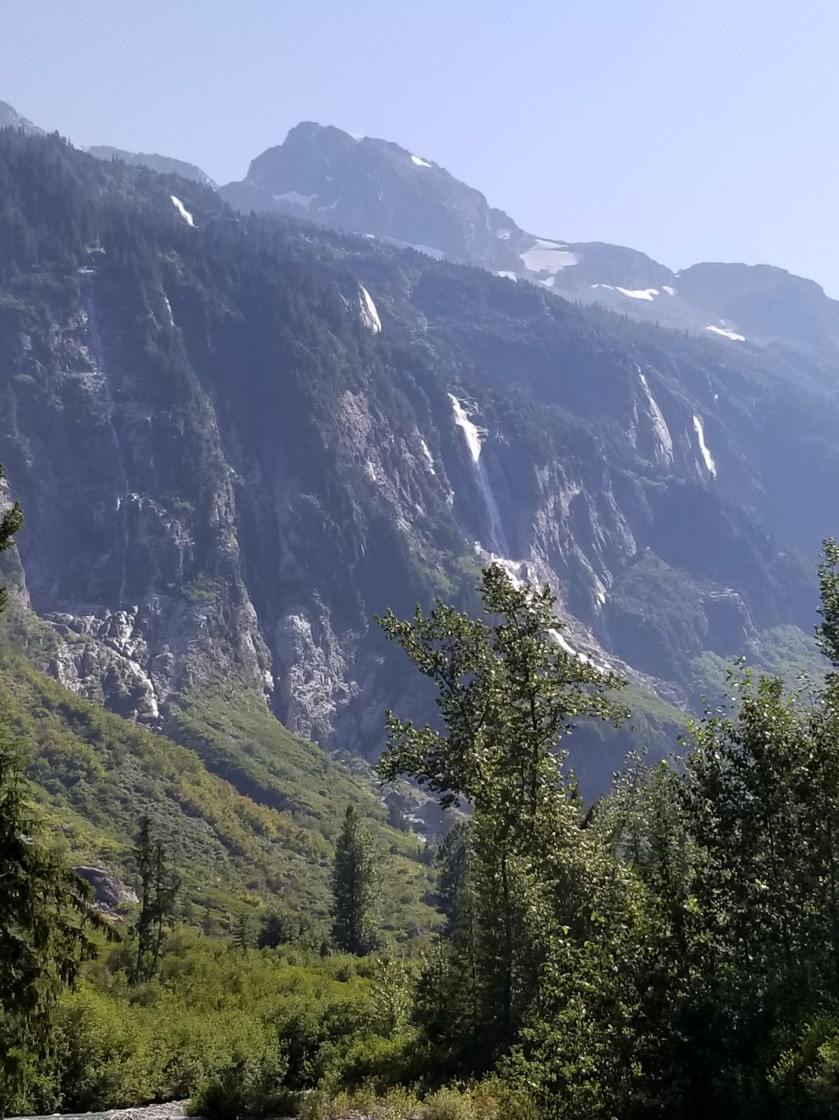
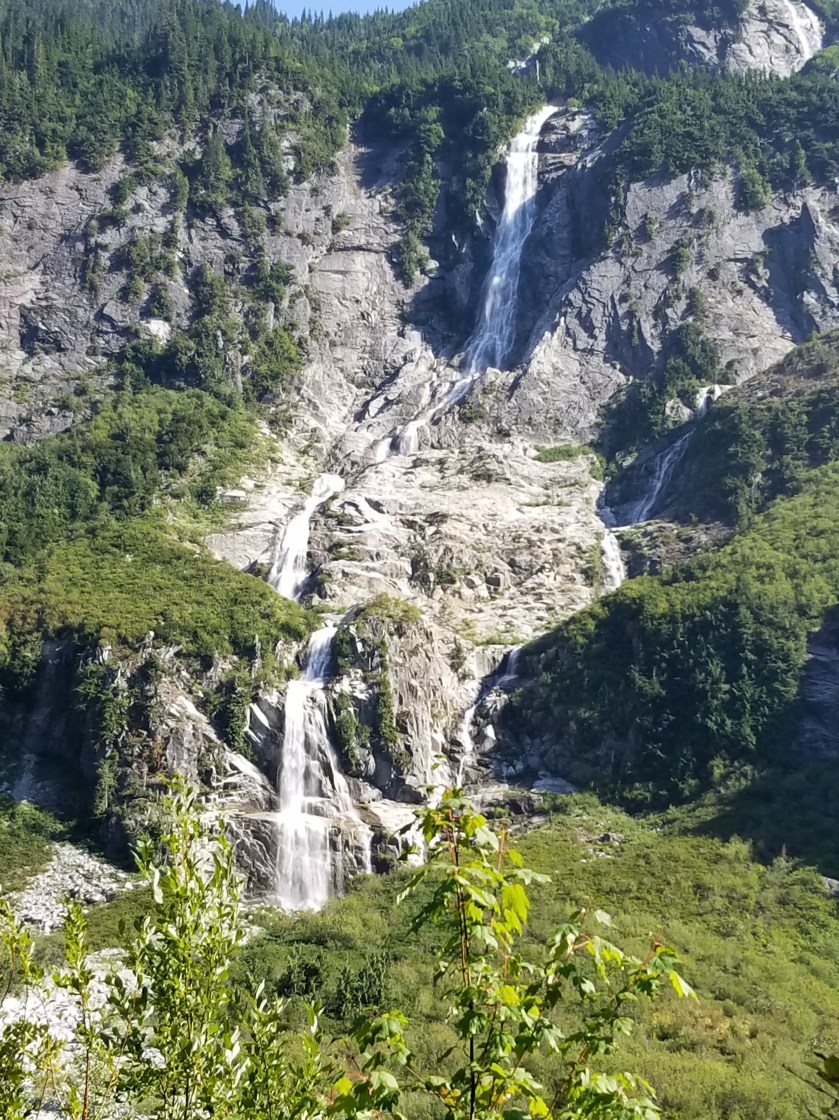
I made my way up the valley. It got high enough that there was snow and glacier up high across the way. With the heat, the melt created numerous waterfalls. Visually, it was mesmerizing.

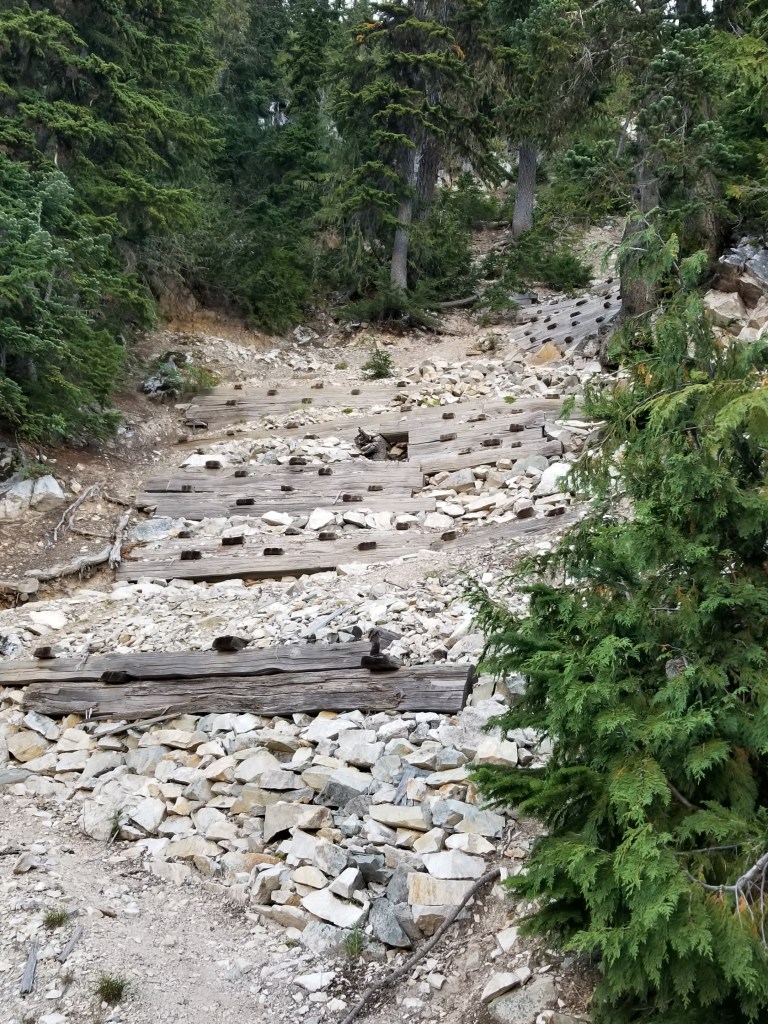
Whatcom (pronounced watt come) Pass was my reserved campsite. It had a legendary reputation as an intense climb. It lived up to its reputation. Near the top, some of the wood buttressing the slope had dissolved.

The gray timbers were there to shore up the gravel trail above.

The campsite had a reputation as prone to bear visits. As a result, I ate my dinner about a quarter mile away to cut down on odors. There was a boulder field with a lot of pikas who squeaked their annoyance at me.

I was the last to arrive at the reserved campsite, so I got the least attractive campsite. The best tent pad looked straight down the valley. Mine looked north at a boulder field. I hung up my food and got my tent put together.

I heard the Pikas going off. Then I heard a large rock tumble. I looked and at the edge of the boulder field was a good sized black bear pointed uphill (away). don’t know the proper way to size black bears, but he looked like four Labrador Retrievers mushed together. If you’ve suffered through earlier blog posts, you know I am not a fan of bears. I yelled and he moved a bit and looked at me. Finally, I clapped loudly and he scurried uphill and away from the Pass, in to the trees.

My neighbors came over to see about the ruckus. We had a good chat and they all said they had hung their food. As you can imagine, I did not sleep too well, startling awake to the slightest sound. As you can equally imagine, nothing happened. When I reflected on this bear’s behavior, he seemed to just want to go over the pass and avoid humans. The biggest wildlife lesson on this trip is that animals very much use passes and saddles as transportation highways.

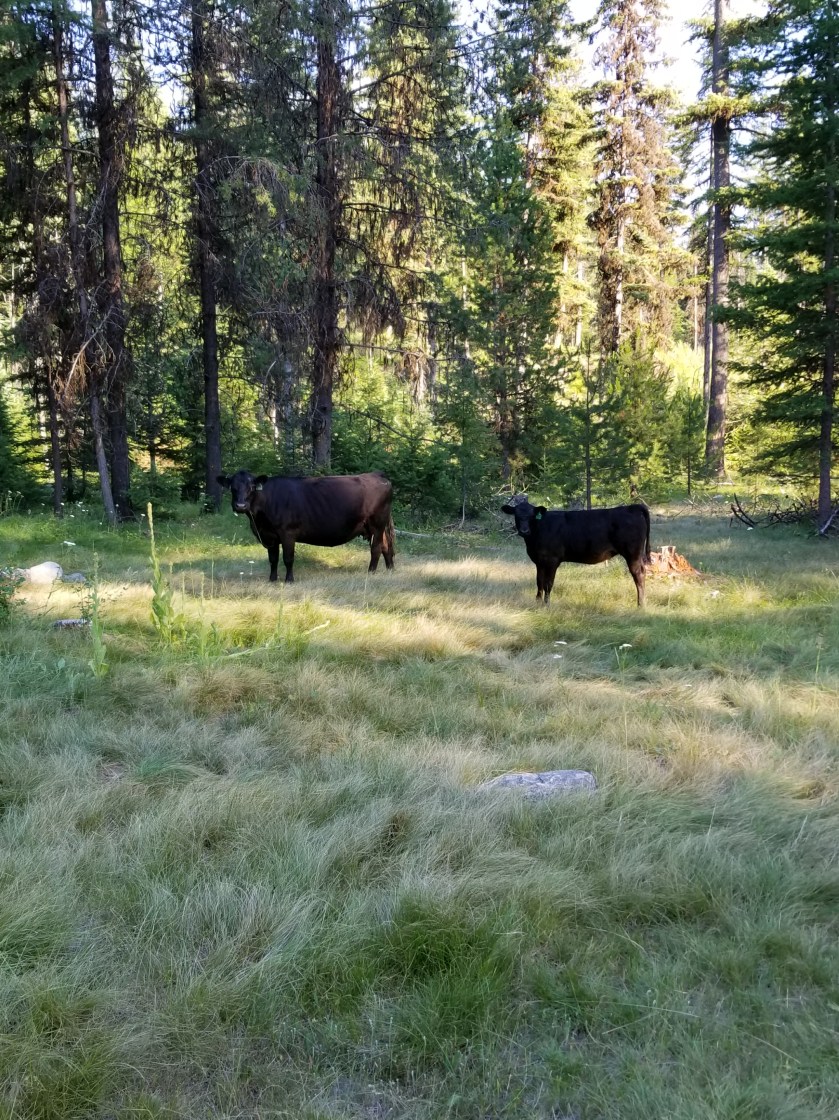
Cattle.

July 25, 2018. From Okanogan Forest camp to Cougar Creek camp. 22 miles

I was not well rested after the rough night. Still, I packed efficiently and even forced myself to eat my breakfast of cold-soaked 10 grain cereal.

It was a beautiful day for hiking along this seldom-used road. I had seen no cars on it yesterday. With this solitude, you would not be surprised that when it came time to perform an important bodily function, I simply took off my pack and went a few yards into the woods to dig my cat-hole and take care of business. Well, as Murphy’s Law would have it, another hiker, heading the opposite direction, comes walking down the road. Nobody for days and this guy walks up on my dump. I tried to recover as quickly as possible, but it was certainly awkward.

We chatted briefly, but I was eager to get on with my life.

Later, as the day got hotter, I took the aptly named Sweat Creek Trail. It was a tough climb on a hot afternoon. Perhaps some steep climbs, I heard the chainsaws of a trail crew. After waiting in the distance for them to see me, I had a good, short visit. It was two adults and three teenage helpers. They were a legitime PNT crew. I expressed my gratitude for all the work they do and showed the younger ones all the scars on my legs from going over blowdowns, etc. Also, I let them know I was a dues paying PNTA member.
Their work is hot and difficult. I whine about carrying a backpack in hot weather, but these folks get up, put on long pants, work boots, hard hats, carry their gear uphill to the worksite, and labor in the sun all day. I thanked them again and let them get back to work.

Part of the work this crew had to remedy was eliminating misleading cattle paths. Generally, cattle are fairly good trail makers, sometimes they riff on their own. What this means is they will very often follow the main human trail, but, when it suits their bovine fancy, they cut a new path. Thus, in many areas a hiker has a very difficult time telling the difference between the human and cow paths.

On my way downhill, I could see the trail crew had a lot of tree and cattle work. As if to prove the point, I encountered a small herd of about three pairs of cows and calves. Always, I stop and talk in a calm manner when I see cattle on the trail. While sometimes they amble off safely, other times, like this one, one bolts and the others follow. You might be surprised how agile these animals at going downhill at speed, jumping over obstacles. I waited a few minutes so they would not feel threatened. I don’t want either a calf or cow to get hurt running.

Unfortunately, I’ve seen this movie before and was not surprised to have the same process repeated. Two more times. In all, they probably ran downhill for a 750 foot elevation loss over a mile. Finally, one of the cows went left off the trail and the calves, who normally choose the trails, chose to follow her.

It was evening by the time I reached the bottom of the trail. The guide book made a vague reference that the trail seemed to go on private property but to veer left. Mild understatement. The trail basically dumps right in to someone’s yard. I didn’t see a dog, but clearly somebody lived in the trailer parked there. I went immediately over to the edge of the yard and moved quickly and quietly away.

Eerily, the occupant(s) had a fascination with skulls and decorated their yard with several plastic skulls and skeletal parts. At age 56, I am just too damned old to be abducted and converted by some cult. Think about it. You never hear about guys like me getting captured and converted, it is always younger people. So, I kicked in to high gear and got the heck out of there.

I came out on a public road. It switched between private property and public land. There were definitely some unique homesteads along the way. Maybe you live in a suburb or a nice urban setting. Indeed, you’ve also probably seen poor, blighted urban areas. However, taking a long walk really draws out a different variation of the American dream. There are rural areas where it is either the start, or fulfillment, of the dream to get a piece of land and park an RV or Camper on it and call that home. Sometimes there is evidence of a more permanent, traditional structure in various stages of completion. I can sort of understand the pride of ownership angle, but most of the situations appear to never convert to permanent housing. Instead a second or a third trailer is added. (I shudder to think what their septic solution looks like.) Pointedly, most of these smaller homesteads were the most prominent displayers of “Private Property” or “Keep Out” with a few specifically mentioning government officials. (Note I have the honor of working with municipal employees in my community and can’t recall any kind of professional that works harder to be fair, judicious, and considerate.)

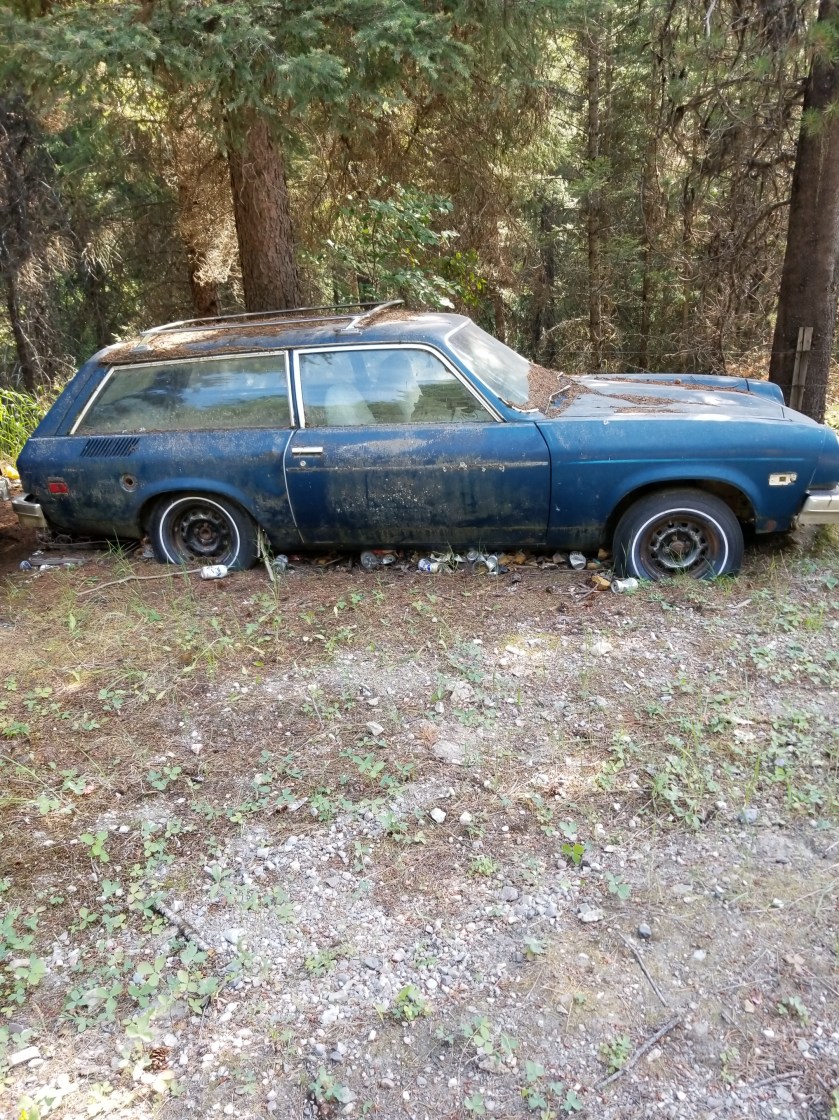
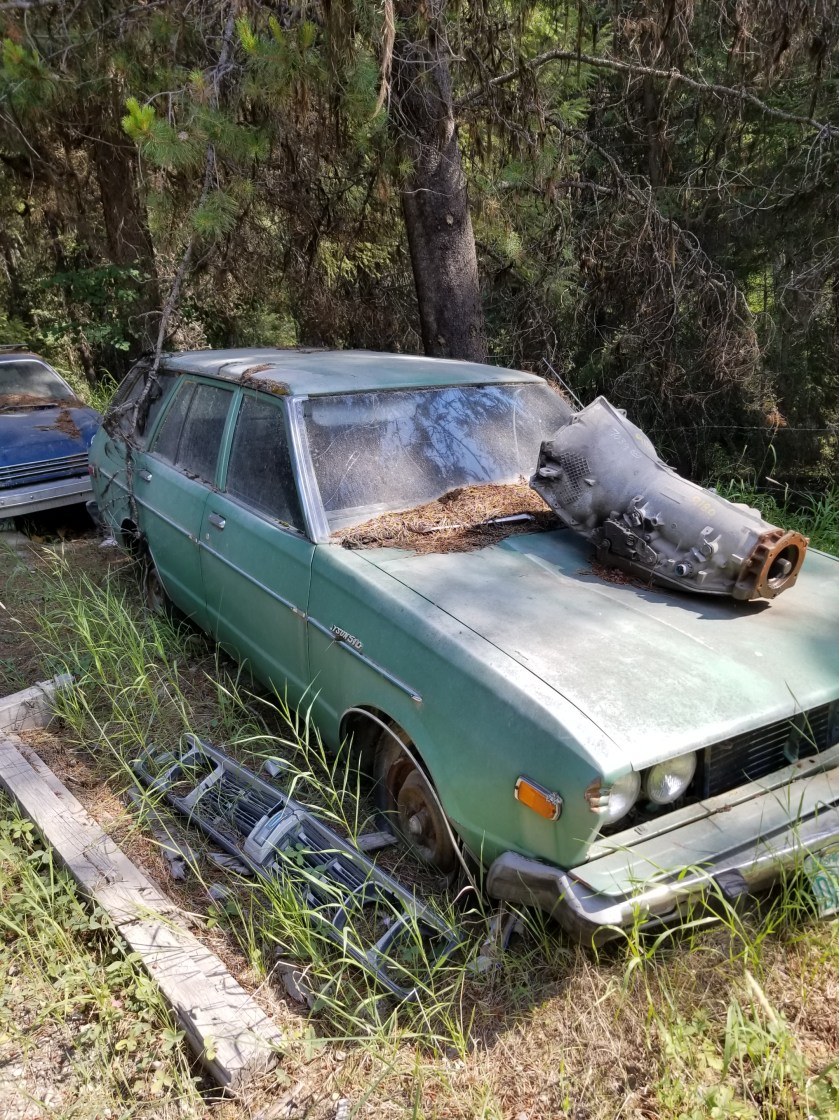
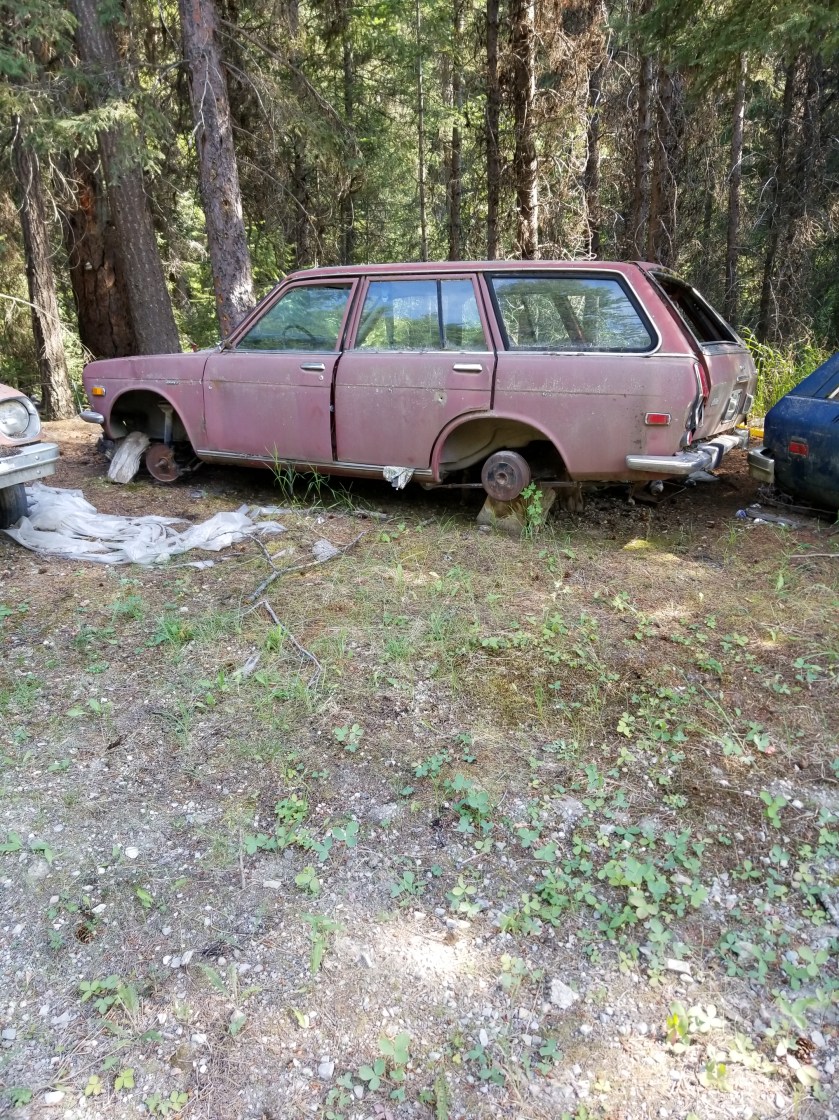
I passed a few properties where they spilled some of their excesses on to the public right of way. I’m not a “car guy” but one place was occupied by one who convinced himself (and perhaps a long suffering wife), that he would hold on to junkers to “part them out.” To nobody’s surprise, the Dodge Aries and various Datsun models did not generate much demand, so these vehicles decorated the road.

Eventually, I found a flat secluded spot on public property down by the creek. It got darker faster in the narrow valley. I ate my dinner while shooing away yellowjackets. I pitched my tent, hydrated some more, and went to bed.

While I initially dropped right off to sleep, in the night I was awakened by a sound. Not one crunching in the woods or brushing against the tent. Eerily, it came from underneath the tent. In the ground, there were subtle digging sounds and then a muffled pig-like snort. Being a guy and having lived in apartments, I naturally reacted by pounding on the ground. That produced silence. For a few hours. I had to repeat this one more time. In the morning, when i packed my tent, I could not see any obvious signs of tunneling or disturbed earth. I’ll never know what it was.

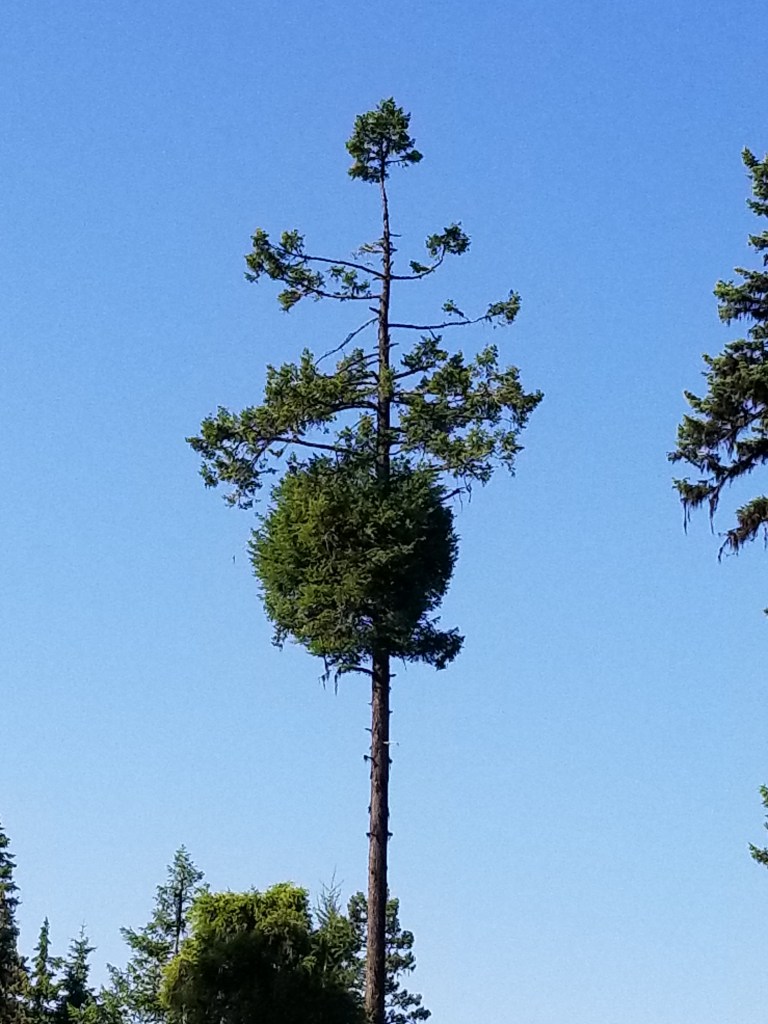
I find it fascinating that spruce trees will “feel” that they are dying and produce these clusters of robust growth, kind of like the opposite of cancer cells. I’m not sure if these anomalous growths are then intended to jumpstart regeneration when the tree falls.
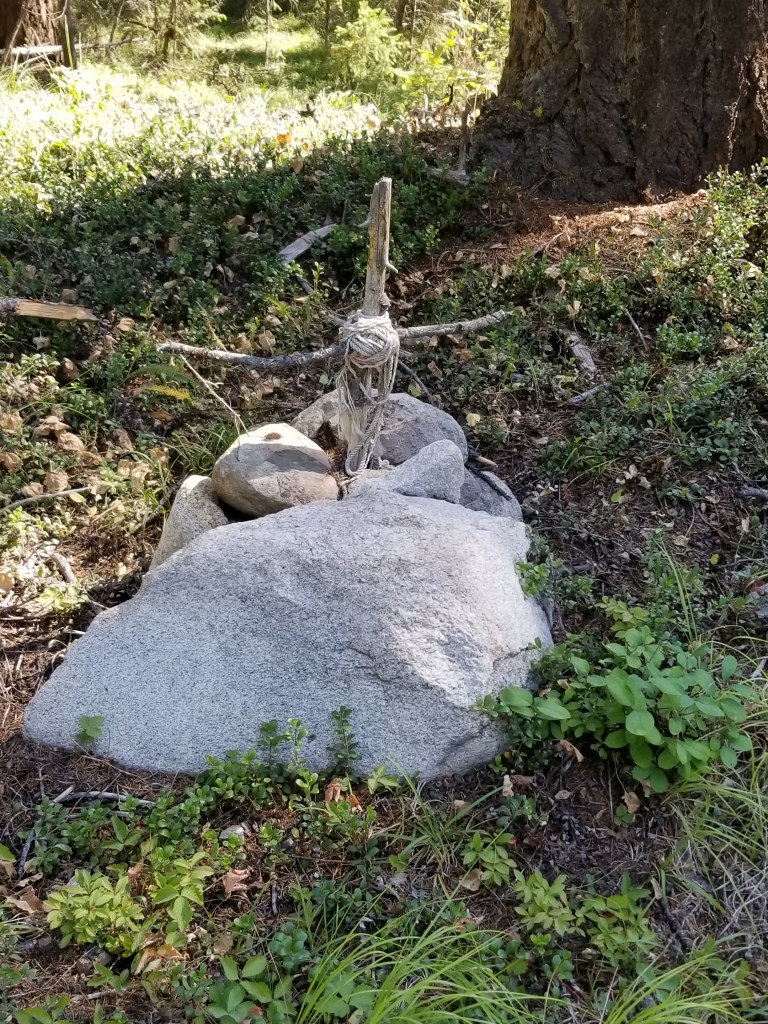
Saw this grave marker along the gravel road this morning. Couldn’t tell if it was for a pet or an unpopular relative.

Tough Miles

July 24, 2018. From Thirteen Mile Mountain to stealth camp on Forest Road before Ogle Creek.

In spite of the strong moonlight, I woke up rested. I broke camp relatively quickly.

It was a brilliant, beautiful morning going slightly up and down on trail through grassy ponderosa forests. Great views.

Later in the morning I was cruising downhill, I went from sunny slope to a sharp shaded corner. That was where the accident happened. For my part, it took me two full steps before I recognized the sound of a rattlesnake. For his part, he waited until I was next to him before rattling as he wound himself up underneath a Bush. We both screwed up. I went back to see him and he had beautiful green markings. The video does not do it justice, but you can understand I did not want to stress the creature or, more to the point, get bit and die all for the sake of a more clear video. This isn’t Mutual of Omaha, people.

Later, I crossed a road with a trailhead. I loved it. There was a description of Thirteen Mile Trail. Best part? The length of the trail. All of my avid blog followers know I love goofy signs. So, both of them can understand my glee over the Thirteen Mile Trail being 16 miles. What do you think happened?

I was too tired to consider how a difficulty rating of difficult worked.

I dropped down an amazing canyon of Thirteen Mile Creek. It had huge 500 foot sheer walls and a churning stream. Suddenly, the stream disappeared. Just as suddenly, it reappeared, apparently choosing to run undergroundfor a quarter mile.

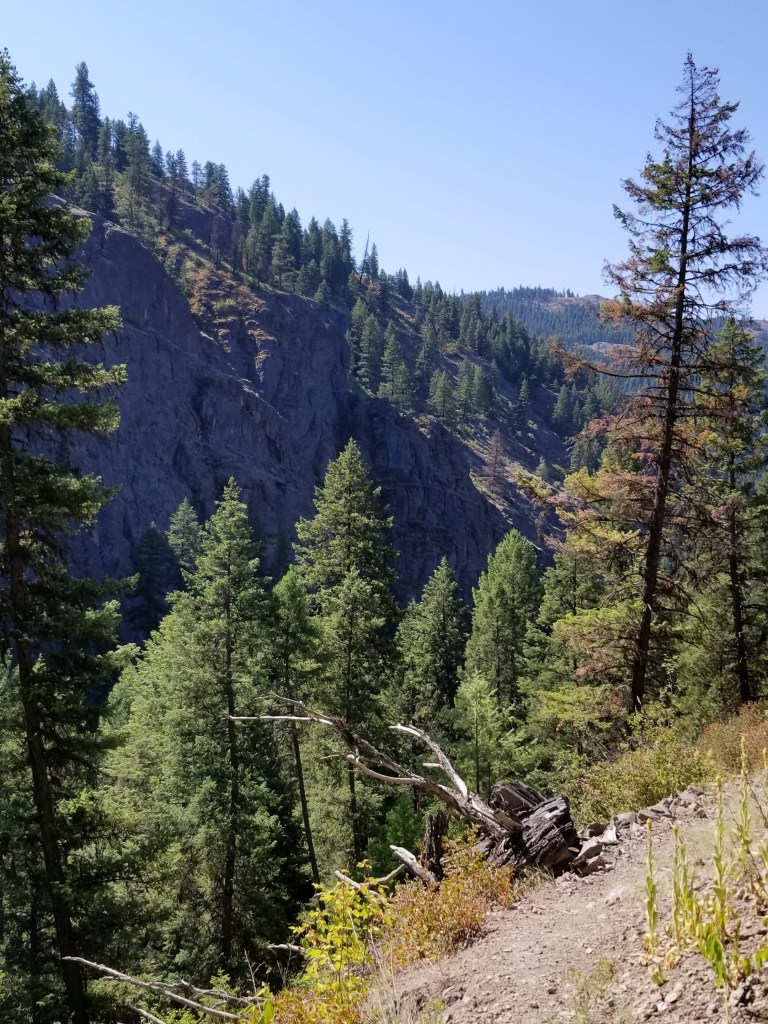
The photo fails to capture how high and sheer the cliffs were.

I next had a 2 mile walk on a highway with no shoulder. The Guidebook said this was the Grand Canyon of Washington. I was not impressed. Plus, there were a couple jerk drivers who clearly could’ve moved over, but chose to hug the lane and almost clip me.

Off the road, I had a dry trail uphill for several miles. It was tough. I had one of my oddest wildlife experiences. Given the amount of time until my next resupply and chance to charge batteries, I have been turning off my phone which is my camera. At a road junction, I was looking at my printed map. A spotted fawn trotted out of the woods. I reached for my phone and turned it on. On a whim, I told the fawn to “calm down.” Unexpectedly, it turned and came right to me. It was panting. It was obviously stressed, but I knew taking my pack off to give it water would spook it. By the time my phone turned on, the fawn was trotting away through the woods. So bizarre.

Late in the day, after passing cattle and timber harvesting, I came to a “V” in the road. A sudden crashing in the bushes uphill made me reach for my phone. I spied some black ears and a scalp. I wasn’t sure if it was a wolf or a black bear. As I was getting my camera ready to video, the bear cub came into the open. “Oh shit”. I hightailed it out of there not waiting a nanosecond to see where momma was.

An eventful day drew to a close when I found a beautiful grassy plateau for my camp. I hung my food far away and went to sleep. Or tried. It turns out I was on a bit of a lump, plus the zipper on my tent failed. So I spent a lot of the night fidgeting to find a comfortable position and waking to a mosquito buzzing my ear.

Long Day in a Burned Forest

July 21, 2018. Stealth camp near Kettle River to unnamed saddle in Kettle Mountains.

The night was very still. I heard some coyotes around midnight doing roll call. No problem with the camping.

As I continued down the road to cross the Kettle River, I walked along a quarter mile of the plateau and not a single private property sign was posted. I was relieved.

After crossing the river and highway 395, I was on a gravel road, passing a large piece of private property which had been logged. As best I can tell, the way landowners make a living is to graze cattle on their forest land and then periodically harvest timber. I would imagine lumber shortages and tariffs probably pushed a lot of folks to harvest lumber sooner rather than later.

Today I was feeling a little sluggish on the relentless gradual climb. I tried hydrating more, but it was tough. Plus, there were about six young guys on motor bikes whipping up and down the trail leaving annoying dust clouds. The scenery was nice, though.

These ferns grabbed a slice of morning light as they grew on top of a boulder.
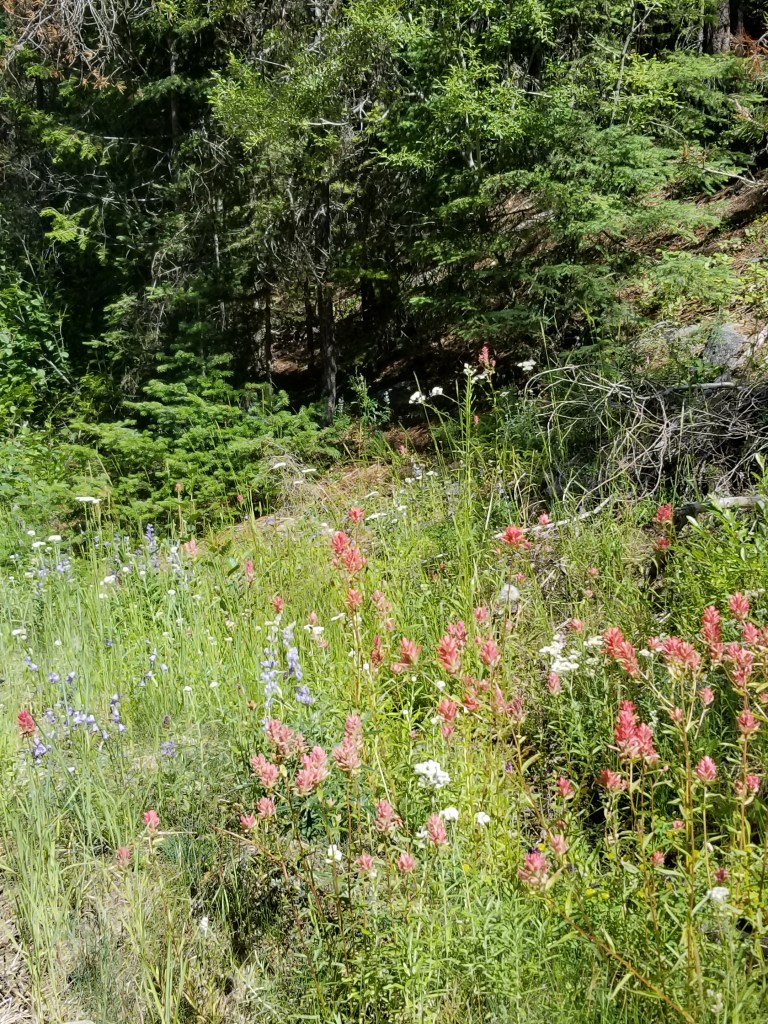
Indian paintbrush (red/orange) and lupine (purple) are attention getters in meadows.

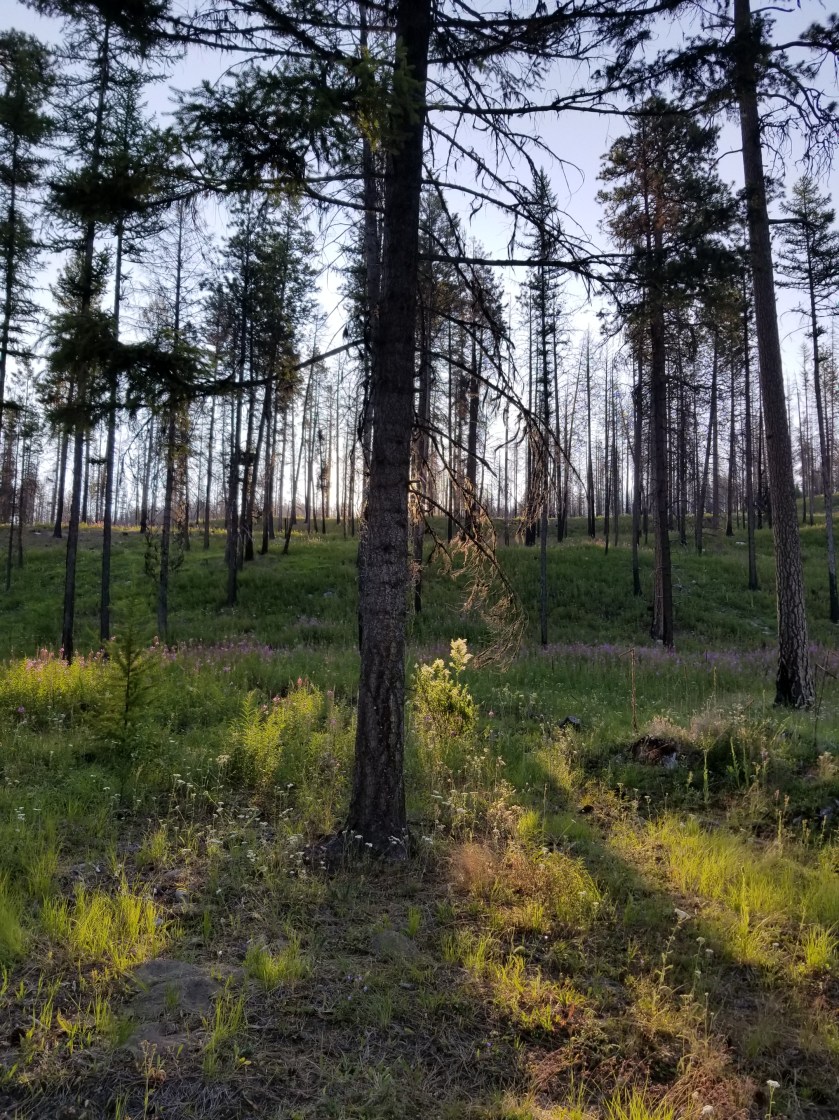
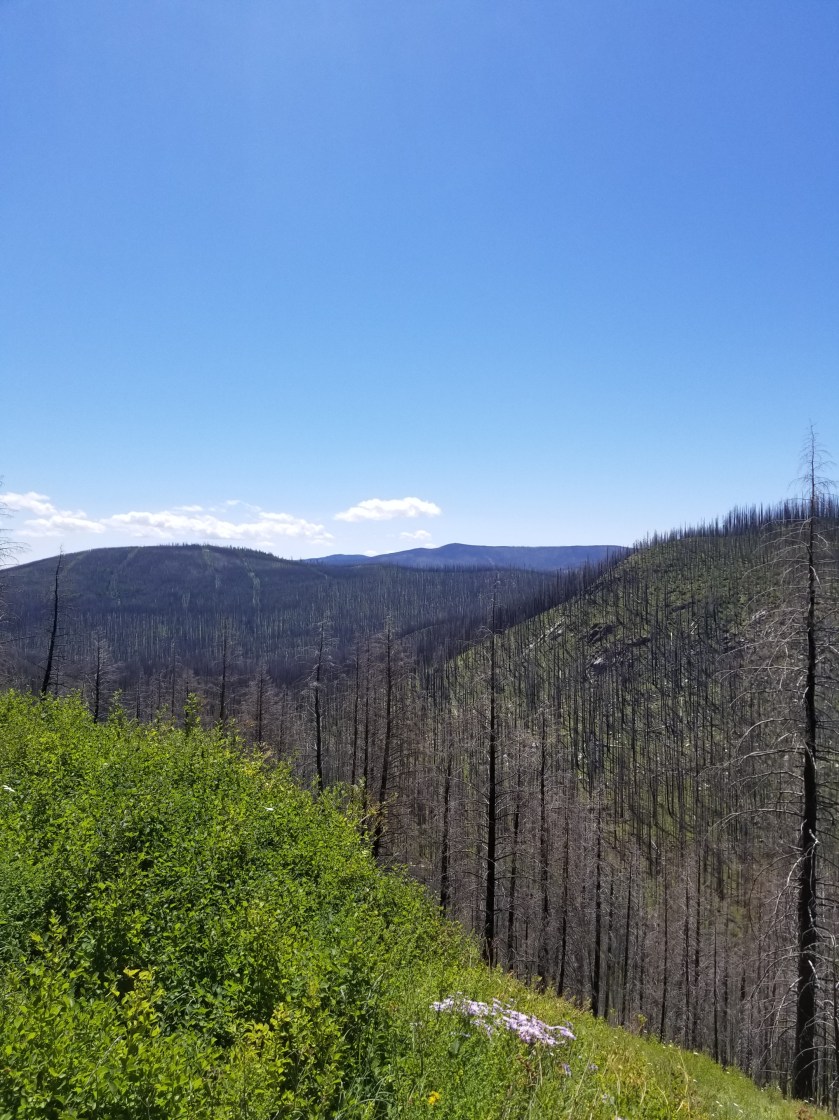
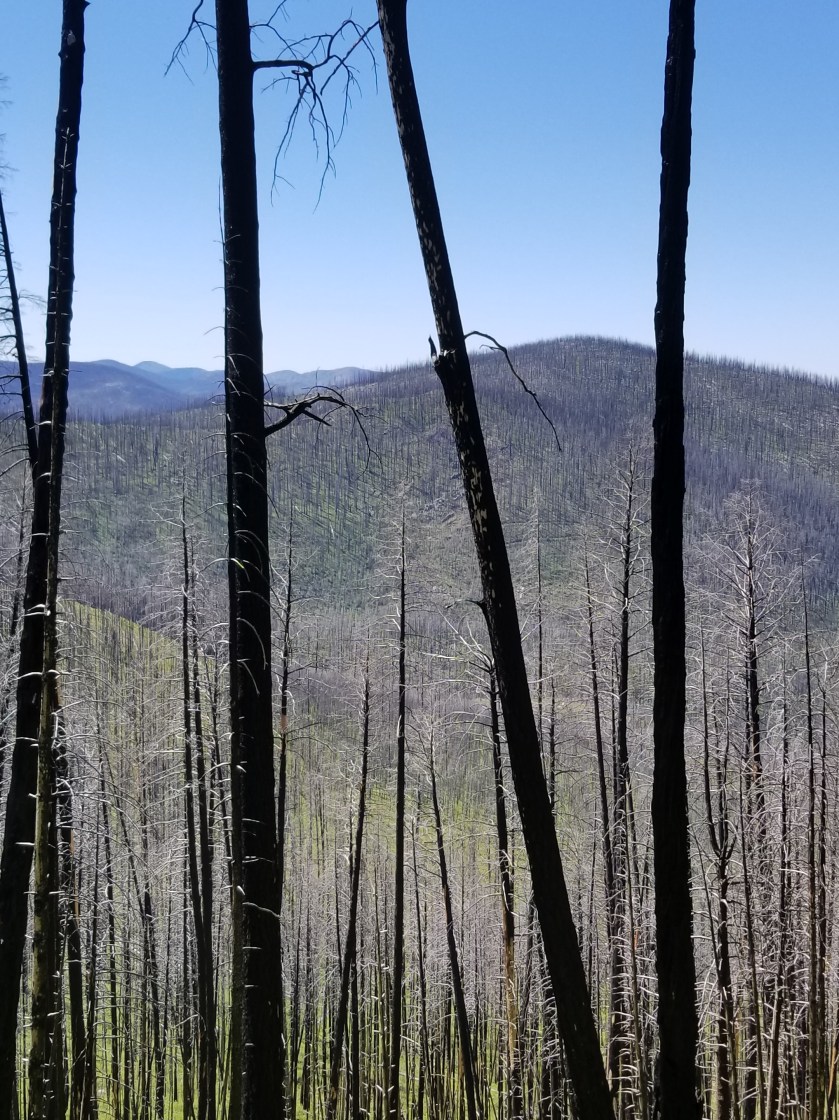
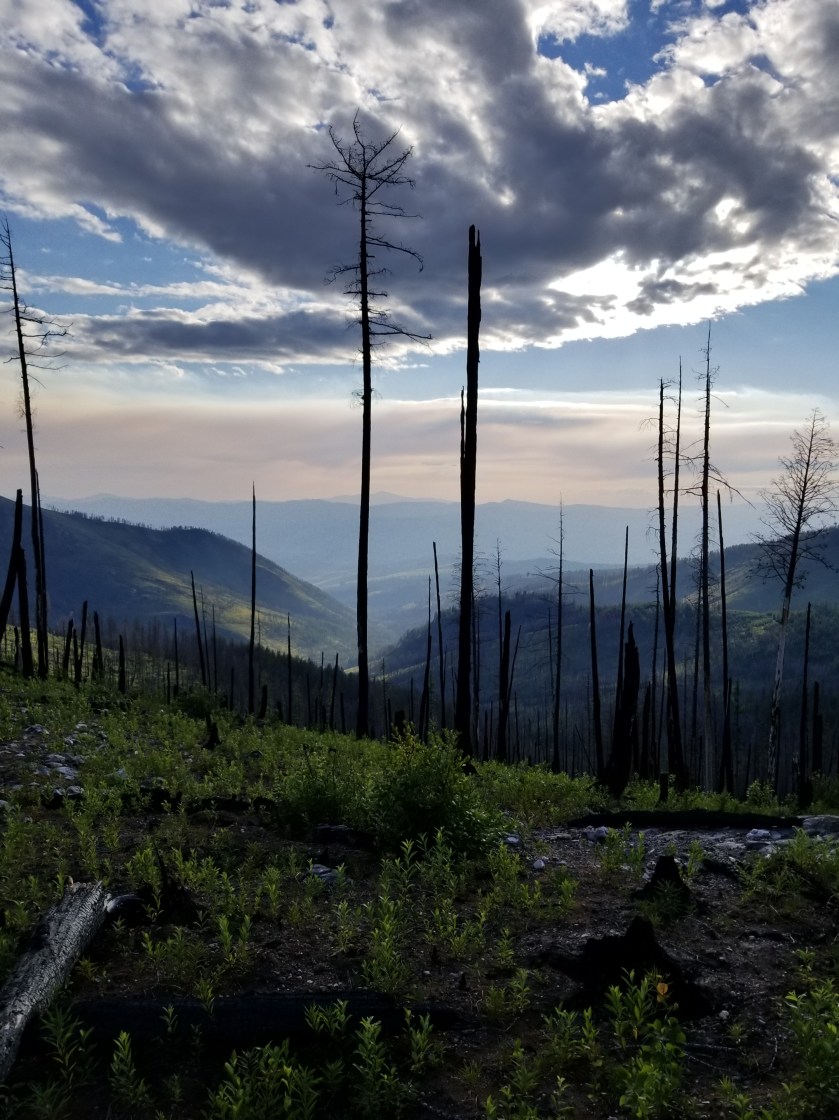
The day changed tremendously when I entered the burn area. In 2015, a massive complex of fires swept over a large swath of this country. I entered an area of standing deadwood, charred fallen logs, fireweed, and lupine. The trail dwindled from a gravel road used to salvage usable burned wood to abandoned forest service roads with multiple blowdowns.

It is such a contrast between the massive carnage of a forest fire and the rapid evolution of plants scrambling to seize the open terrain. Lupine has an explosive takeover strategy. It develops seed pods that twist and then pop open, scattering seeds. The most interesting thing to me was the absence of pine, spruce, and larch seedlings. They must bide their time and rely on their height genetics to overcome the early lead of other plants.

I’ve only seen two sets of footprints. That is, until I got to an intersection with a paved road. Then, a new pair of prints appeared. This was the famous Kettle Crest Trail.

Kettle Crest was a well maintained trail. I could not recall how many days since I had been on a real trail. It was good, but again seemed more like a bike trail than a hike trail.

I was able to get my last water supply and then followed the trail as it switched back and forth uphill. The map showed three turns, but there were at least six.

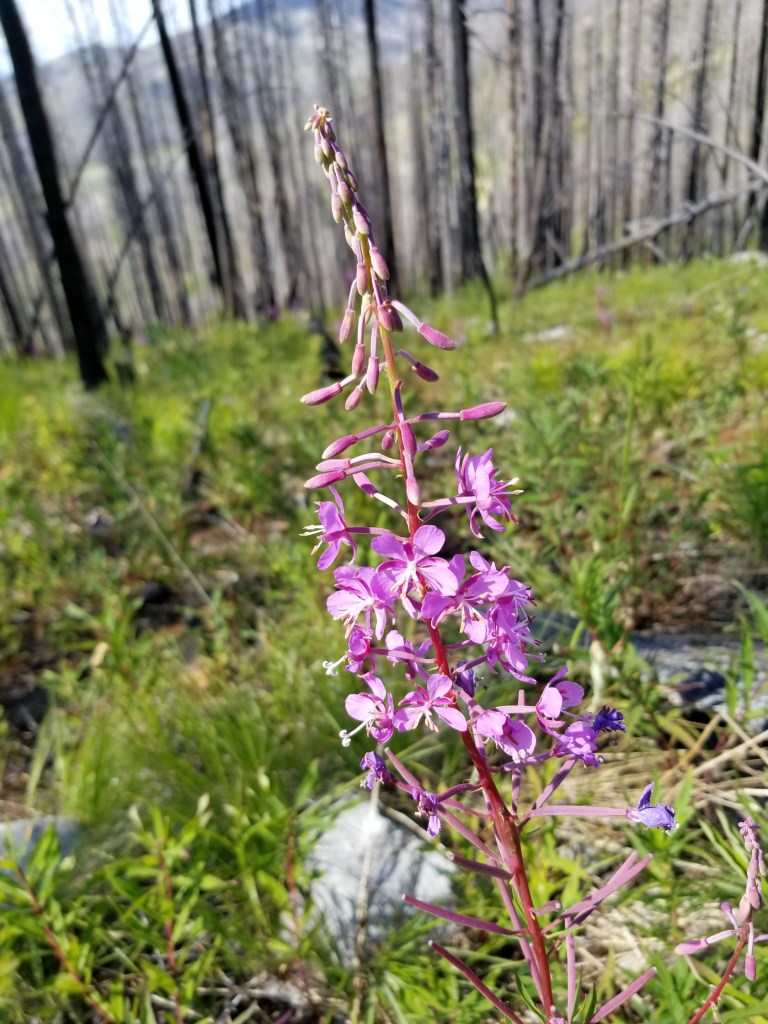
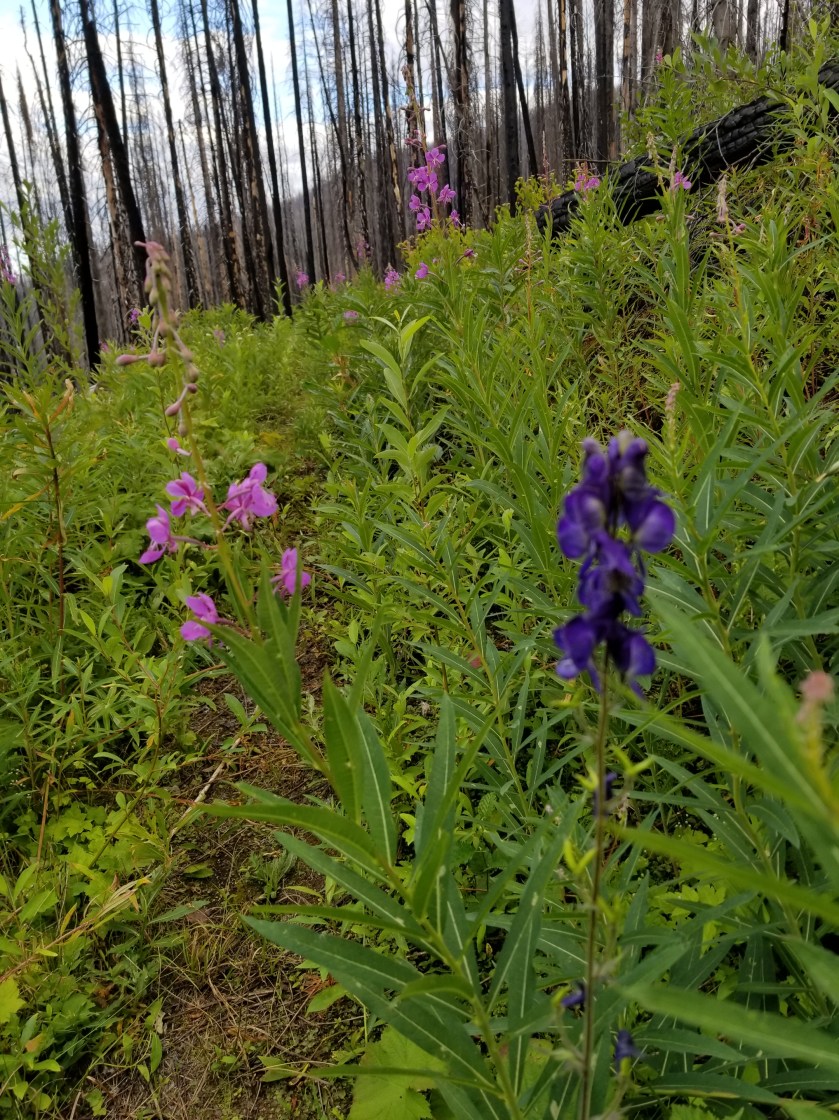
Fireweed
Sorry for bad focus, but seeing fireweed next to something that looks like a delphinium was an unusual sight.

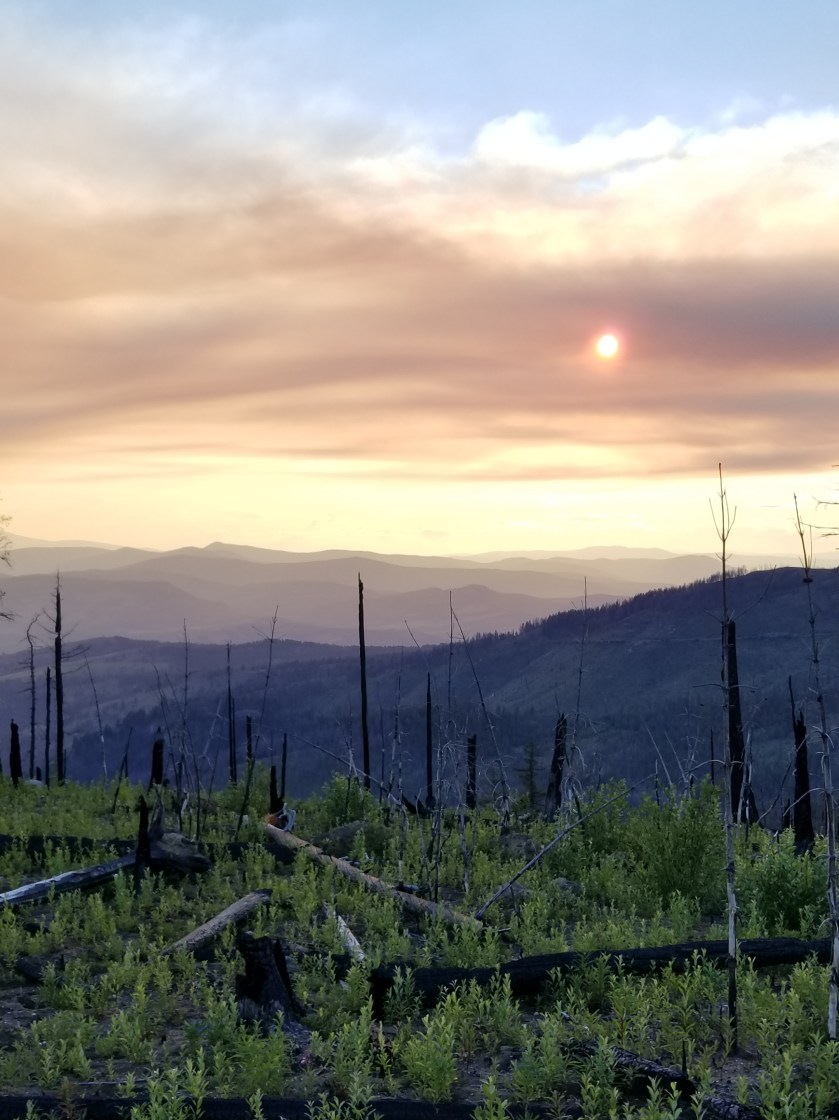
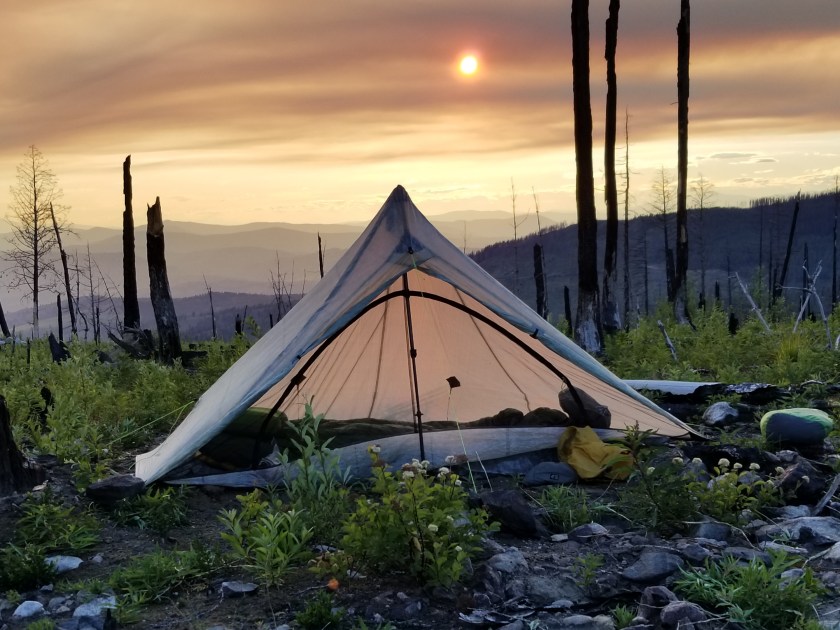
Eventually, I reached the saddle I was shooting for. There was about 45 minutes before sunset. An odd cloud of smoke hung in the air. Plus, for once, it was windy. So, I made camp quickly, avoiding standing dead trees. I pointed the open end of my tent away from the wind. I had to put on my wool hoody plus my down puffy.

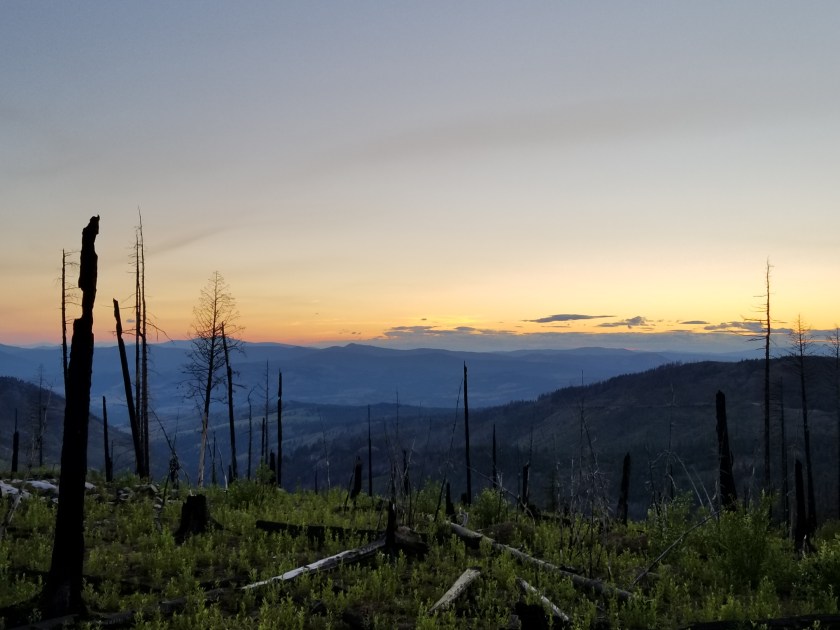
View from the saddle. The mountain saddle; I’m not on horseback.
Sun behind smoke cloud.

As a shock element, while I was eating my dinner, a mountain bike went whizzing past. Not sure if he saw me, but I hoped he made it to the road before dark.

My Zpacks Altaplex tent. The company stopped making them. Too bad because they were great for tall people.
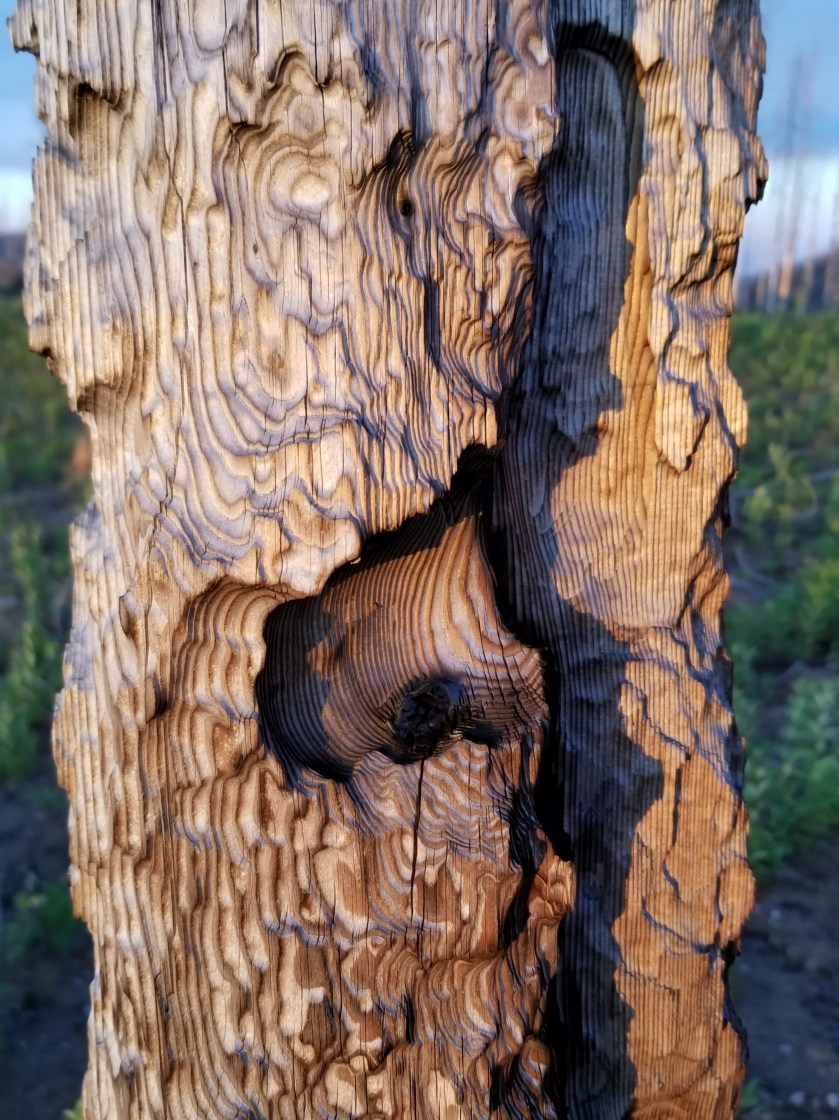
First fire, then wind carved this.

It was the first cold night in weeks. I liked it and I liked sleeping up so high. It was a long hard day, but tucking in to a warm sleeping bag was a great reward.

My Worst Day

July 14, 2018 From Pyramid Lake to stealth camp on Lion Creek.

I woke up way early and forced myself to stay still for a bit. I knew the family wouldn’t be up. I snuck out to get a sunrise pic of the lake and grab my food hang.

Another sunny day. It would start with a climb to two nearby lakes. From there it would be bushwhacking. In case you are wondering, bushwhacking means taking a course between two points with no established trail. As the name implies, you must go through bushes, downed trees, bogs, etc to achieve your goal. Without these obstacles it would be walking or traipsing or strolling or perambulating or something.

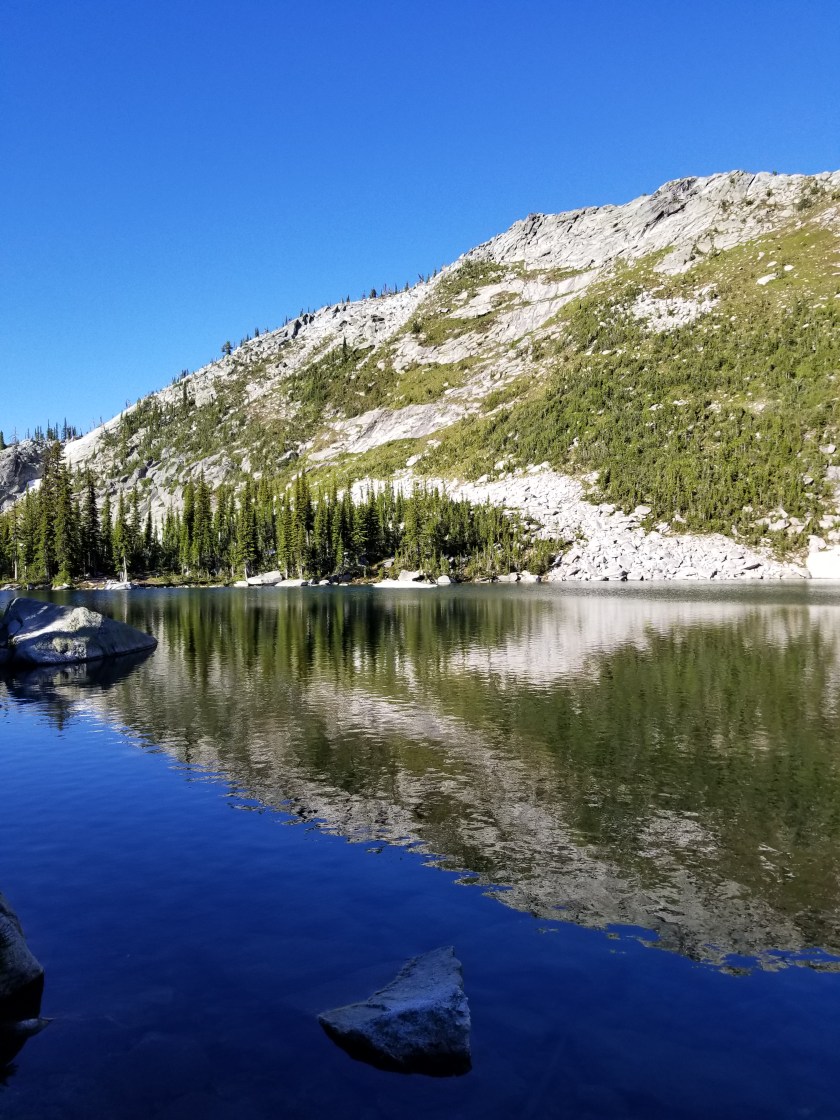
The first lake (Upper Ball) was beautiful and I regret not having the daylight or energy to get there the previous day. The second lake (Lower Ball) had families with barking dogs.

I scaled a hill and the first part of the bushwhack began: cross a mountainside. It was a little steep, but manageable. Until the rock slides. Then, I had to edge my way uphill to get above the steep area with no apparent footholds. This happened a second time as well. Falling here would be unpleasant, to say the least.

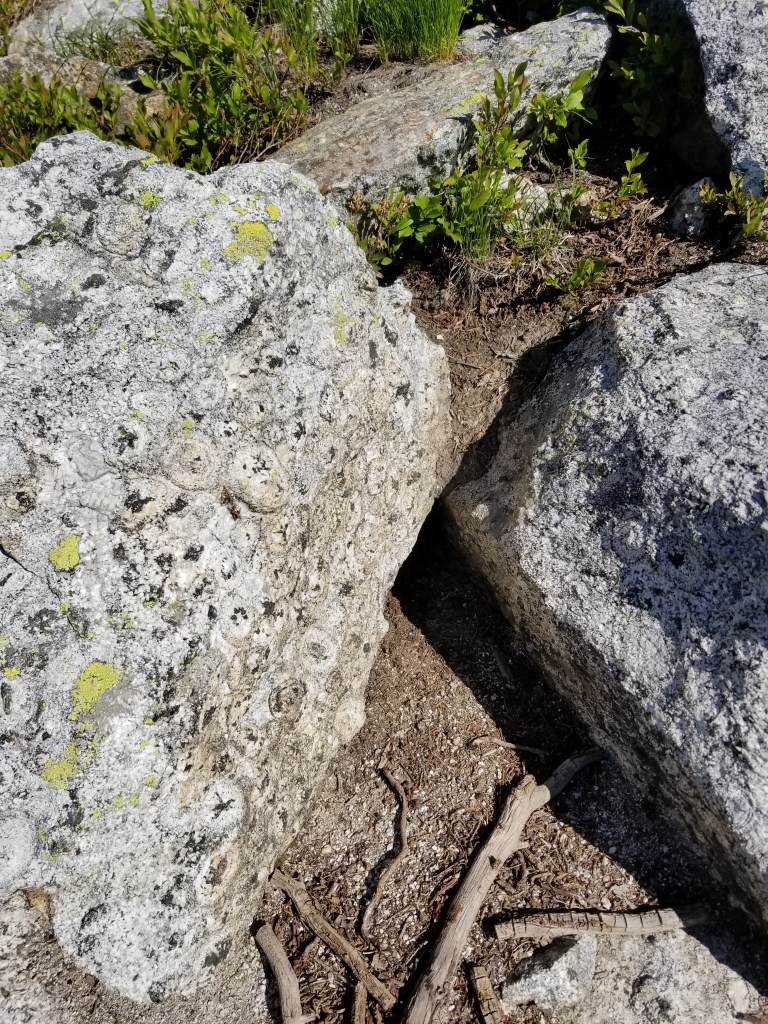
The only consolation was that some of the rocks at the ending ridgeline appeared to have fossils. It reminded me of Sandia Crest near Albuquerque where I found fossils at 6,500 feet elevation. This old earth sure moves around.

The rock on the left had formations that looked like fossilized sea anemones.

The next installment was to go down a heavily vegetated hillside, veering west slightly to end up in a particular canyon.

At first there was a trail, but after about 100 yards it disappeared. Most of the bushes are alders ( I believe). They grow about 4 to 8 foot branches. The devilish part is they grow in the same manner as crabgrass: the branches shoot out, then up. So, they end up interweaving their branches. This makes for tough hiking.

Downhill, I eventually made my way to the right location. Allegedly, there was an old faint trail. While this was true at times, other times it wasn’t. In fact, the further down Lion Creek I got, the more frequently the “faint” trail disappeared.

The main point is that it is slow and difficult to push your way through shrubs and step over downed trees on a hot day. I reached a point where the guidebook and GPS map said I should be connecting with a real road, but that was simply untrue.

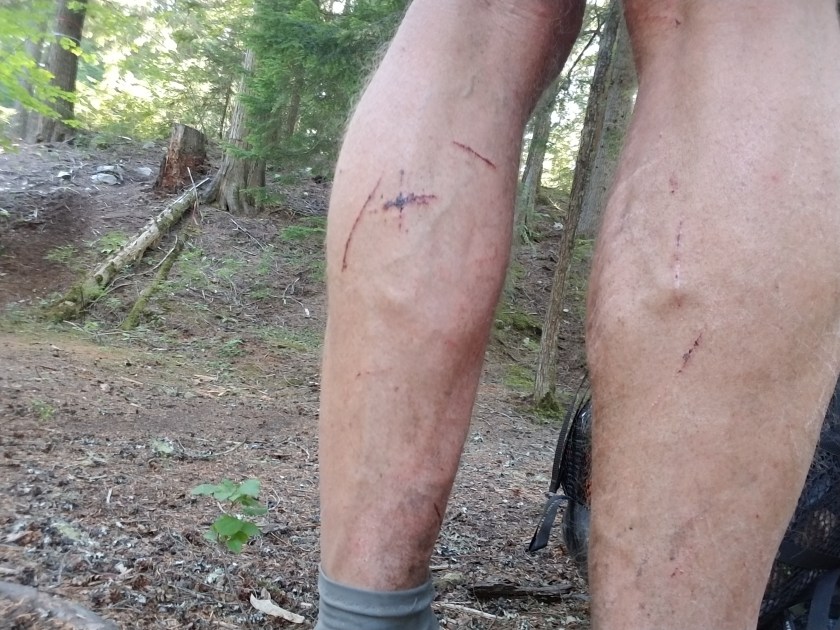
I eventually stumbled out of the woods sweat-soaked, bleeding from lacerated arms and legs and in a foul mood and odor. Immediately I met a family pulling a wheeled igloo cooler in swimsuits. We both looked at each other like WTH?

The back of my legs.

After several more people passed me in flip flops and swimsuits, I asked a couple what the attraction was. Apparently there is a natural waterslide famous with the locals. This trail eventually turned to a road, but before it did there were several cool streams that provided needed refreshment.

Exhausted, beat up and late in the day, I weighed my options. The official trail climbed a mountain to a….Lookout! And then climbed down to meet the gravel forest road I was now on. Hmmm.

So I stayed on the current forest road, listening to an audiobook. One kind couple stopped and asked me if I wanted a ride. Tempting as it was, I demurred. Near the bottom where the stream I had been following almost all day (Lion Creek) was going to feed into Upper Priest Lake, I found a stealth camp away from the road but near the creek.

I ate dinner and then washed my wounds in the cool creek water. It reminded me of why I always filter water.

* * *

P.S. an obvious question is why don’t I wear pants. The answer is that pants, on me, get sweaty and thus tug and bunch and chafe. None of us are here for an anatomy lesson, but suffice it to say I chose the coolness and flexibility of shorts even if it means scratches.

Rebound to a Good Day

July 15th, 2018. From stealth camp on Lion Creek to Mankato Mountain.

It was warm to start. Normally, camping by a creek can lead to waking up with a damp temp as cold wet air sinks. Not this morning. It was going to be warm.

I cruised past all the RVs and boats and jet skis and ATVs at the campground. When I get home, u want to add up how much America spends on all of these and I will bet it probably ranks in the GDP equivalent of some European countries.

Don’t get me wrong. I am not trying to be self righteous and insist my way of enjoying the outdoors is best or right. Instead, I am concerned that people take so many mechanical distractions with them to the wilderness.

Off of my soap box, I traveled past Upper Priest Lake and some great campsites. Then, without warning, I entered an area that was epic. Recently society has screwed up the word epic by applying it to common things. Thus we lose the true impact of epic when used appropriately.

I entered a land of giants. Cedars. Trunks 12 or 20 feet in circumference. Crowns reaching hundreds of feet high. Walking on a forest floor of decades of fallen needles and cones. A smooth green shag carpet of ferns wherever a ray of sunlight would penetrate. No wind. Once in awhile a whitetail. This went on for several miles. I’ve been to the Sequoias and redwoods, but this was so unexpected and vast that I have to call it epic.

But then hot road walking kicked in. Eventually it switched to trail. Finally, it switched to uphill forested trail.

I climbed up along Jackson Creek. I was very thankful for the tree cover because it was hot. The guidebook suggested collecting a lot of water at the bottom. I did and was lugging five liters which is 10 lbs.

Surprisingly, the mosquitoes were horrendous. At least 20 or 30 around me at all times. I used DEET 100. Some people hate it and I may end with numerous tumors and lesions, but by God did I get relief from the little bastards. Except, of course, when it dropped in my eye along with sweat which is a feeling comparable to someone grinding lemon juice with tobasco into you cornea.

Except for the mosquitoes and passing dozens of streams with plentiful water, I felt good and trudged my way up. I entered a burn area with fantastic views. I had my eye on a saddle between peaks that was level and I could have sunset and sunrise views.

Finally, as I approached, I saw tents. There were three ladies camping there, enjoying their dinner and my view. We chatted a bit, but I pushed off, hoping that the saddle in a half mile would offer similar views.

Upon arrival, I found the Washington Trail Association trail crew. This was great because these were the heroes cutting up blowdowns and making the trail clear. Selfishly, it sucked because the next flat area on my map was a half hour away and it was getting dark.

Out of the blue, I spied a little flat area about 50 feet downhill from the trail. I was able to scratch out an area big enough for my tent. As is my custom, I sent out a satellite note to my family identifying my stopping point. I was surprised to see I was on the slopes of Mount Mankato. In Minnesota, Mankato is a sleepy college town on flat land, so I have no idea how this mountain got named.

Just glad to be laying down, I watched as darkness enveloped the valleys below while the relentless mosquitoes still tried to get in my tent.

A (Not So) Brief Recap of Bonners Ferry

July 12, 2018. Zero Day in Bonners Ferry.

If you have been reading this blog for some time then there are two things: you need to get better reading material and you know I love to hate bad signs. You’ll have to resolve the first thing and I’m not sure where the latter comes from. It could be EOGOG (Early Onset Grumpy Old Guy), but is it really all that much to ask that people who make big, permanent, useful signs take maybe just a second to double check their work?

With that set-up you know exactly what I had to accomplish today: where the hell did the apostrophe go? Edwin Bonner from Walla Walla, Washington ( a town they loved so much they named it twice) had one of the few official licenses to ferry people across the Kootenai River. So, why was it not Bonner’s Ferry?

Until the historical society opened, I first mailed home some extra gear, bought mosquito repellent, and then went to the library to catch up on blog posts, perform some financial stuff, and research the town I was in. I must say librarians, contrary to stereotypes, are generally friendly and extremely helpful.

In case you forgot or are hamstrung by youth, the Ruby Ridge incident occurred here in 1992. Oddly, it happened on Caribou Ridge. Long story short, federal law enforcement agencies had a shoot-out, then a siege, with a reclusive family. The man at the center lost his wife (sniper shot) and son and dog. A US Marshal died as well.

At the time, my simple mind encapsulated it as nut job shoot out with trigger happy feds. More nuanced than that, in the beneficial light of hindsight, it really was a tragedy. Weaver really should’ve just gone with the flow and appeared in court and not escalated things. The feds really made a mountain out of a molehill and got way too aggressive. In short, it was a bunch of guys who wouldn’t back down or compromise.

Back to the hot topic of the day, I noted the time and went to the Historical Society for Boundary County. When I walked in, a bearded fellow who must clearly perform some Santa Claus work in season, put down his browned historical newspaper and greeted me. I explained I am hiking the PNT and like to learn about the towns I visit and asked if he could give me an overview of the museum.

Immediately, I got the sense they tend to get one type of visitor. His smooth opening line explained there was a $2.00 admission fee and the bathrooms were down the hall.

Having cleared that up, he overviewed the following areas / collections

  • Railroad
  • Mining
  • Farming (early, 1930s, today)
  • Chinese workers
  • Women’s roles through time
  • Wooden clock collection
  • portrait gallery
  • Saloon
  • First Doctor
  • Native Kootenai history
  • Gun collection

And a whole lot else that I didn’t catch. Fearful he might grab me by the elbow and show me all of it, I broke off to the railroad & farming.

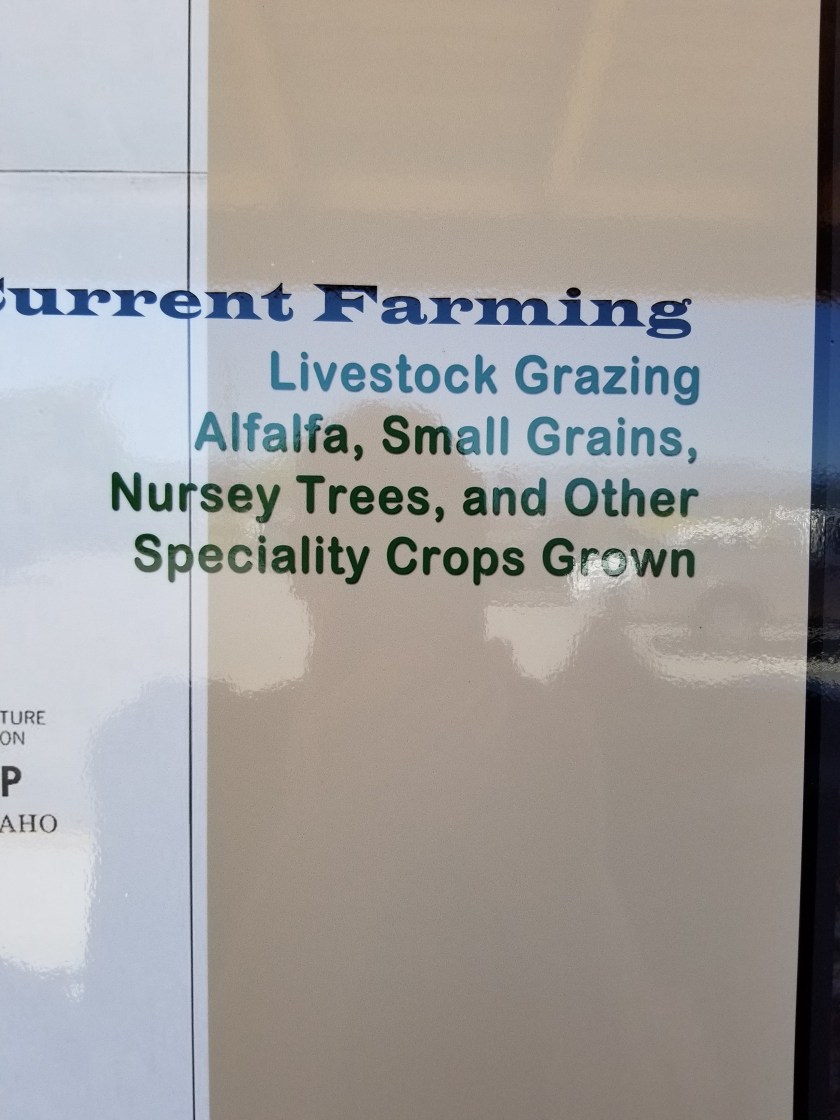
Wouldn’t you know it, one of the first exhibits about farming was a large display contrasting early versus current farming.

I patiently extracted my $2.00 worth of value. They truly had tons of stuff. I’m not sure many people died in Boundary County without naming the historical society as a beneficiary. Indeed, there was a collection of about 30 large wooden clocks. They were all elaborate scroll cut pieces with a generic clock put in it. Clearly these were kits. The blessed retiree obviously spent 1,000s of hours on his hobby. However, I’m sure his long-suffering wife must’ve pleaded like crazy to be sure the entire collection was donated to the historical society to get it out of the house.

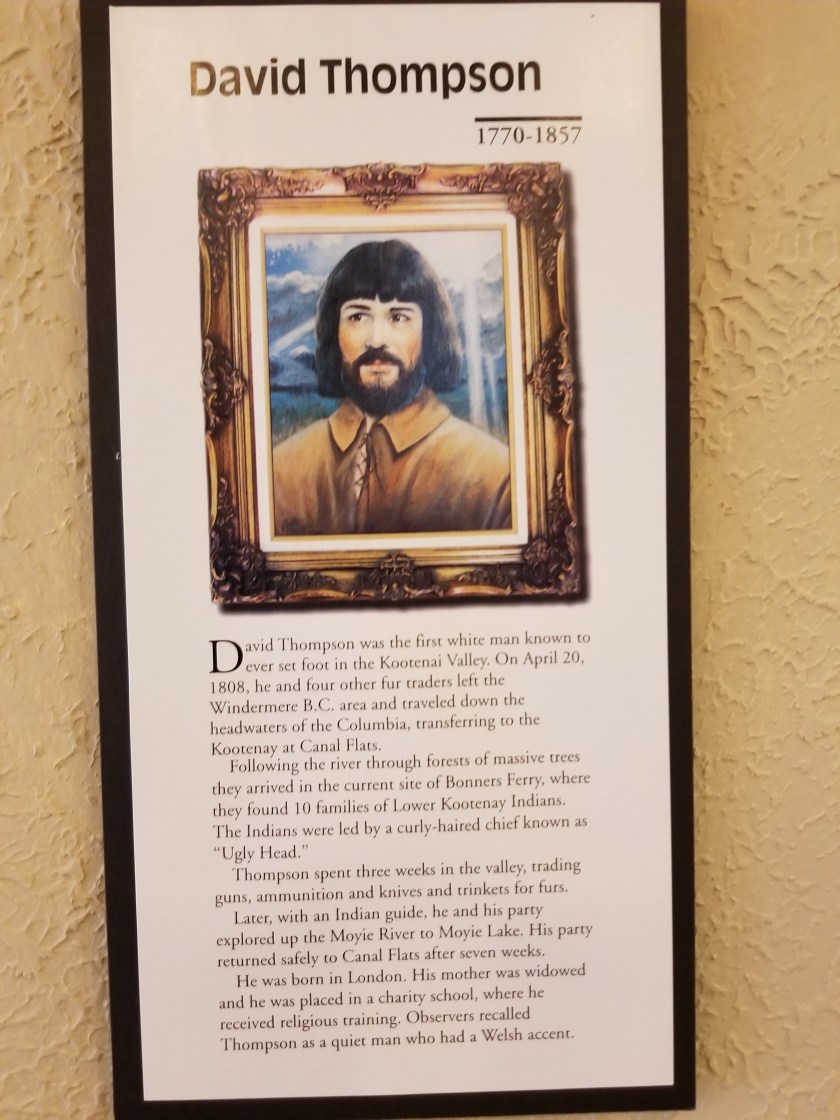
The portrait gallery was surprisingly large if not awfully good. One early hero was painted with quite a fetching style.

There was one truly remarkable exhibit. An albino woodland caribou. Native Americans killed it in the late 1800s and a local saloon owner obtained it and made it his mascot.

At last, I returned to the front. I said “I am not an English teacher, but I cannot find an answer to why Bonners Ferry doesn’t have an apostrophe?” He sighed, looked down at the old newspaper and said “For a long time we tried to correct it, but it just became customary to use Bonners.”

I grumbled my way back to the motel. Letting the matter go was cathartic. After all, we have a grocery store back home established by Russell Lund and it is not called Lund’s, just Lunds. I was hungry and just wished this town had a McDonald’s.

On the walk back I noticed a few pickup trucks with Confederate and US flags flying. The ignorant, hopeful part of me tipped my hat to these scholars who were passionate about state’s rights, but the realistic me accepted I was in the heart of Aryan Nation country.

Leaving Bonners Ferry, I was brooding. It is a beautiful town in a sumptuous valley where the untamed Kootenai River created a fertile flood plain. When the river was dammed, the land could be farmed. Mining and lumber come and go. It would be stunning to have a house on one of the local ridges, catching both sunrise and sunset, witnessing the first snowfall on the all-surrounding mountains or the bright yellow canola crops in the summer. However, like many smaller towns, meth is a problem and there is the white supremacists stigma. However, every worker I met from motel owner to the restaurant employees to librarians were all hard working and considerate. Like Montana, people here look you right in the eye. I like that.

In summary, I am glad I spent a whole day in town. A roadtrip here could be in my future. Maybe I’ll get a modified camper van and call it Kevins Van.

A Beautiful Decline

July 11, 2018 From Bussard Mtn to Highway 95.

I woke up at 5:30 and tried to sleep in. It worked a little, but by 6:30 I was too restless.

The fire still had some embers, amazingly. During the night I had to get up once and there was a glow from the fire on the ground and brilliant starlight above. I had not seen the milky way in two years.

I tried to pack slow knowing I had a lot of waiting ahead. I used some of the miracle water to make sure the fire was totally out. I dispersed the fire stones and used forest debris to mask where the fire had been.

Gathering my food hang, I was finally ready to go. It was glorious hiking.

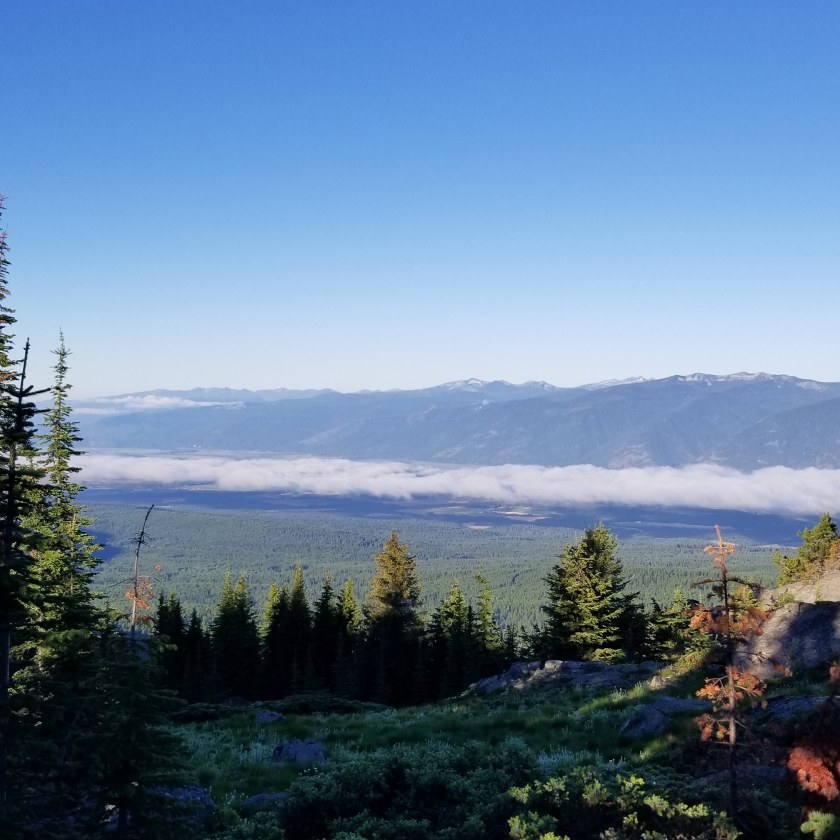
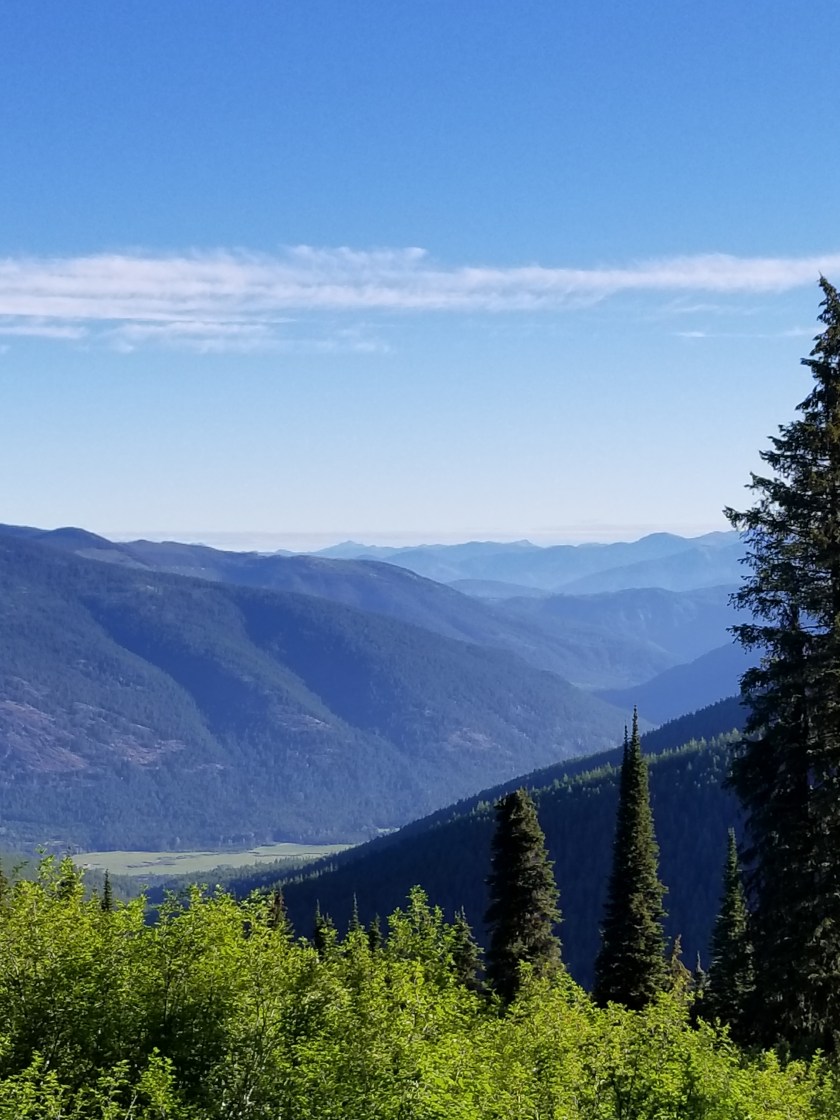
Almost immediately I had views down into the Kootenai valley. There were some low clouds in the valley and the sun shone on the next mountain range to tackle, the Selkirks.

The Kootenai valley was beautiful. Large patches of canola crops made for yellow patchwork.

The other side was beautiful, just without a big valley.

The trail meandered for a few miles. There had been a lot of stabilizing work and trail-raising. I suspect there were motorcycle fees that had been allocated and this trail won. I didn’t mind as long as no motor bikes used it while I was on it :-).

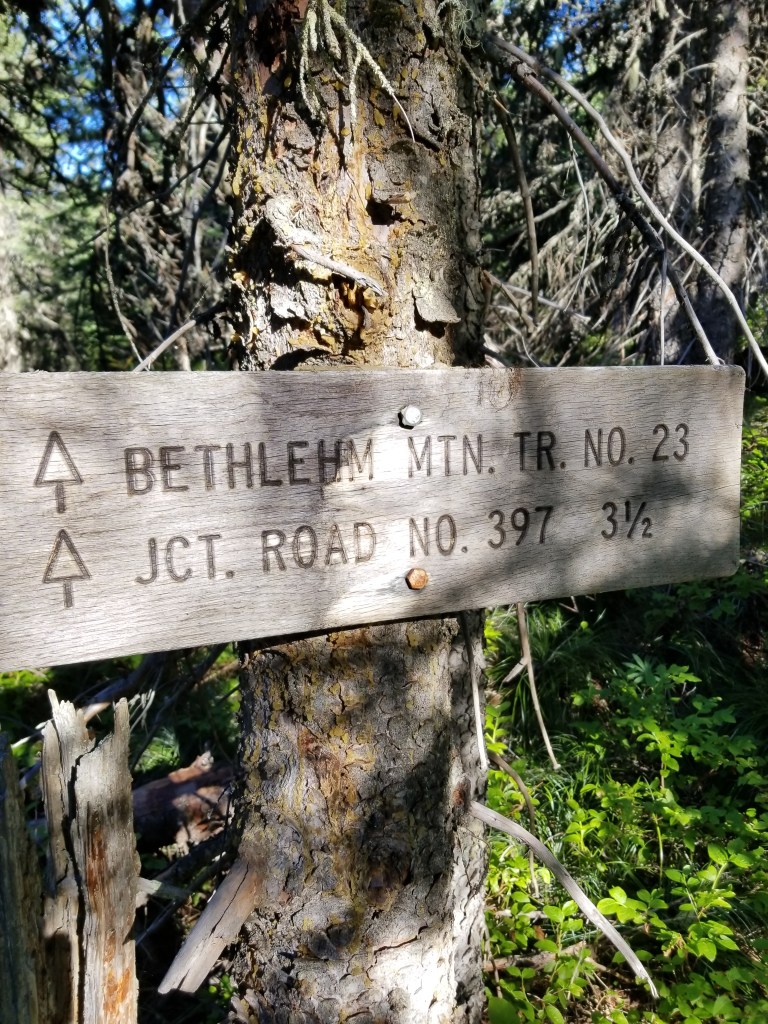
The well-maintained bike trail went right, but my foot trail veered to the left. Of course, the trail sign had misspelled the word Bethlehem.

…and there was no room at the in. Poor baby Jess.

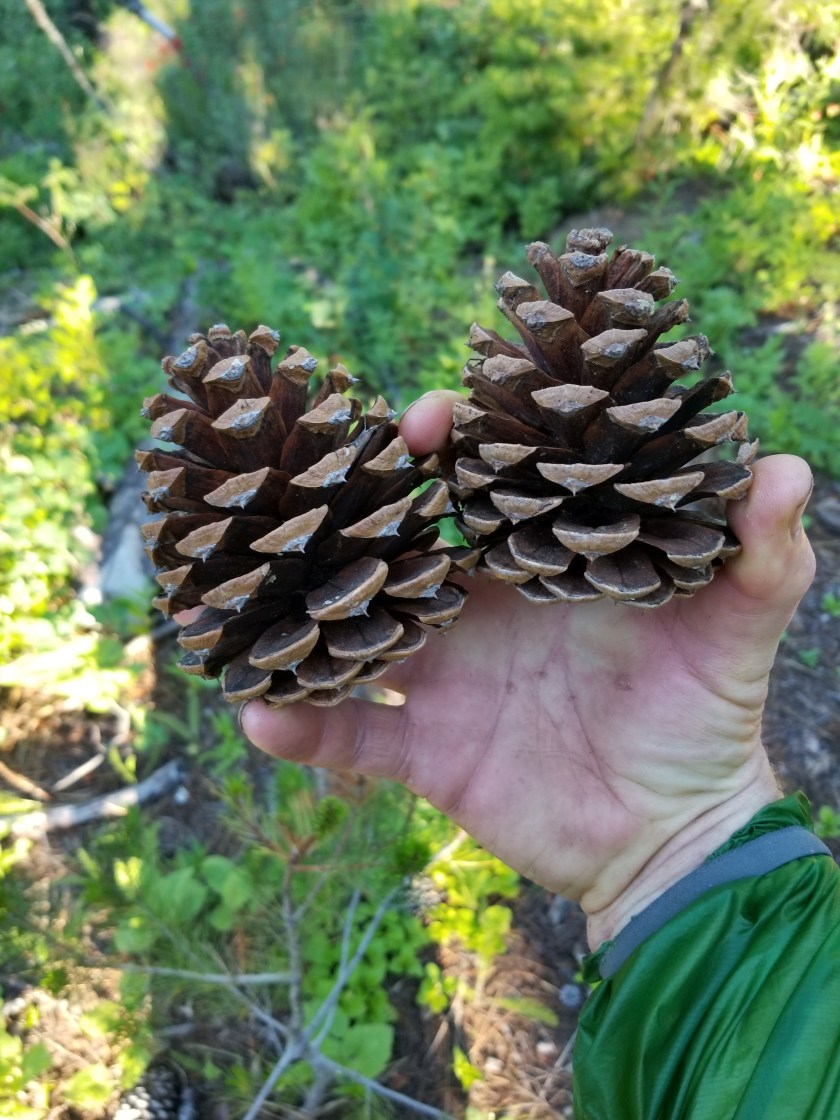
I didn’t mind. As I went down I passed a tree that produced 100s of perfectly shaped pinecones.

There were also some interesting meadows.

These white flowers are about the size of a thumb tip, but can grow in eye-catching clumps.
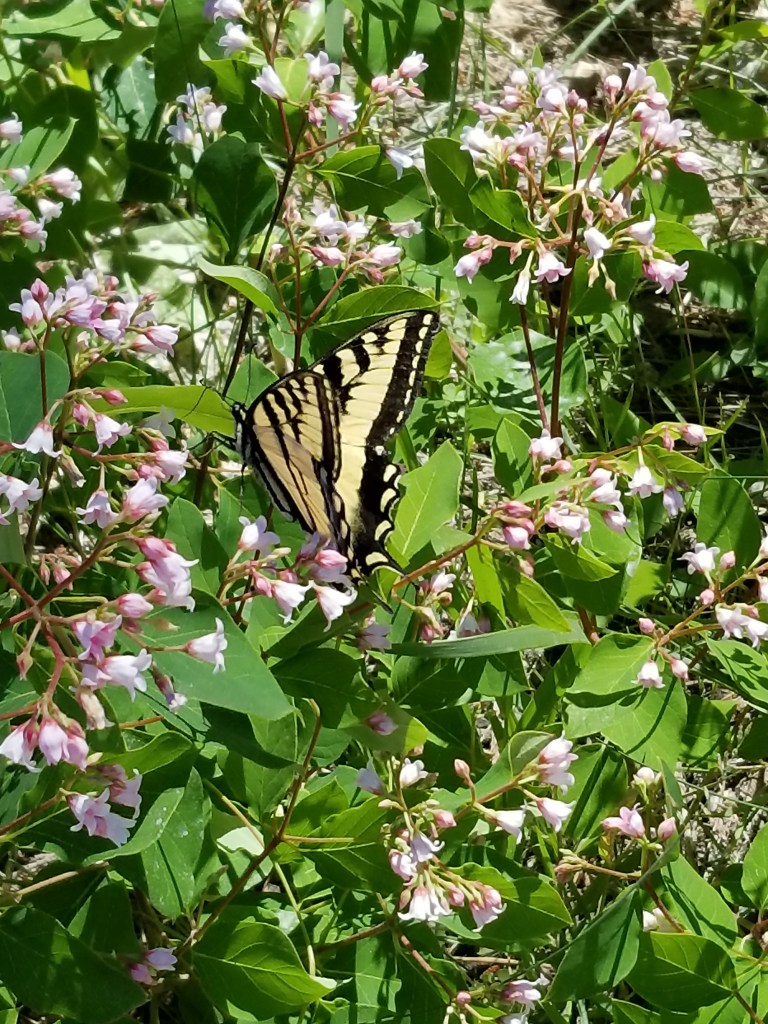
Finally, a butterfly that would hold still.
This burned tree had about 80% burned through but still stood.

Alas, I arrived at highway 95. I had four hours before the trail angel in town could pick me up. I tried hitchhiking, but it was not an ideal spot. Mostly trucks, family vacation mobiles, and Canadians. After an hour, I gave up, found some shade and waited.

Finally, Sharlene arrived. She was very helpful and thoughtful. She had started section hiking the AT a few years back and found out about the trail angel concept. Coincidentally, after noticing some backpackers in town, she discovered the PNT was in her backyard and desperately needed a trail angel.

I checked in to my motel, the Kootenai Valley Inn. My first reaction was Whiskey Tango Foxtrot, we have a situation. The outside of the office was a decaying mess and the office was a barren room, like a murder had occurredand they had just finished removing the blood-stained carpets and walls.

Ed, the brand new owner, quickly put me at ease. He and his brother had purchased the place as a semi-retirement activity. He was clearly busting his hump and there were some diamonds in this rough. My room was clean and the carpet had been deep cleaned. The bathroom was sparkling.

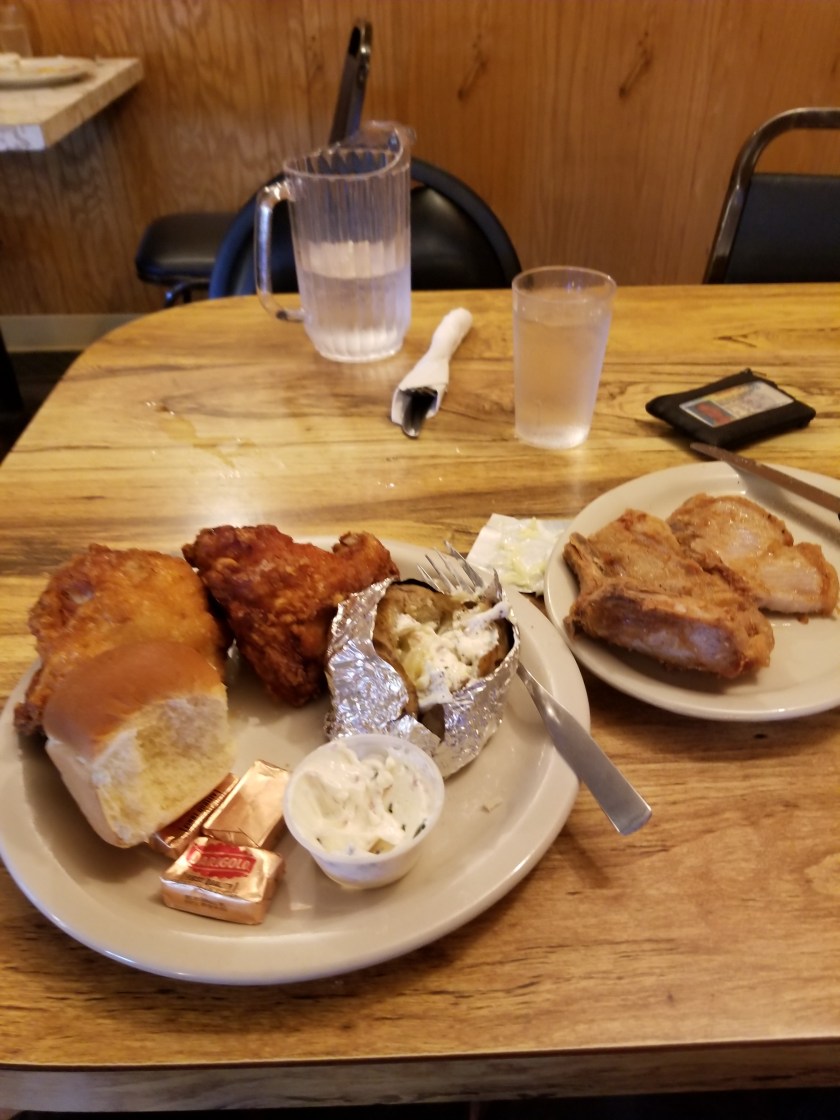
Next door was a restaurant that both Sharlene and Ed recommended. They both called it the “chicken chop.” I went there. It was “Chic-n-Chop” and while the name made no sense they had classic dinner choices. I don’t know about you, but when I’ve been eating couscous, lentils, and quinoa, I’m jumping all over the special of two pork chops, two broasted chicken pieces, a biscuit and baked potato.

In fairness, I did order a full dinner salad first.

I was asleep by 9:30.