To Hell with Roadwalking

July 31, 2018. From Oroville to Goodenough Mountain.

Not sure whether I’ve done the math here before, but I generally pack about 2 1/2 pounds of food per day. Seven days of food is thus 21 pounds.

I bring this up because there is a “taxi” service that could take me from the motel over 28 miles of paved roads to the start of a dirt road incline leading to the mountains. Given pack weight, temperatures around 100, and scenic value (nil), I broke down and took the taxi.

It was $40 for about 45 minutes through arid canyon country. Dan, the driver, seemed to only give hikers lifts. He refused to go up the dirt road that rose out of the canyon saying the road was too rough for his sedan.

I got dropped at the bottom of the Chopaka road. The air was smokey and warm, the road steep, and the valley below a sprawling cattle operation. I huffed and puffed my way up the hill and noted how very smooth the road was. If I were an entrepreneur in Oroville, I would offer rides up to the trail junction for $50.
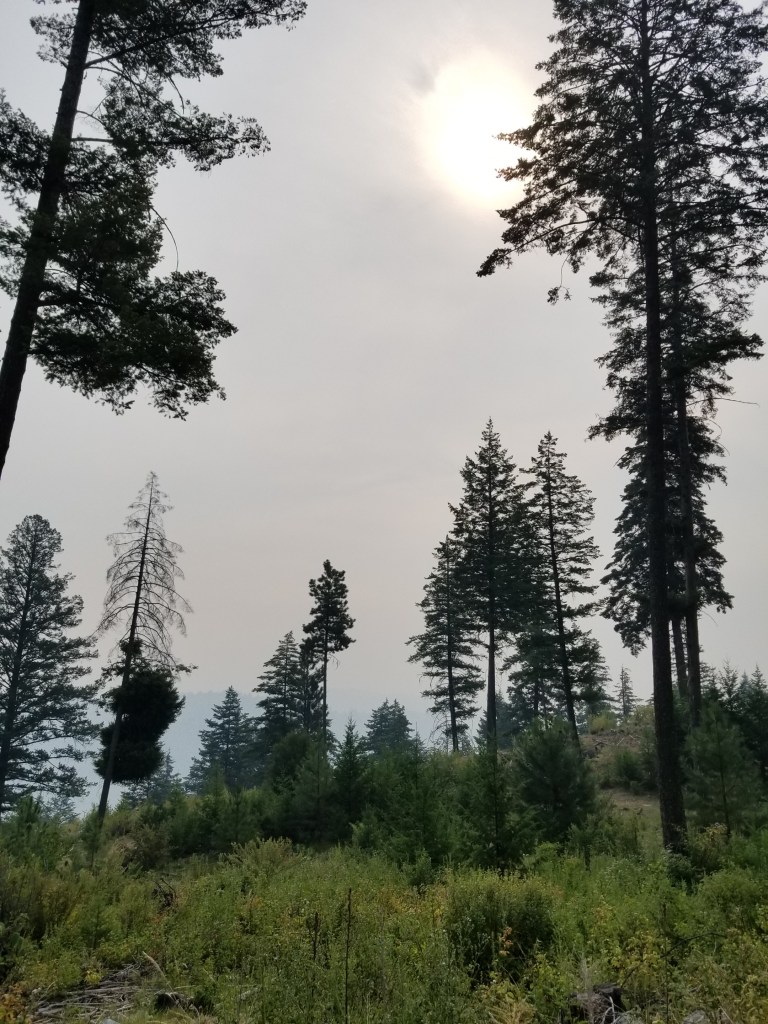
Sun still blocked by smoke at 10:30 am.

Eerily, I was getting water, and I heard a strange whirring sound. I looked uphill for the source. It was two guys on motorcycles rolling downhill with their engines off. They were clad in black and did not acknowledge me.

Around 11:30 I left the dirt road and followed an abandoned jeep trail. I would catch glimpses of footprints and could see Jackson’s.

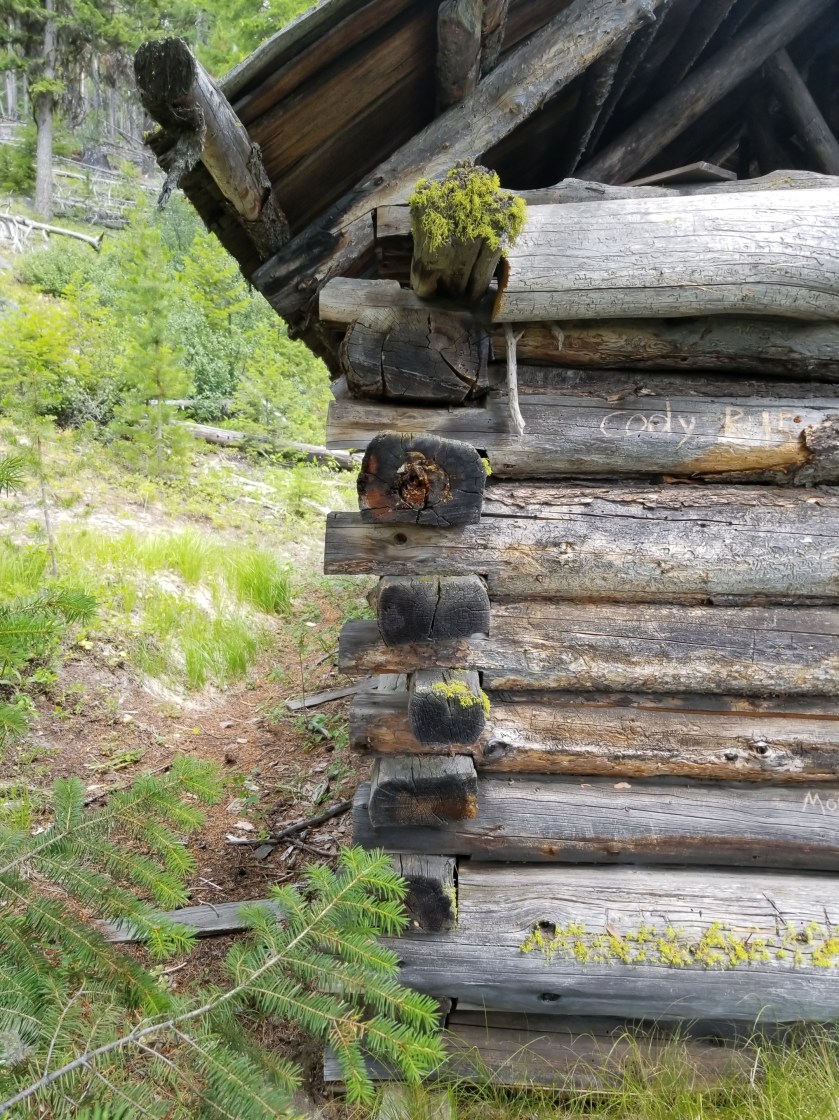
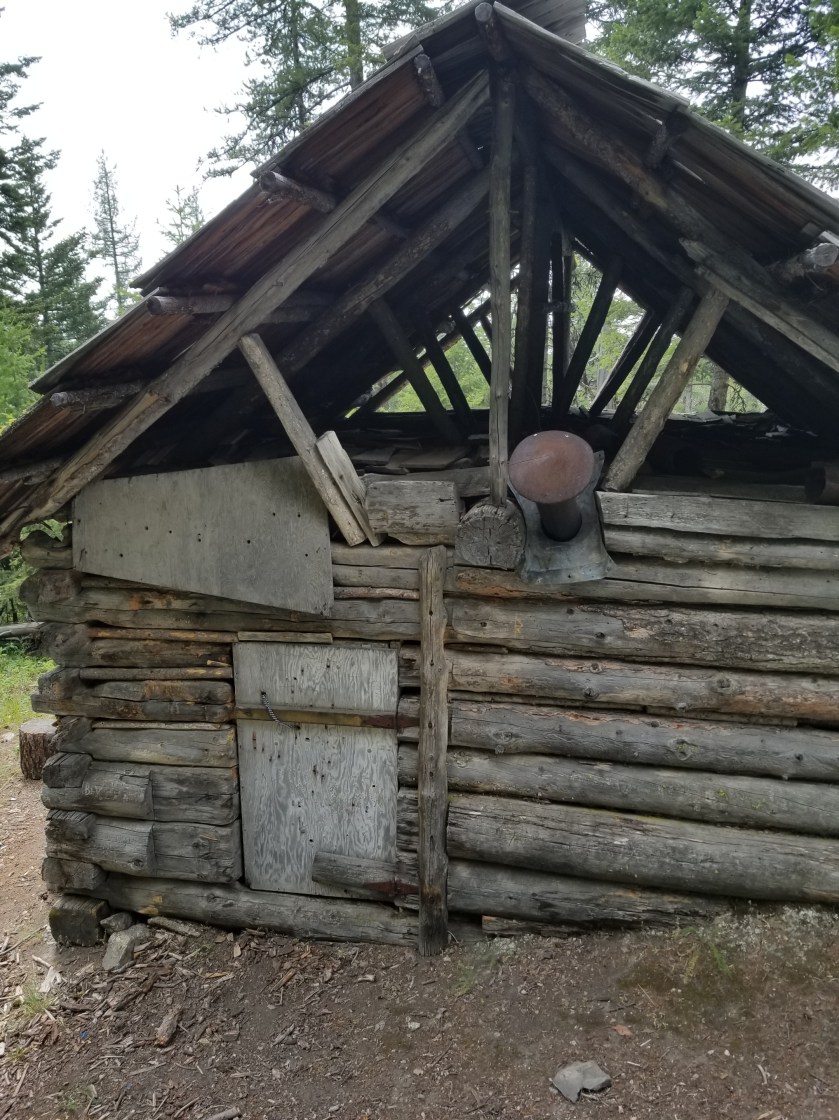
I passed an abandoned mine and cabin. Later, there was also an abandoned cowboy cabin in the appropriately named beef pasture. Cabins have an irresistible draw to Americans, conveying comfort, coziness, and peace. In reality, they were often harsh places of respite for hardworking folks at the fringe.
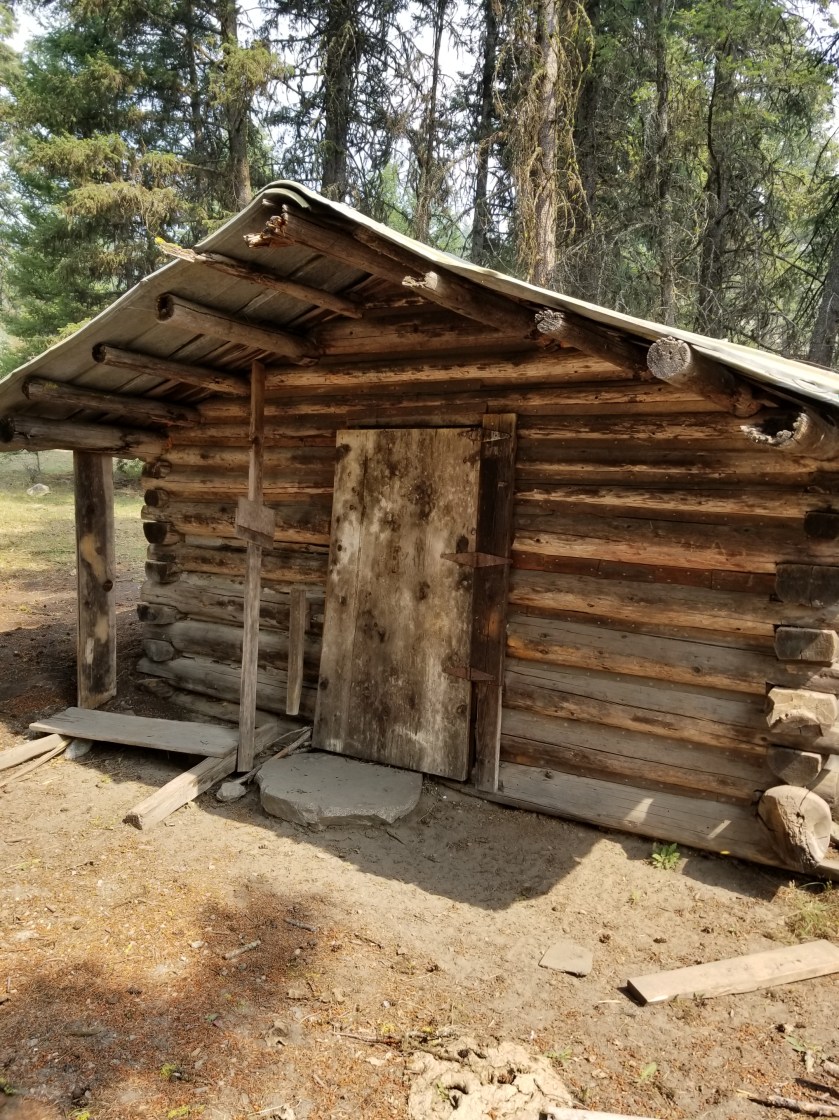
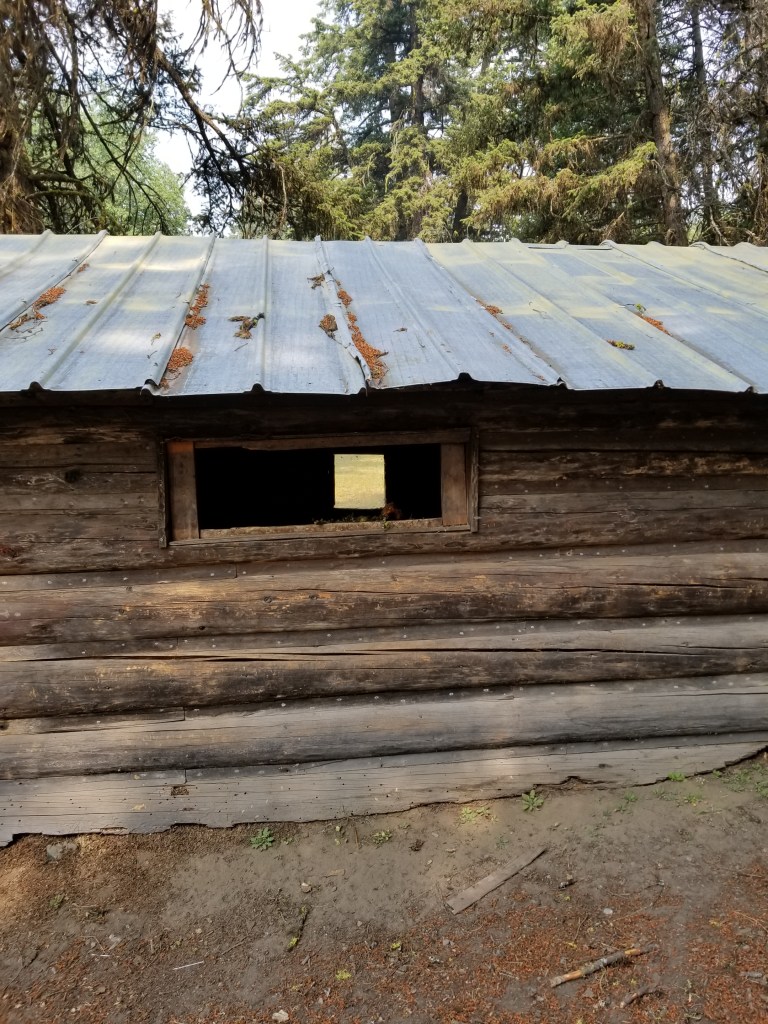
This side had the panoramic window.

The trail basically disappeared heading uphill in a meadow. Being an overachiever, I walked a quarter mile uphill further than I needed to. It was cooler in the mountains, but still the temp must’ve been upper 80s.

Thankfully, a beautiful developed spring was on the route. The water was so refreshing and cold. I downed a liter and a half, figuring I would rather carry the water in me than on me.

The trail got worse. Basically it was an abandoned jeep road that was crisscrossed by cow paths. At some point, it joined a real road. I decided to stay on the unabandoned road and it looked like it would intercept the next main route. Even when the road turned severely in the other direction, I rationalized that I was at least walking faster than I would’ve been on the official route. Eventually, my long-cut turned out ok, adding only an extra mile and a few hundred more feet in uphill elevation, the cost of stubbornness.

After the trail/road leveled out some, the wind picked up from the west and the temperature dropped a bit. The mosquitoes were gone. Unfortunately, that was because the flies were so pervasive no living thing remained for the mosquitoes to eat.

I passed a very impressive campground developed by the Okanogan Valley Back Country Horsemen, the same organization that built out Whistler Canyon and also the Fourth of July Trail. These guys were busy. And they did great work. They weren’t horsing around. (Sorry, that sounded really funny in my trail mind.)
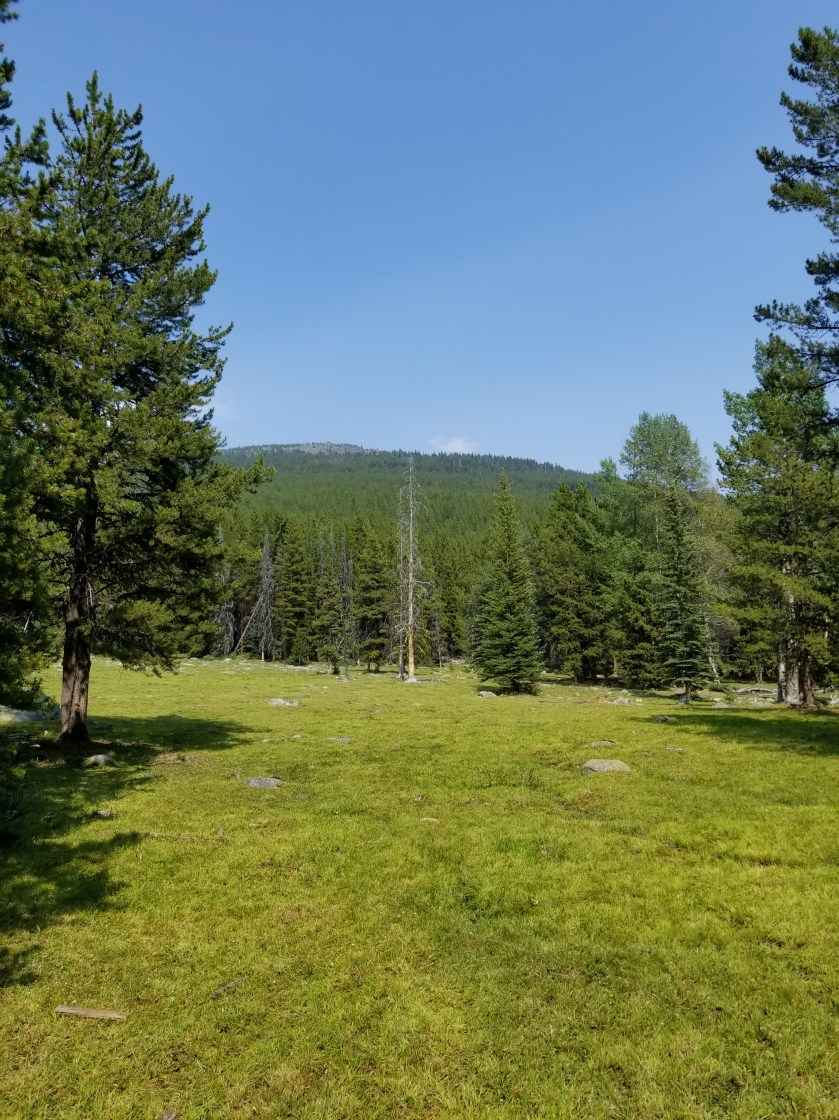
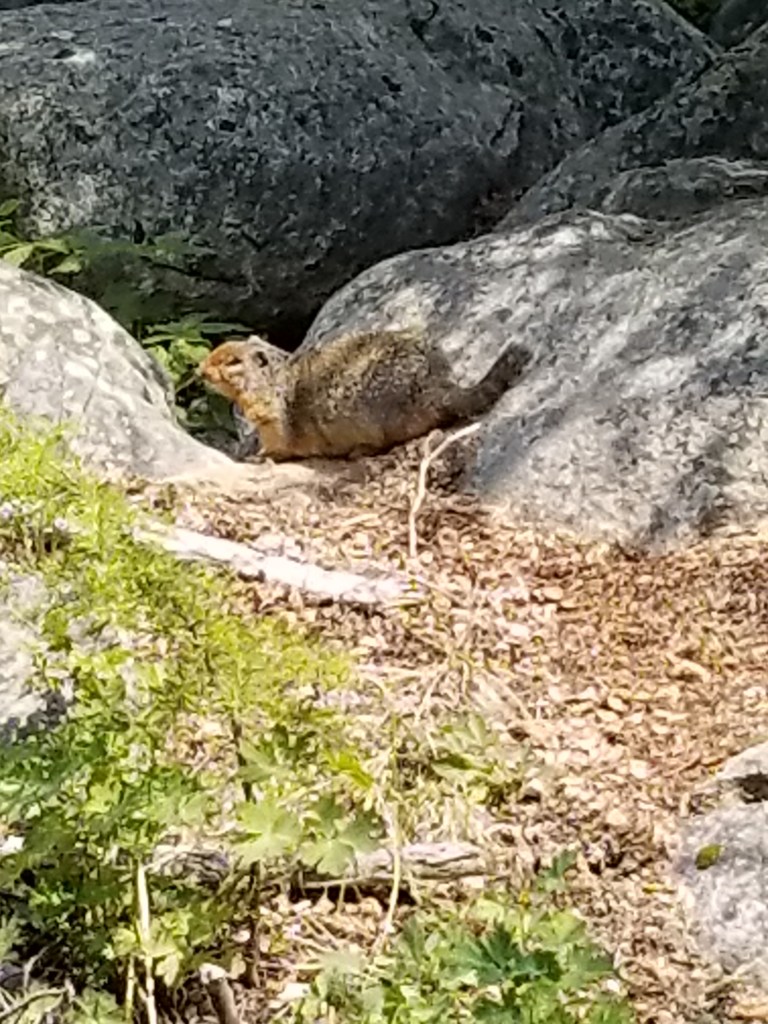
A species I know to be a “Fattie”

After meandering on a wide dusty trail, I eventually came to another burn area. I needed to pass through this and climb to my targeted campsite: a saddle high up in Pasayten Wilderness.

Remarkably, the trail through the burn was good. At 6:00, I hydrated my dinner and tanked up on water, knowing I was sleeping up high. The small stream had some big trout.

I climbed Goodenough Mountain. The trail was clear at the start. I was glad that I was able to steadily climb despite a long day, heavy food, and four liters of water. About halfway up, though, it all went to hell in a hand basket. Some hikers went one way, the cows another. Fortunately, I guessed right: I went with the cows.

Cutting across the grassy face of the mountain, I came across some small springs.
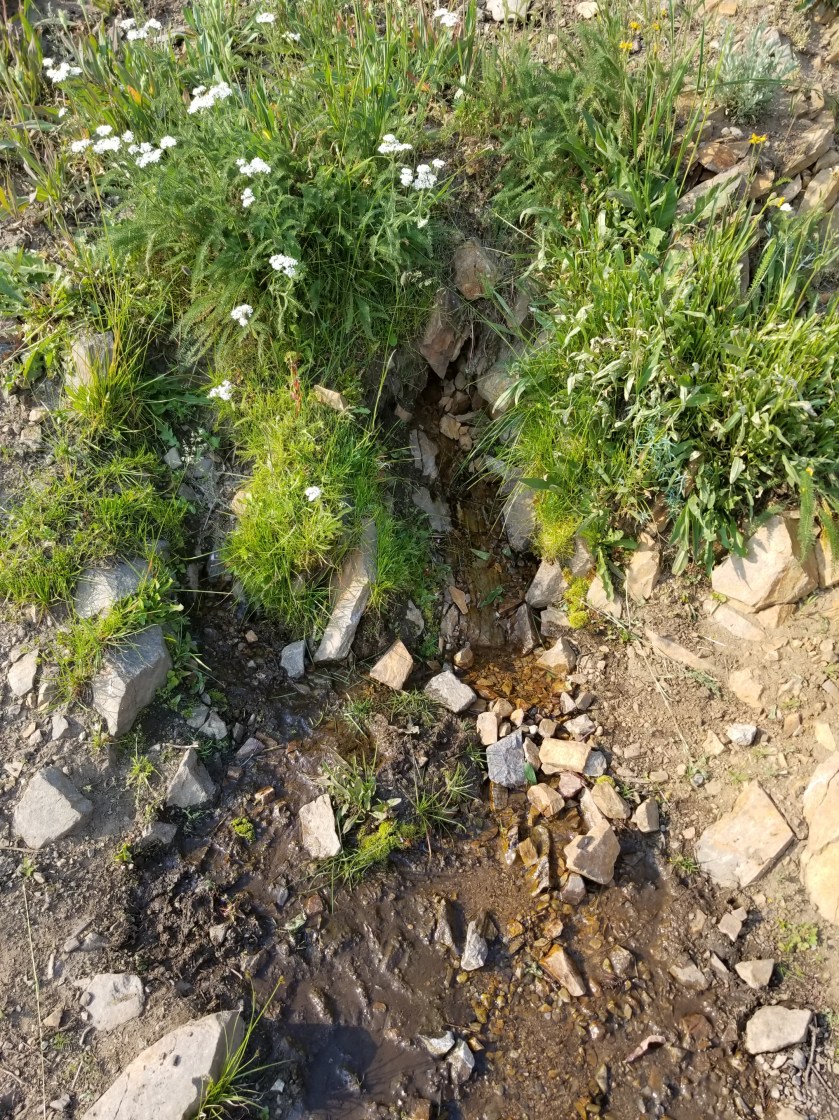
Then, I ran into a small herd of cows and calfs. We danced the timeless dance of them running up the trail, me eventually catching up with them, and repeat. However, one of the cows was at the evolutionary vanguard and led the herd off the trail. Better yet, this was right before the trail led to a refurbished spring with a water tank and cold water.

Around 7:30 I reached the edge of the Wilderness.
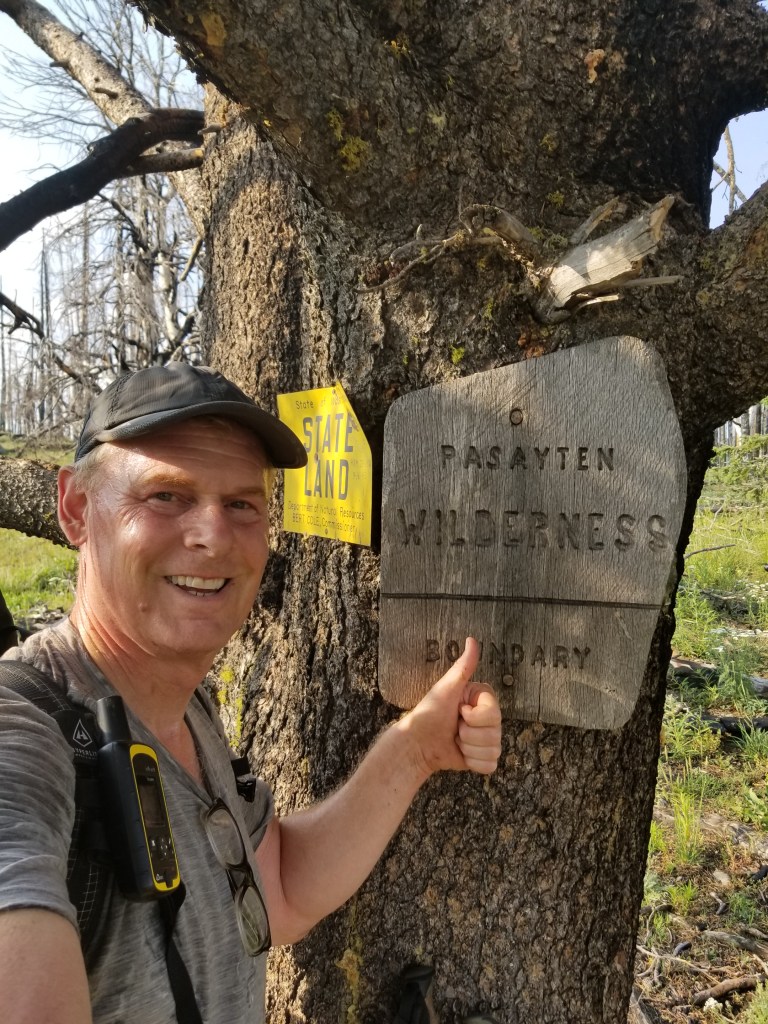
Hard to believe this was a fake, forced smile.

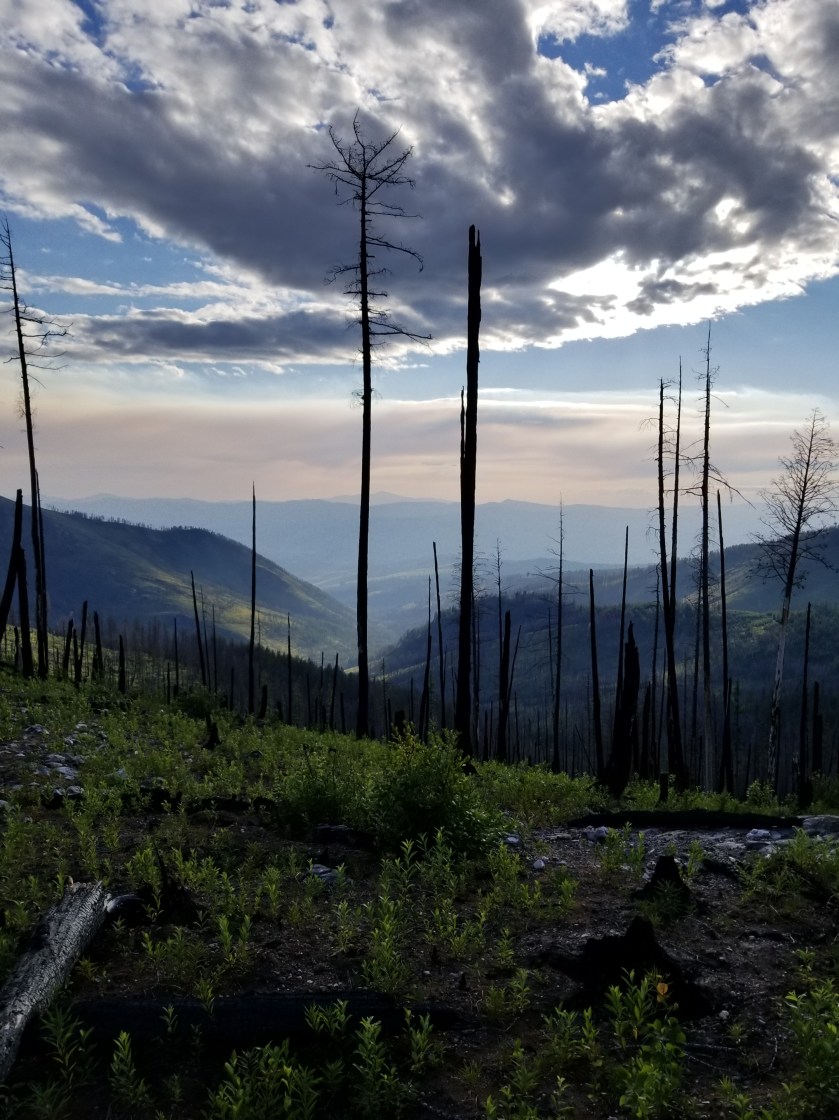
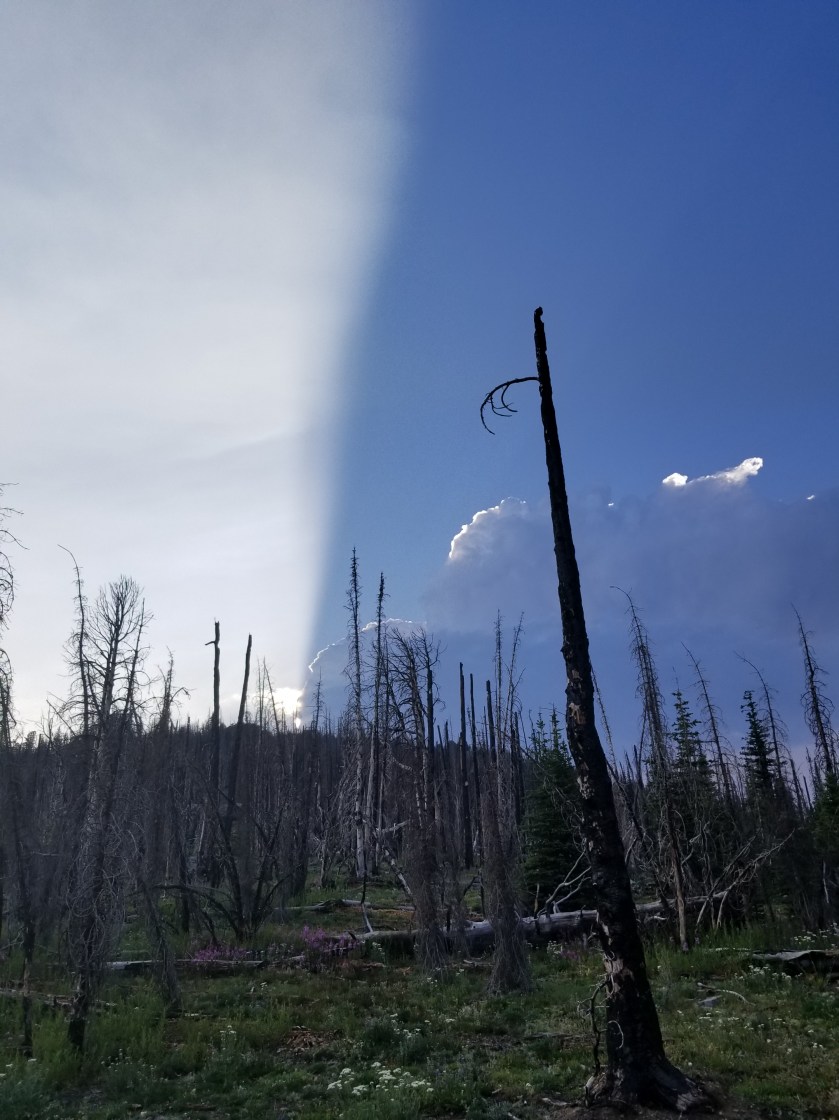
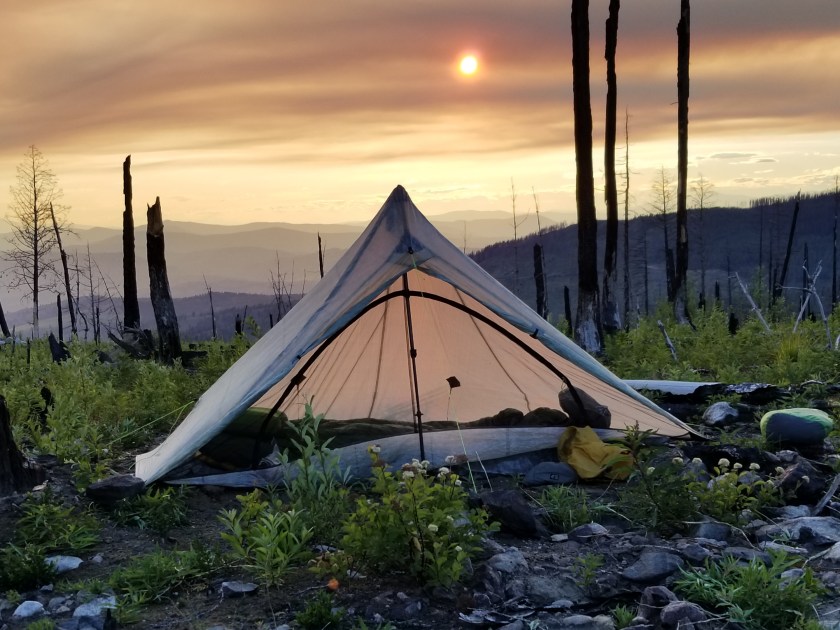
I was exhausted, but needed to get a good campsite. This was a bit of a challenge because the top of the mountain had been burned in the fire. Combine standing dead, burned trees with the winds common on a mountain top, and camp selection gets tricky. At times like this I wished I had paid closer attention in geometry so I could figure where trees would fall and where I would be clear.

Eventually, I found a place about 100 feet off the trail. Ironically, Jackson’s footprints were there, too. He may have been looking for a campsite, but for sure he was likely taking a look at the smoke plume from the Canadian fire.
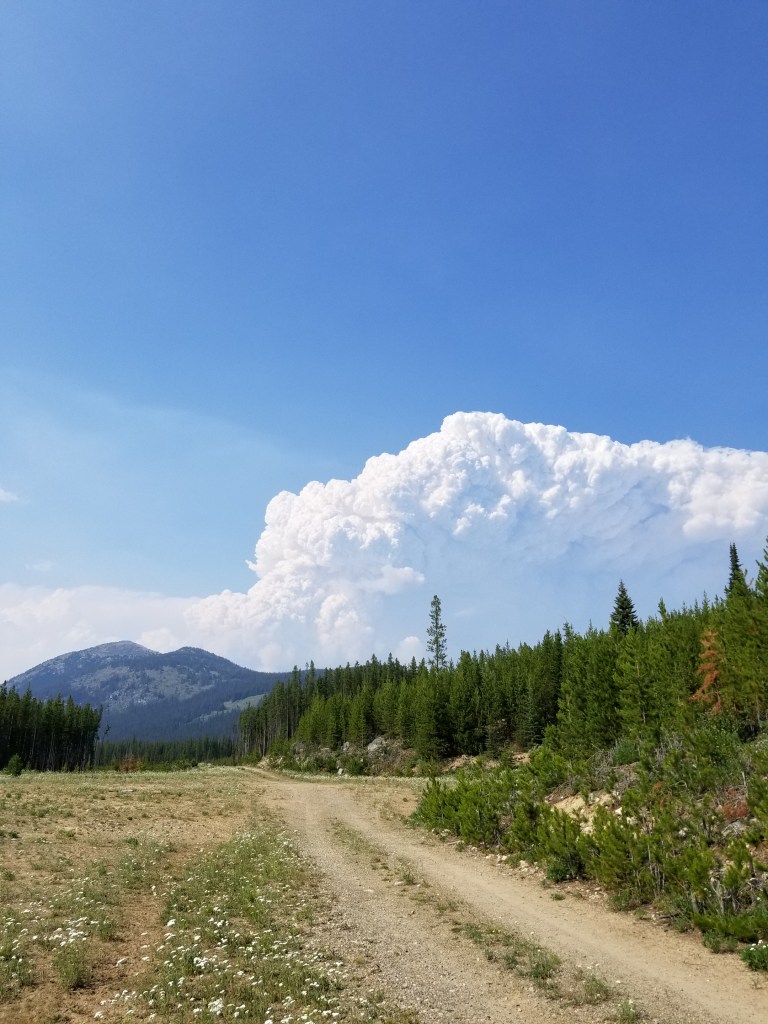
The plume was impressive from the gravel road below Goodenough.

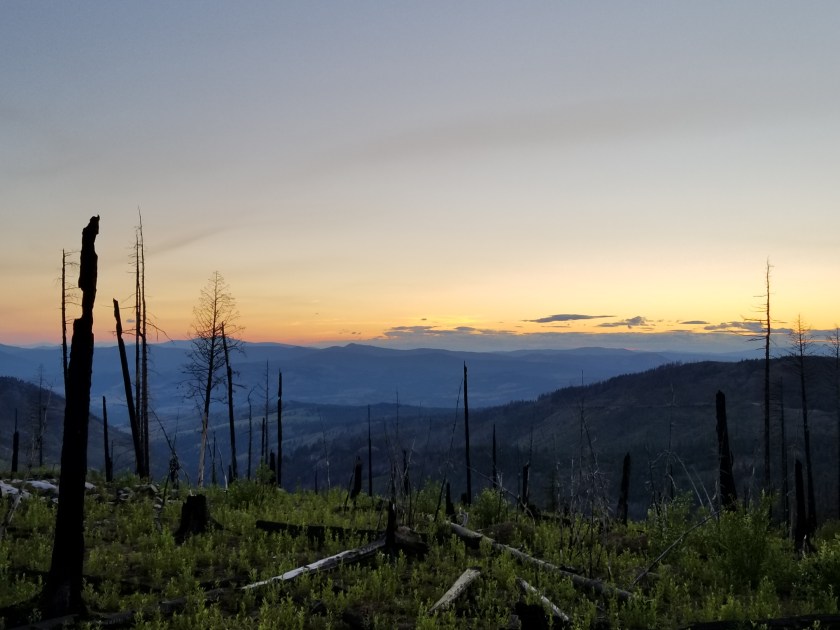
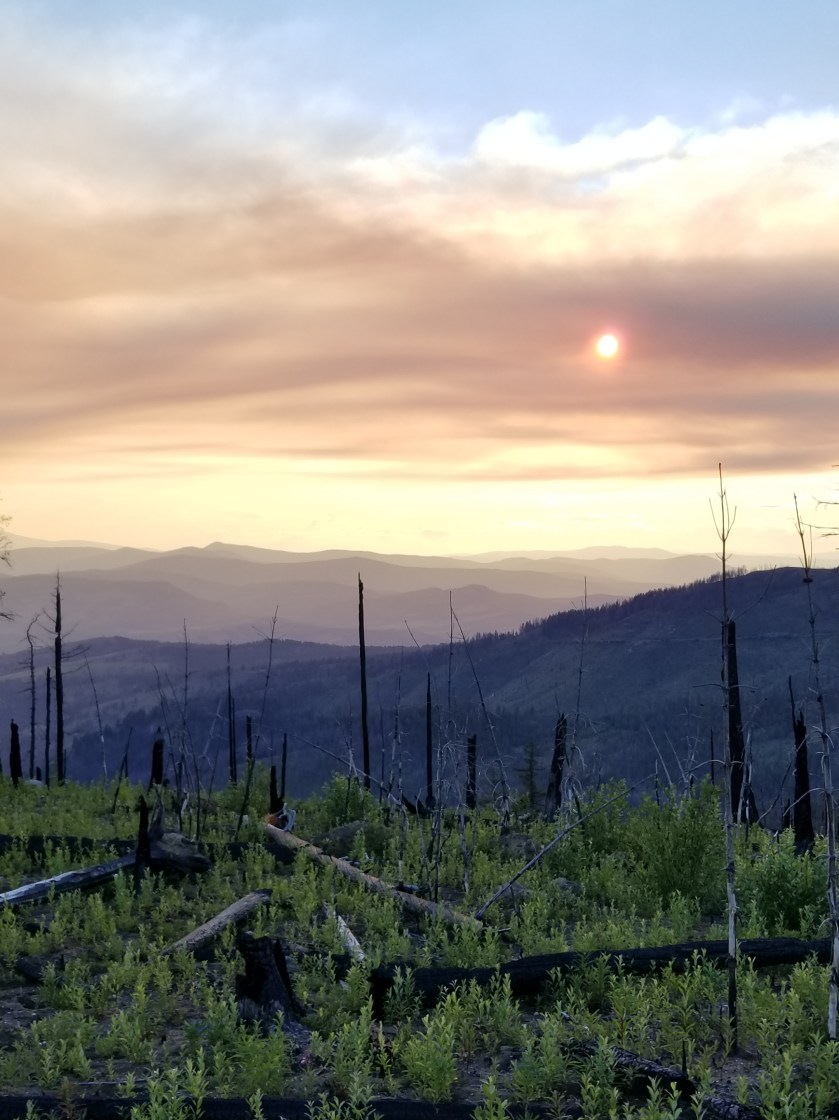
There were some interesting sunset pictures. Fortunately, the strong western wind died down and I fell asleep up high in the charred forest waiting for the moon to rise.
Oroville

July 29th and 30th, 2018. Oroville, WA.

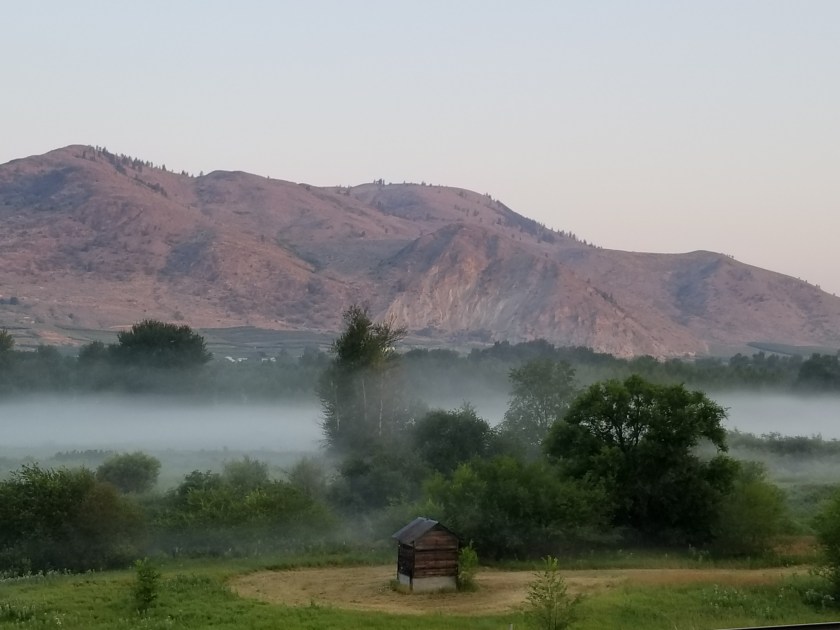
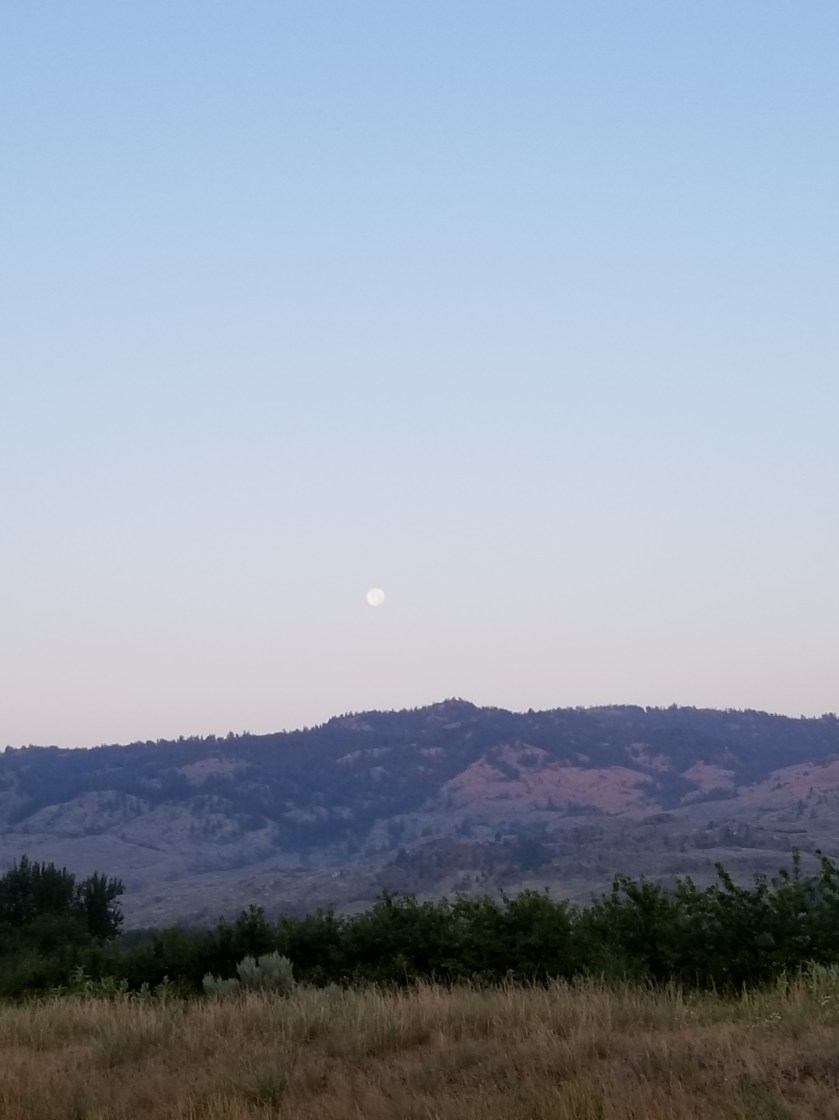
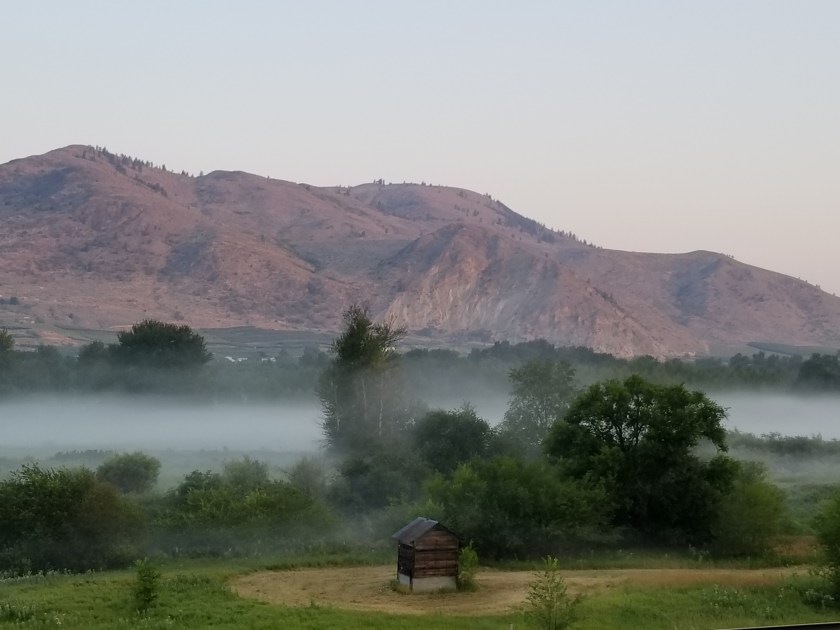
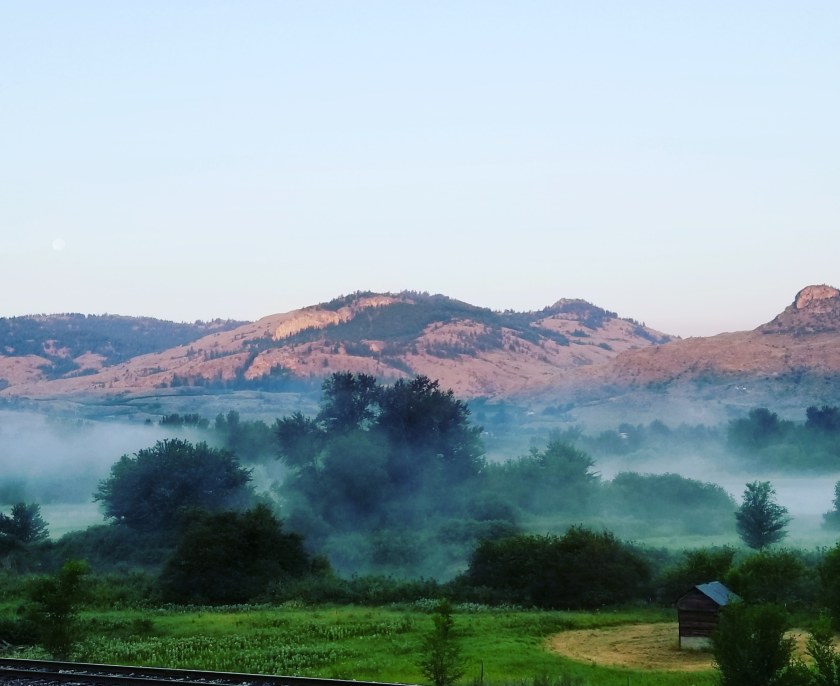
I road walked in to Oroville. Nice fog clung low over the river, the sun slowly rose over the mountains to the east chasing the full moon as it sank over the western hills.

Early morning to Oroville

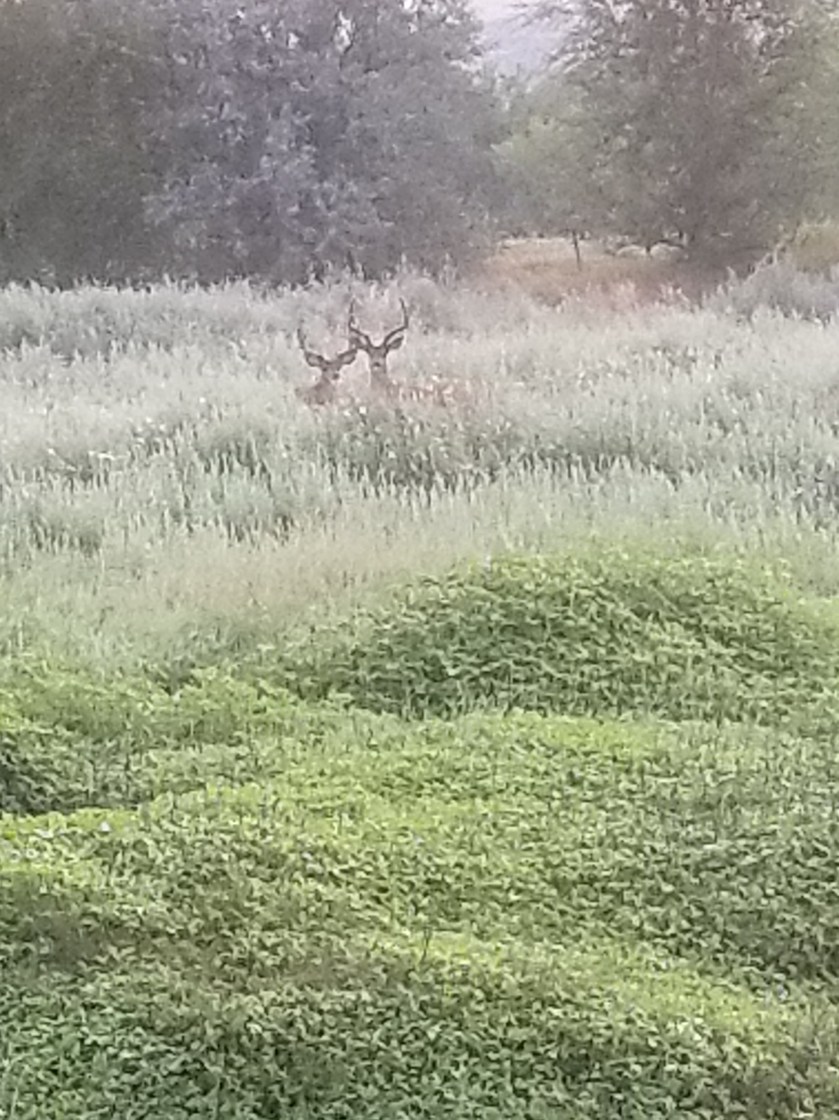
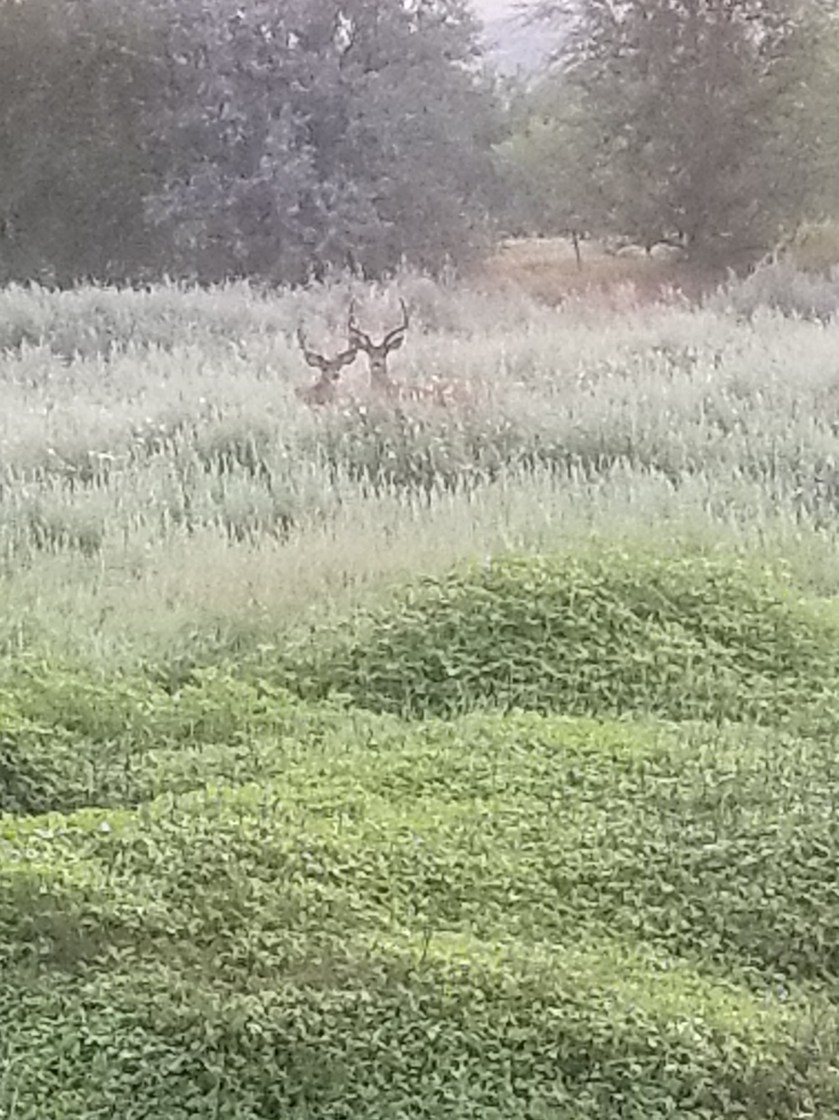
Two bucks were just waking up when I annoyed them.

I love early morning in small towns. I knew the earliest any restaurant opened was 7, so I stopped at an ATM and then went to a gas station for coffee.

I waited outside the restaurant. An older, local gentleman and I chatted about the trail and his town. When they opened, he sat in the middle of a long table with a couple of friends who arrived just at 7:00. Over the next 45 minutes, he held court over about 10 other guys who came and went, including two with sidearms. Another beauty of small towns is the informal network. I’m guessing these guys were mostly bachelors or widowers.

The Camaray Motel is definitely backpacker friendly. They have loaner bikes to get around town, free laundry, and a few other things. Sandy, a whirling dervish of a woman, checked me in very early and got me situated.

My resupply box had a plastic bag around it. Inside was a note explaining the USPS was sorry, but another package spilled a solvent all over mine. But it was okay, in their infinite wisdom. My maps and a few things did reek of fuel, but thankfully none of the food was fouled.

It was hot and smoggy, a little bit of L.A. There was a large fire in Canada. Temperatures hovered around 100 degrees and the valley trapped both heat and smoke.

Oroville is now mostly agricultural. The feeling I got was that this town might make it. Sure, there were the usual shuttered businesses and the five second-hand / collectibles stores, four more than needed. But the businesses that operated were busy. It is less than 10 miles to the Canadian border. Plus, there seemed to be an above average number motorcyclists.

There were two Mexican restaurants in town. The motel recommended the one across the street. It was okay, tasting just like every other Mexican restaurant. Everyone in there was caucasian. Later, when I went to the grocery I passed the other one and it was definitely more of a Hispanic crowd; should’ve gone there.

The first morning I saw Jackson at breakfast. He was heading out after a night at the motel. Later, I met Snowberry. We had dinner at the brew pub in town. It was nice to visit with another backpacker my age. She had an interesting life, has overcome some real challenges, and definitely had an intelligent view on life.

I finished packing and got ready. It was going to be at least seven days in the Pasayten Wilderness, a section I was very much looking forward to.

Intermezzo

So I am leaving Oroville. I travel through the Pasayten Wilderness area for seven days. Although tomorrow is supposed to reach 102 here, it should start cooling off.

My next stop is Ross Lake Resort. Google it, as it is quite unique. I can only pickup my resupply package. With luck, I may be able to charge my electronics.

From there, I have another seven days before I reach a town.

The point? I have some serious backpacking ahead with little ability to write or send blog posts. Battery power will be reserved for my satellite communication device.

So, be patient. Assume I am not dead. And hopefully I can post again in a few weeks. Unless I am dead, of course.
Wait up.

Morning fog on the way to Oroville.
Two bucks in the morning dew outside Oroville.
To the Edge

July 28th. 2018. Stealth camp to Whistler Canyon Trailhead.

Immediately, I could tell it was going to be a hot day. I cruised downhill through a ranch. Some cattle, instead of running, treat you like a rock star. This herd started coming towards me so I thought they were going to crowd me.

This morning I could choose between a quiet public road for 5 miles or an official quiet public road plus a trail that gained and lost 700 feet over 10 miles. I chose the former.

I met an older lady on her way downhill to a Saturday morning yoga class. She loved living up high in the woods.

Eventually, I came to an area where the road walk and official trail met. For the next ten miles I’d follow a trail a group of local horsemen had developed. Up high, it was hot and sunny. For the first time, I got to the point where I just found a shady spot and took a power nap. I awoke refreshed. Within 100 steps, I looked back to see the PNT hiker from Bonaparte Lake.

We hiked together for the next few hours as the trail descended to the valley where Oroville awaited. He was young and enthusiastic about many things. He was going to hitch in to town. Knowing I had two nights of reservations ahead already, I opted to camp at the trailhead on the edge of town (technically 2 1/2 miles, but to a backpacker that’s an edge).

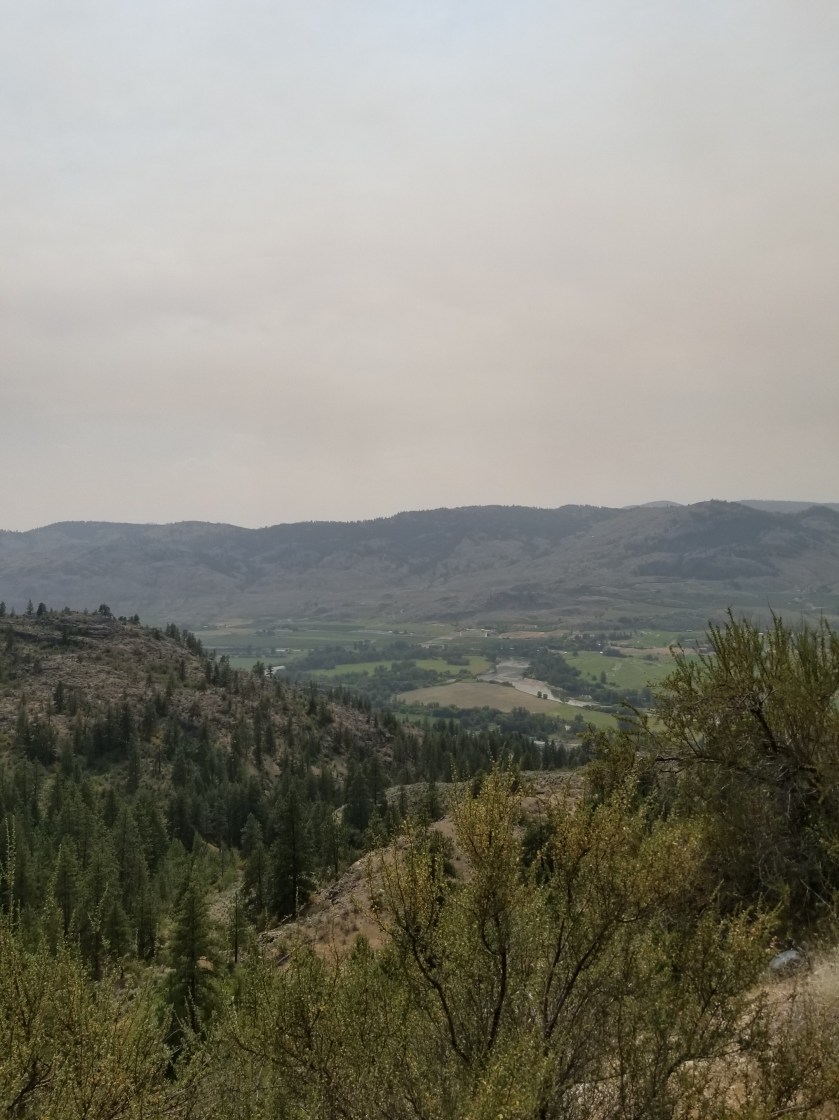
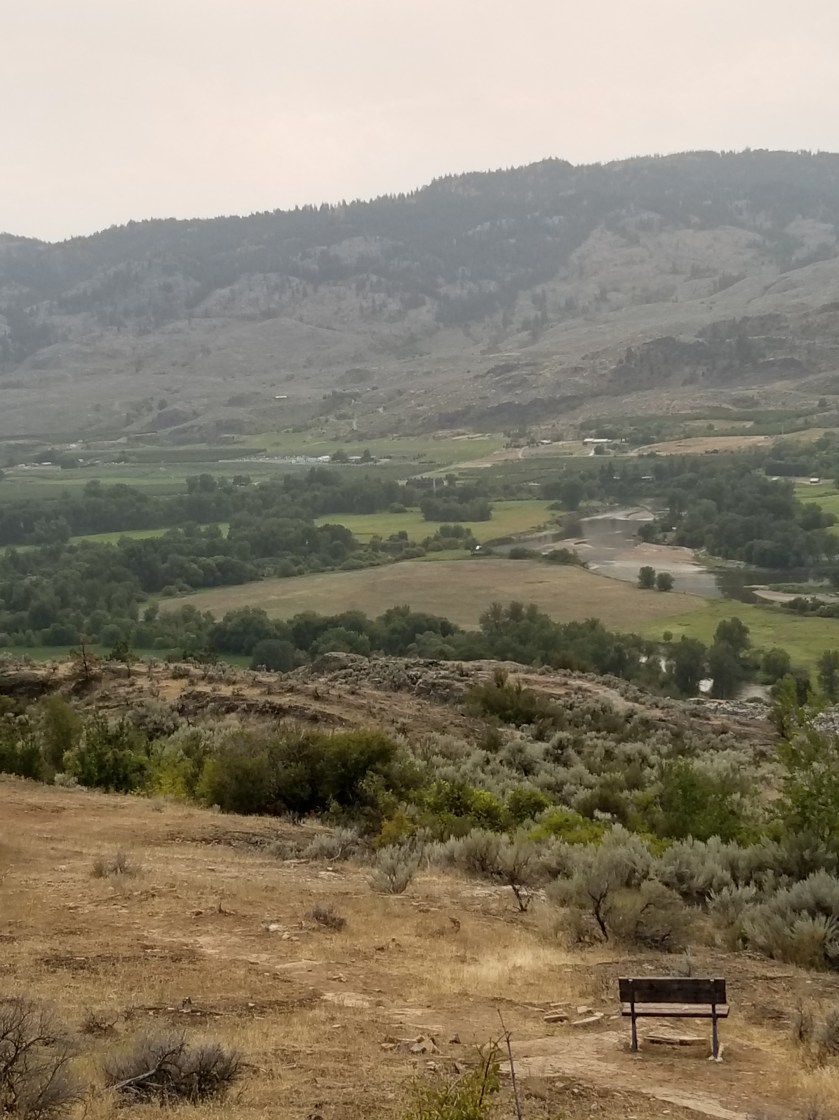
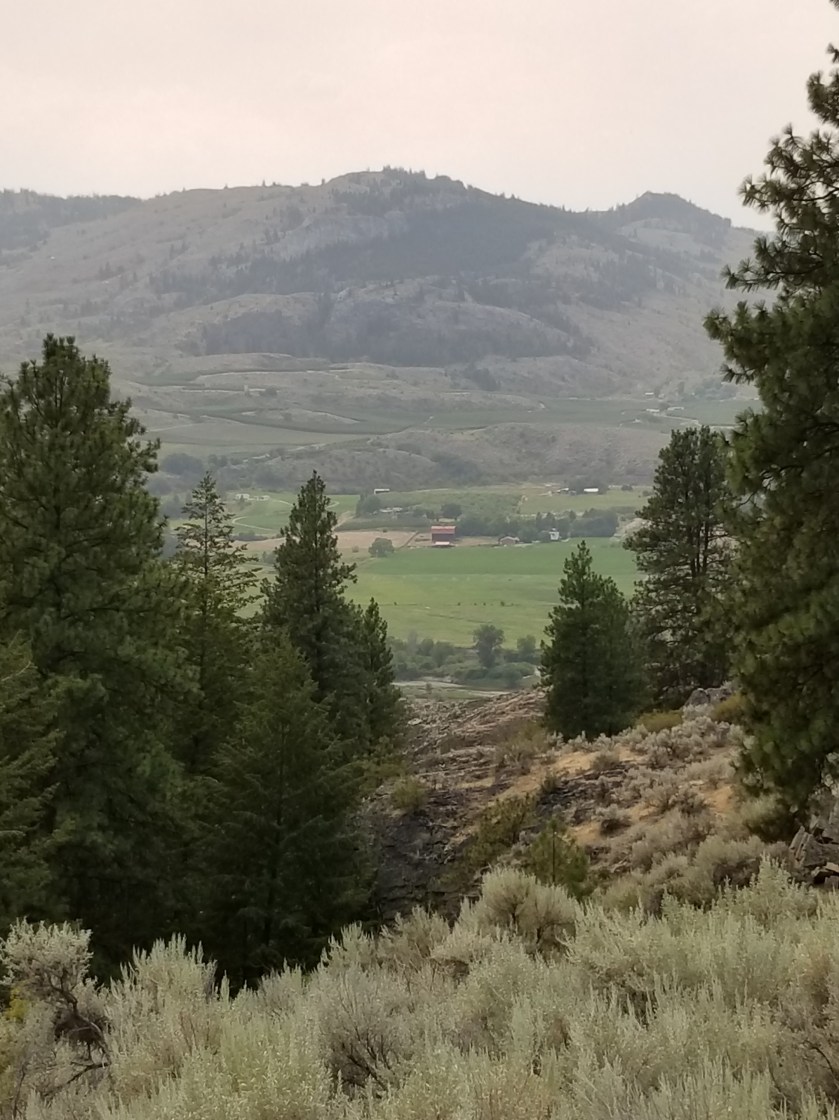
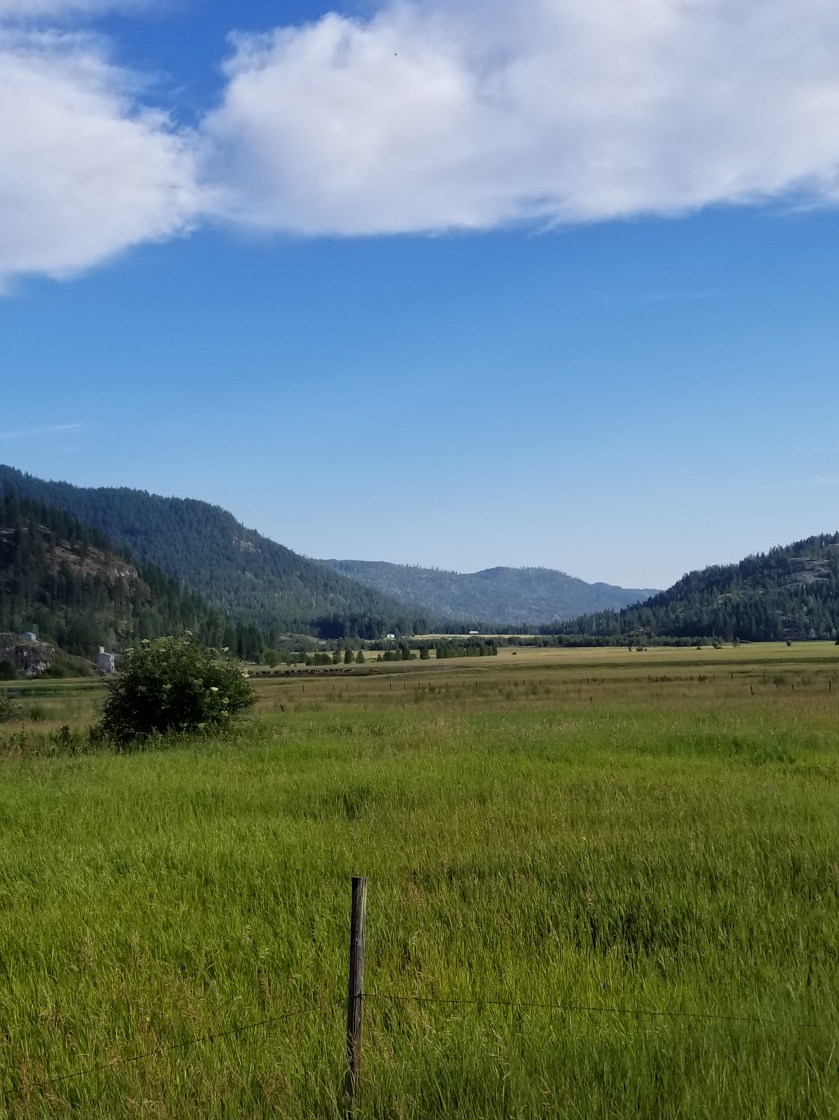
Though smokey. You could see the valley below.

Nearing the bottom, there was a sign mentioning an alternate trail with a water crossing and then a connection to “W.C.” The main trail was just to connect to “W.C.” While I am not British, I could not figure out why trail signs out here would suddenly reference water closets. Still, I needed water and cut over to the alternate, wishing my fellow hiker good luck. “W.C” stood for Whistler Canyon, the local trail name.

Just a few yards from the main trail, the alternate revealed a gurgling stream. There were a couple teens there trying to make out. I awkwardly blurted out “I’m just getting some water” and went past them upstream 30 feet. As the Dad of daughters, I fought hard to keep from asking the girl if her Dad knew she was up here with this loser.

With enough water to rehydrate and get me through the night, I descended. I was surprised the trailhead was so spacious. I found a place on the fence near an apple orchard. I propped up my backpack and opened my umbrella to create a shady spot in the 96 degree heat.

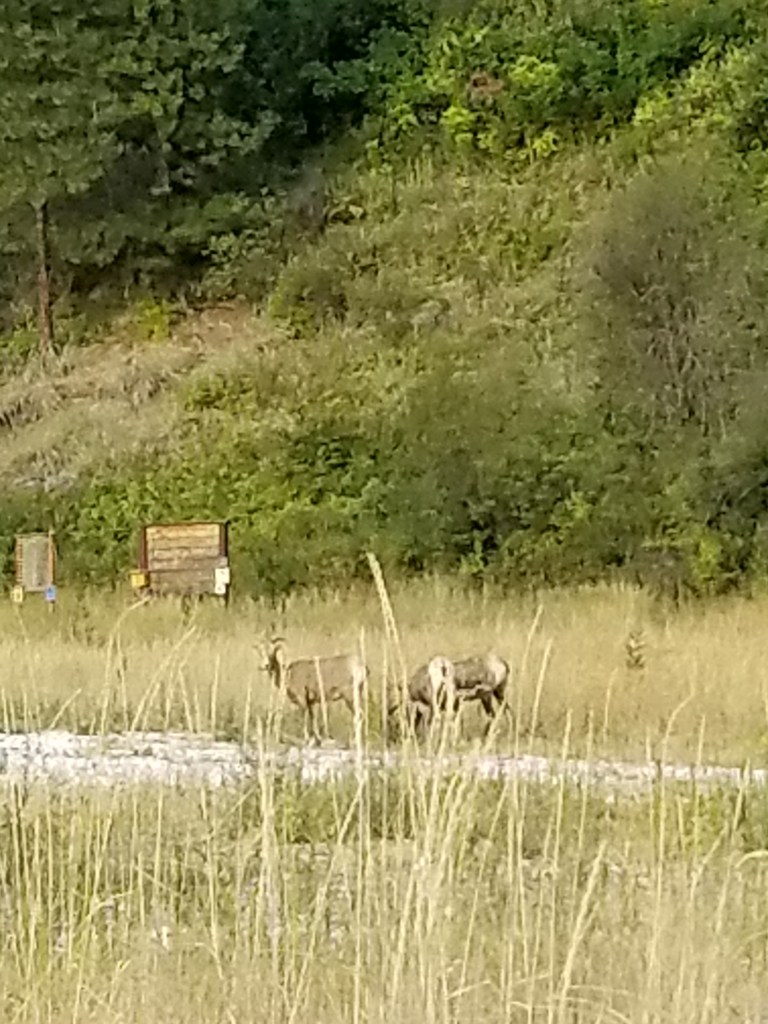
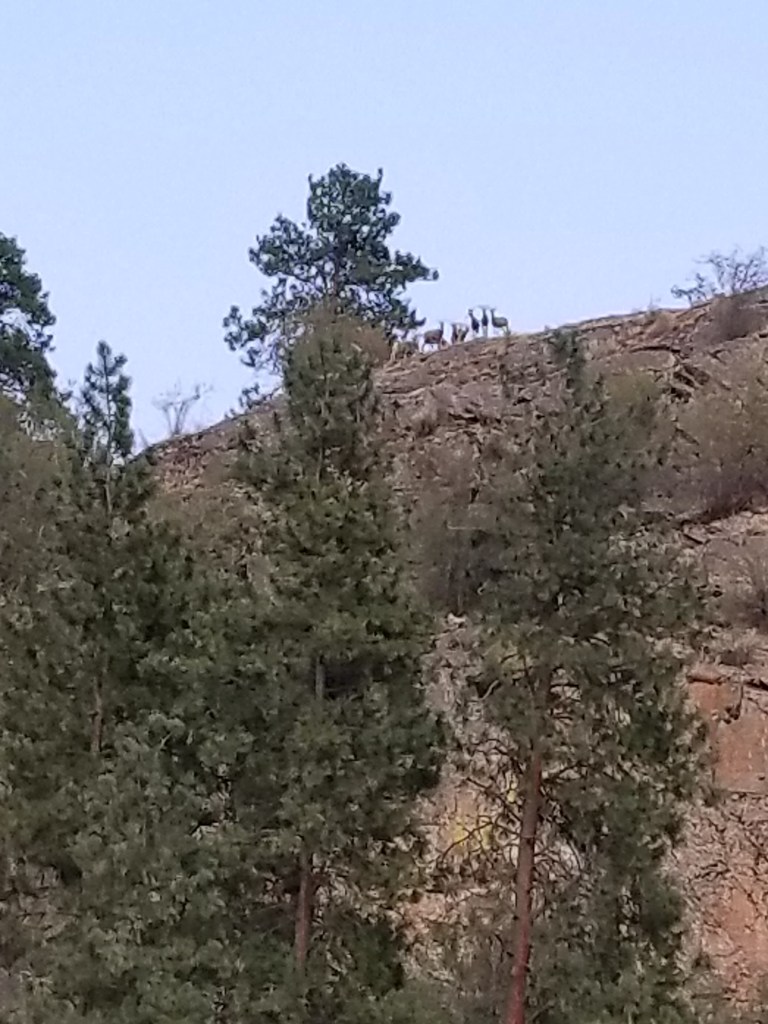
For amusement, a herd of mountain sheep went up and down the hillside in front of me. The younger ones even came down to eat. However, when the dominant Male returned, they just watched me and even when I got in my tent he would not let any of them come down.

The younger ones came down to feed while adults remained up high.
Once the alpha Male returned, he kept the herd up high looking down on me.

Fourth of July with Bonaparte.

July 27, 2018. Bonaparte Lake resort to Stealth camp off trail.

I had reservations in Oroville in two days and planned to take a zero (miles hiked) day there as well. My pack was light and I was in no hurry.

After breakfast at the Resort, they didn’t open until 8:00, I started up Mount Bonaparte. Later, I would need to look up why a tall mountain in central Washington was named for a short French dictator. I was going to go from 3,000 feet above sea level to at least 6,000 feet.

The higher I went, the more I sweated and slowed. At one point, a trail crew had clearly cut and cleared some large logs. Inexplicably, they left a six foot clump of branches in the trail between the cut logs. I thought I should do a good trail deed and move the branches once I got over them. However, halfway across, I felt a sharp pain on my left forearm and looked down to see a hornet stinging me. I smashed it, registered there were a large number of hornets around me, and put Usain Bolt to shame in my sprint away. No wonder the trail crew had not cleared the branches.

On the trail, I am a little bit of a hypochondriac. My first thought was I had not been stung in over 40 years. I wondered how allergic reactions tons to bee stings developed. My backcountry solution was the Nyquil pills (2) I had from my sinus issue had, among much else, anti histamine. After ten minutes, it was clear I was not going to die and u just got on with my day.

The trail offered a choice:split off and take a level contour around the mountain or go up to almost the staffed fire lookout tower and then bomb downhill. I chose the longer 4th of July contour around Mount Bonaparte. I was not in a rush and had no desire to see a lookout.

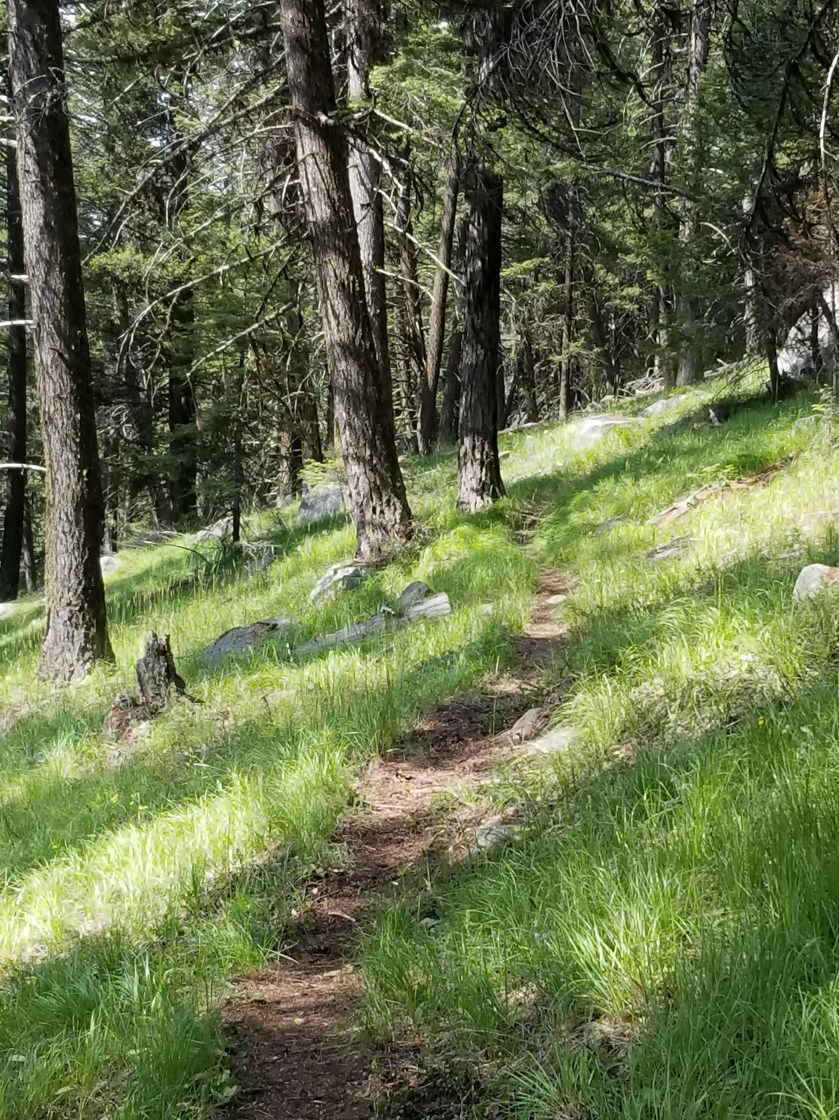
Although it was still smokey, it was a good choice. On the eastern side of the mountain, the trail was a little scarce, but discernible. However, about halfway around, it was clear a trail crew had just recently cleared blowdowns, but also widened and smoothed the trail. It was impressive. To help you visualize, the trail went from a faint eight inch path through grass to a scraped 24 inch clear trail.

I went past one supposedly “reliable” water source that was non-existent. I was concerned. No need as this 4th of July trail crossed several small, cold beautiful streams. Here’s a video of one of them that seemed almost like a screen saver.

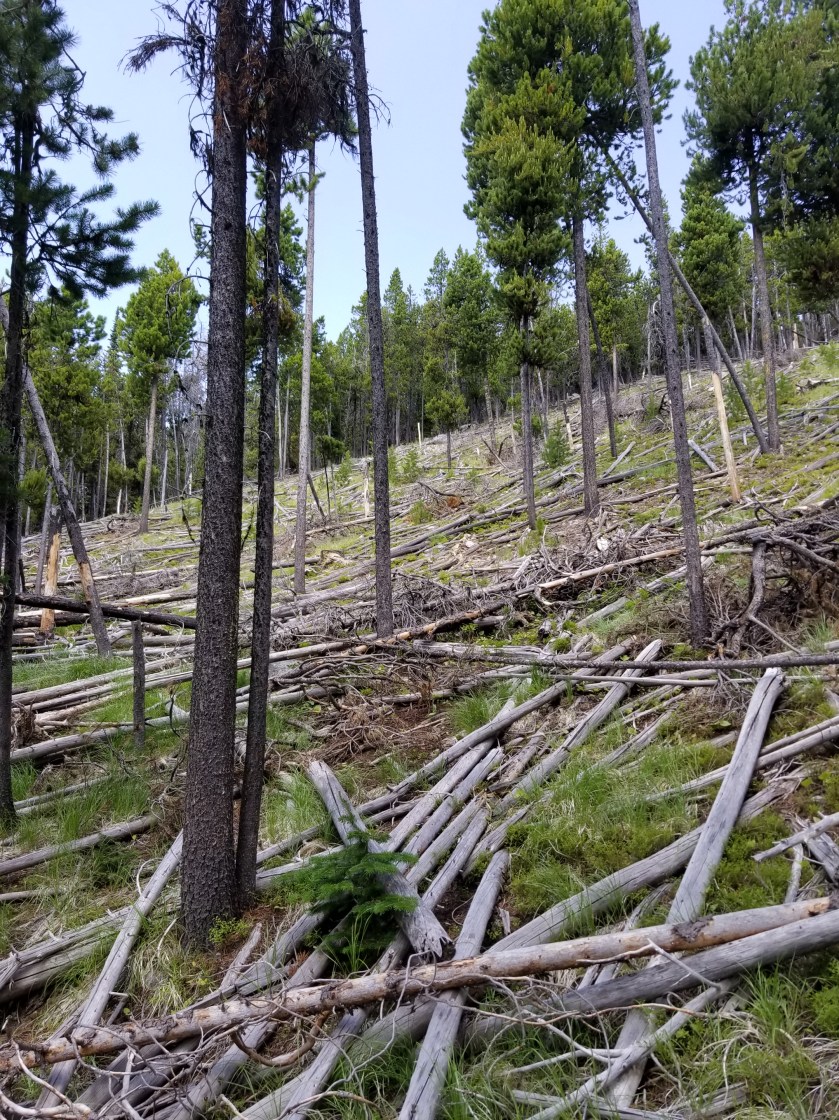
To be honest, there were some sections of zombie forest. Tons of dead trees across the ground and hundreds of standing dead trees. It is hard to maintain a trail in a zombie forest and not much fun to hike on it.

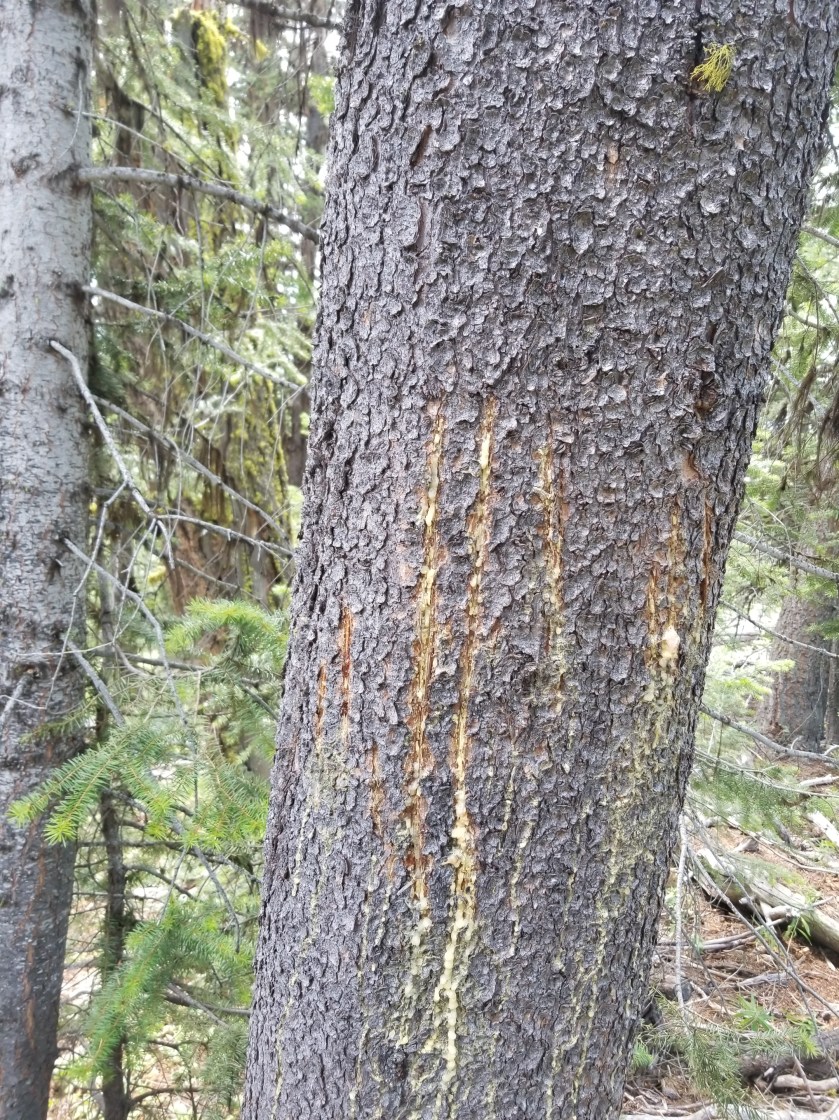
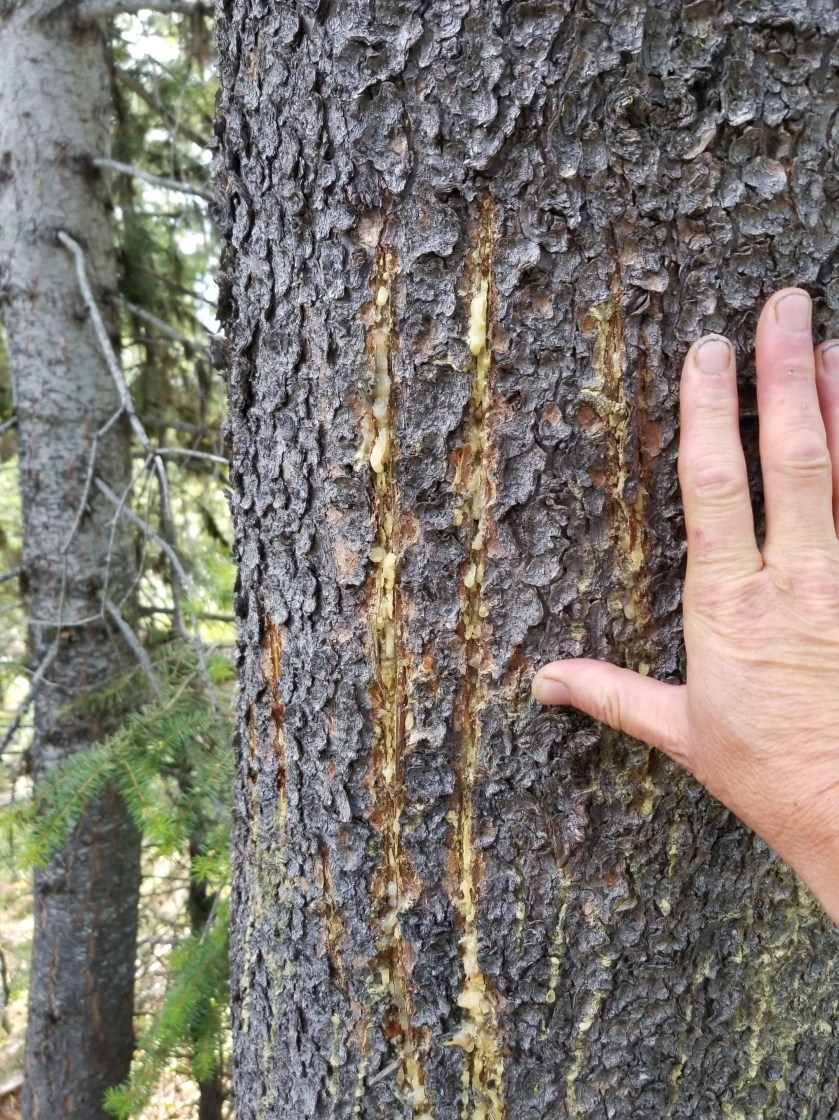
I found what I think was a boundary tree. To my untrained eye, it seemed like an animal about the size of a cougar had scratched a tree about six feet high to mark its territory.

I spooked a large moose. It did not have antlers, was powerful in the shoulders, and moved with strength and grace through blowdowns. Of course, after 100 feet it stopped and turned around and looked at me.

Next I came to an old cabin that was actually serviceable. The roof was whole, the door snug and there was a sturdy bunk and functioning stove inside. It was called the Riggow cabin and it was amazing how it lucked and did not burn in the fires that have swept up this mountain over the years.

I descended down to cattle area. Cows grazed freely and messed up the water sources. Before leaving the national forest, I decided to camp on public land. I crossed a water source and chose a campsite where trees had fallen across the cow trails thinking this was a dead end for them.

I filtered all the water I would need from the source, setup my tent, and ate. Later I walked back to the trail junction to see if the other hiker made it through. He had and must’ve taken the shooter steeper route.

Going back to my tent, I ran in to a cow standing in the water source. She looked me in the eye and just crapped right in the water. Immediately, I vowed to have steak in Oroville.

A small herd of cows kept wanting to walk by my tent. Even into the night I had to get out and shoo them away

A loud group of coyotes announced nightfall and I enjoyed a small steady breeze blowing down the mountain, making for a cool evening of sleeping after a long hot day of hiking.

Cougar to Bonaparte

July 26, 2018. Cougar Creek to Bonaparte Lake Resort.

Leaving behind my subterranean mystery, I scooted down the gravel road with a skip in my step. See, I was going to be at a restaurant in just a few hours.

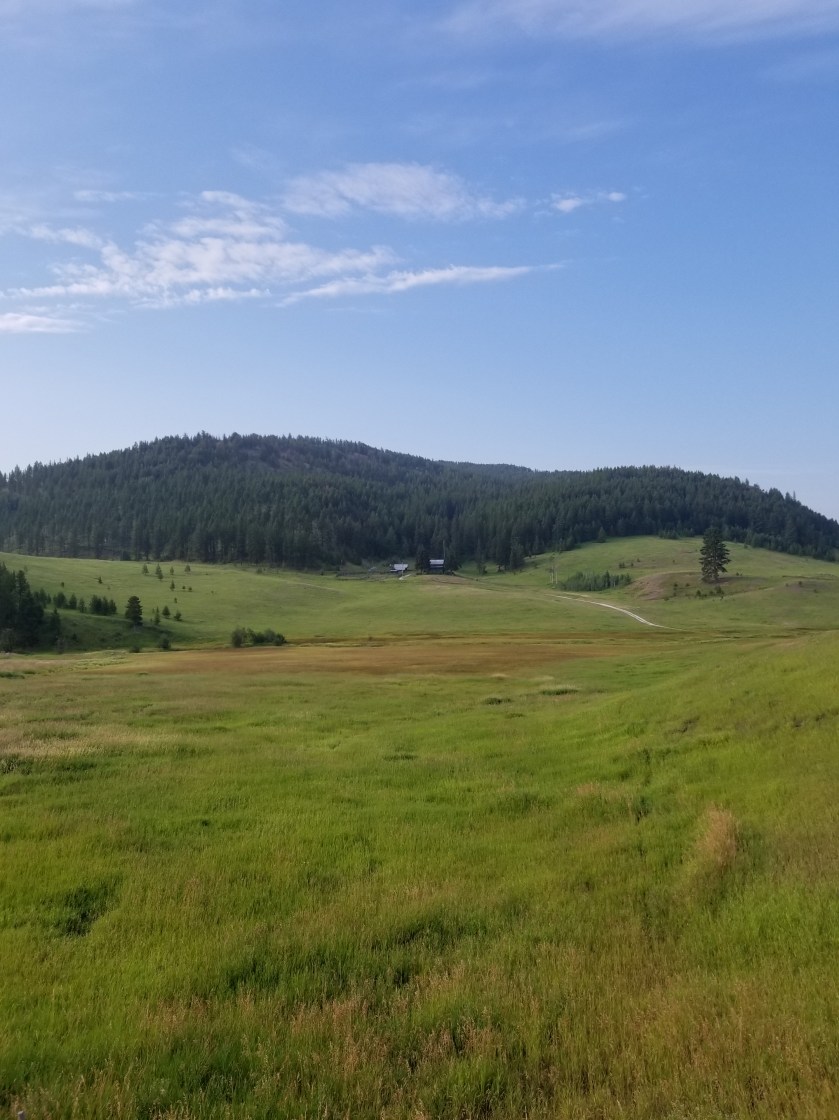
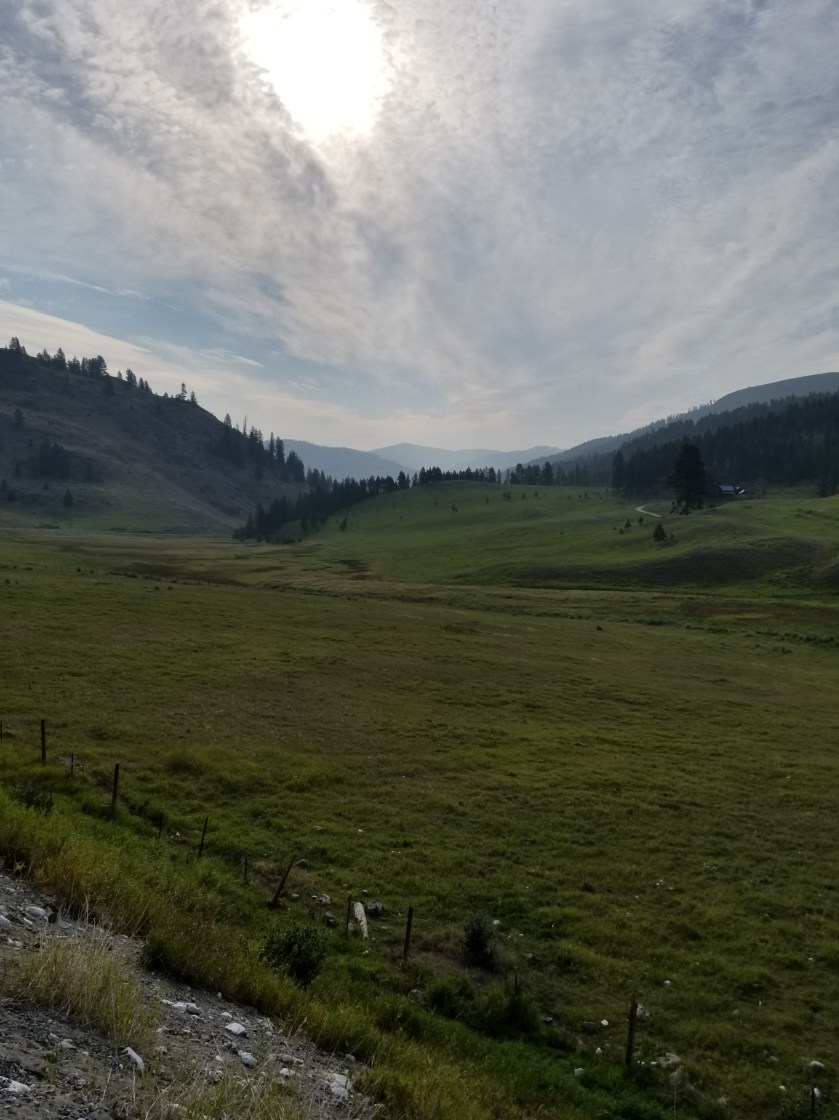
Out of the forested Cougar Creek valley I climbed to higher grassland country. There was a gorgeous old ranch there.

A

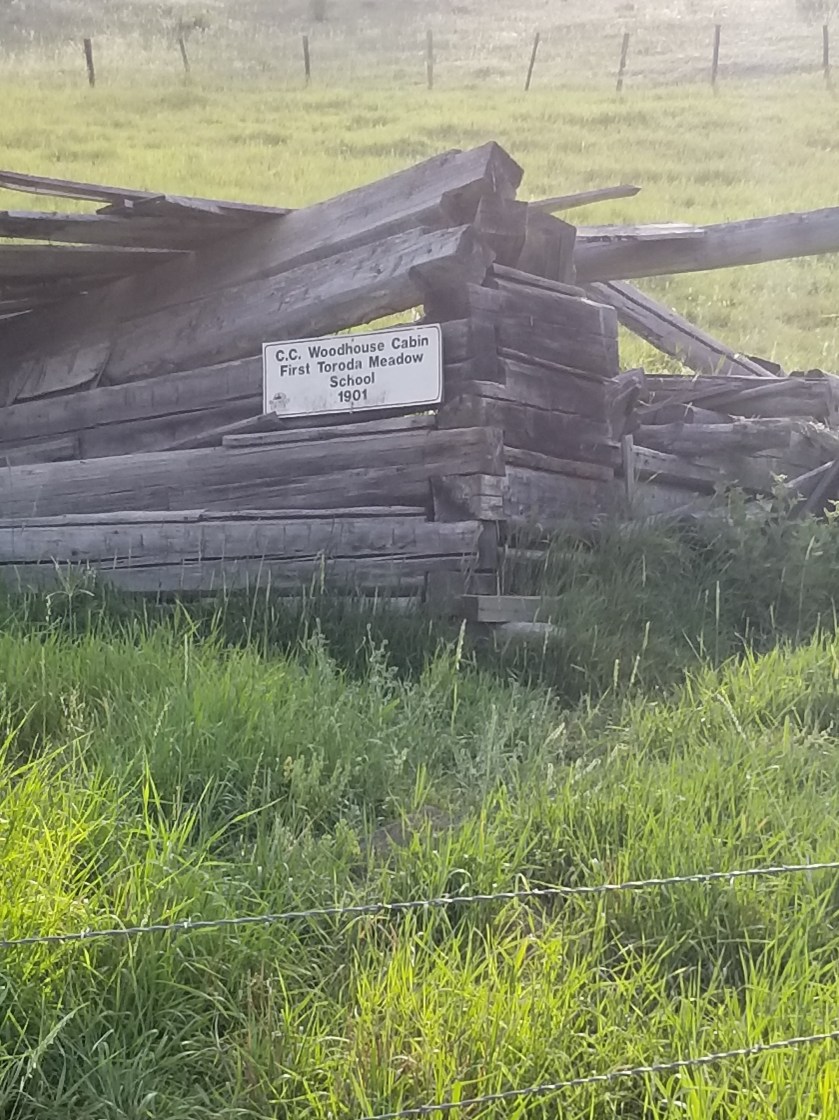
Also, the remnants of an old school.

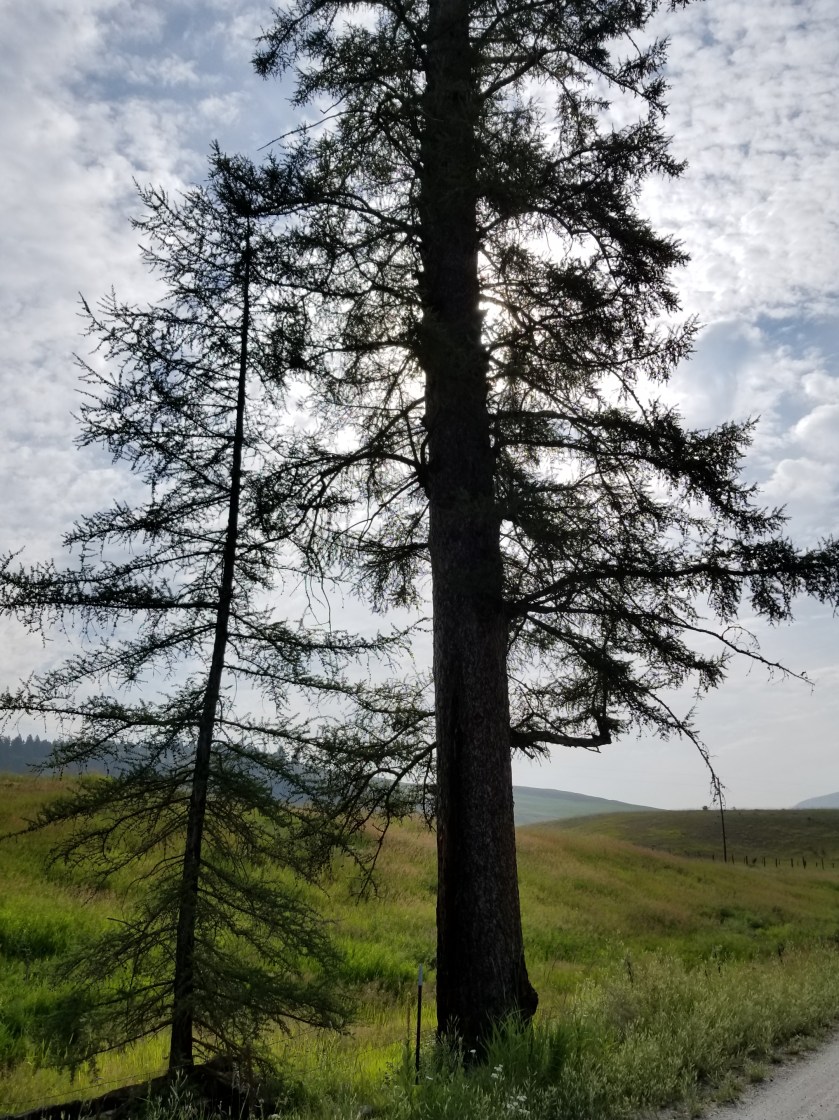
Leaving the grassland I passed the largest larch tree I have seen on this trip. It had to be 80 feet tall.

Eventually I entered a forested area where the mosquitoes were vicious. For the first time in weeks, I stopped hiking to put on repellant.

The PNT official route was supposed to veer off this empty road and angle towards the resort on an abandoned road. I chose to stay on a perfectly good unabandoned road that went straight to the resort.

They had my resupply package. On an impulse, I purchased a tent site for the night. I had a designated spot with a picnic table and access to restrooms and a warm shower.

I ate a huge breakfast, showered and then lazily soaked my legs in the lake. No fish died.

Since leaving Northport, there have been two types of military aircraft on a daily basis. First, there are fighter jets that sometimes have exercises. I recall watching a couple of very aggressive moves on one day where a low flying jet flew through a valley and then went quickly up to intercept a plane coming towards me.

Second, there must be some stealth bombers practicing. You can clearly hear the plane. But when you look up and follow the sound and project forward, you don’t see a plane. A commercial aircraft is easy to spot this way on a clear day. Even if there are no contrails, the plane is easy to see. Only once was I able to see a bomber. It was late and the sun was low in the horizon and somehow the sunlight illuminated the underside so I could see it for about ten seconds.

I mention this because I was lazily soaking my legs in Bonaparte Lake when I heard one of the fighter jets. It sounded like it was approaching. The sound got louder until the jet roared overhead only 100 or 200 feet above. It was fast, loud, and such a contrast to the idyllic lake.

Under the category of “No way!” I went over to the resort restaurant for dinner at 6:00. I walk in and there’s a big sign saying “closed.” I asked the server why. She said the cook sliced his finger badly and had to go for stitches. In remote locations like this, there is no backup. One thing I’ve learned backpacking is to not react emotionally, instead just honestly stating my situation. “I’m staying here tonight. I am backpacking and only have two dinners to get me 50 miles to Oroville. I was counting on a meal here. Do you have any ideas on what I should do?” The server said she was not allowed to cook, but there were some veggies for a salad. I said that was perfect. She ended up making a delicious salad with ham and avocado to boot.

A PNT backpacker came in. They gave him the bad news about the kitchen. They served him a beer and he bought a bag of Doritos. I walked out with him, asking him questions about the trail. Since I was clean shaven, I’m sure he thought I was just a pesky old guy.

I went back to my tent site. While it was ideal for much of the day, unfortunately the RV closest to my tent site turned out to be the host location for some large family reunion. A whole family of RVers! They were mostly older, so many headed off to bed at 8 or 9. The hardcore drinkers, of course, stayed on and got much louder but made even less sense. To my relief, they shut themselves down at 10:00 sharp with “good nights” shouted to each other five feet apart.

I slept ok and felt pretty good having eaten, showered, and rested.

Long Day in a Burned Forest

July 21, 2018. Stealth camp near Kettle River to unnamed saddle in Kettle Mountains.

The night was very still. I heard some coyotes around midnight doing roll call. No problem with the camping.

As I continued down the road to cross the Kettle River, I walked along a quarter mile of the plateau and not a single private property sign was posted. I was relieved.

After crossing the river and highway 395, I was on a gravel road, passing a large piece of private property which had been logged. As best I can tell, the way landowners make a living is to graze cattle on their forest land and then periodically harvest timber. I would imagine lumber shortages and tariffs probably pushed a lot of folks to harvest lumber sooner rather than later.

Today I was feeling a little sluggish on the relentless gradual climb. I tried hydrating more, but it was tough. Plus, there were about six young guys on motor bikes whipping up and down the trail leaving annoying dust clouds. The scenery was nice, though.

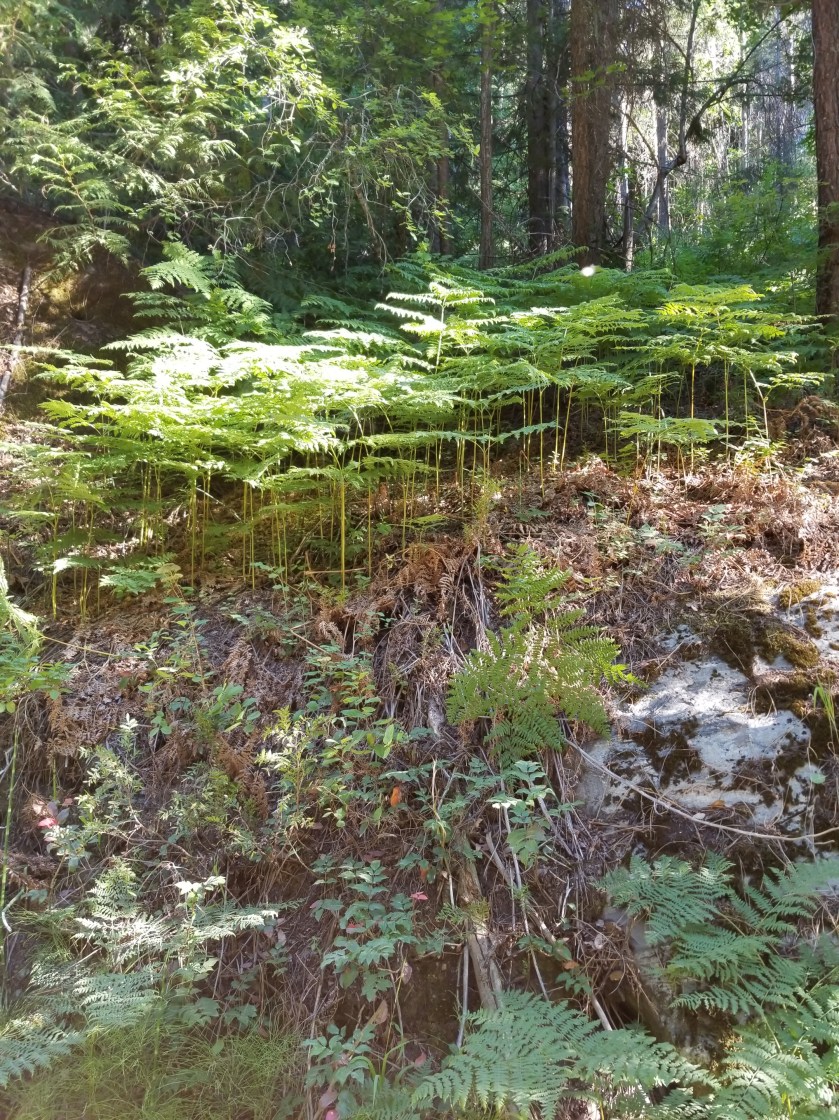
These ferns grabbed a slice of morning light as they grew on top of a boulder.
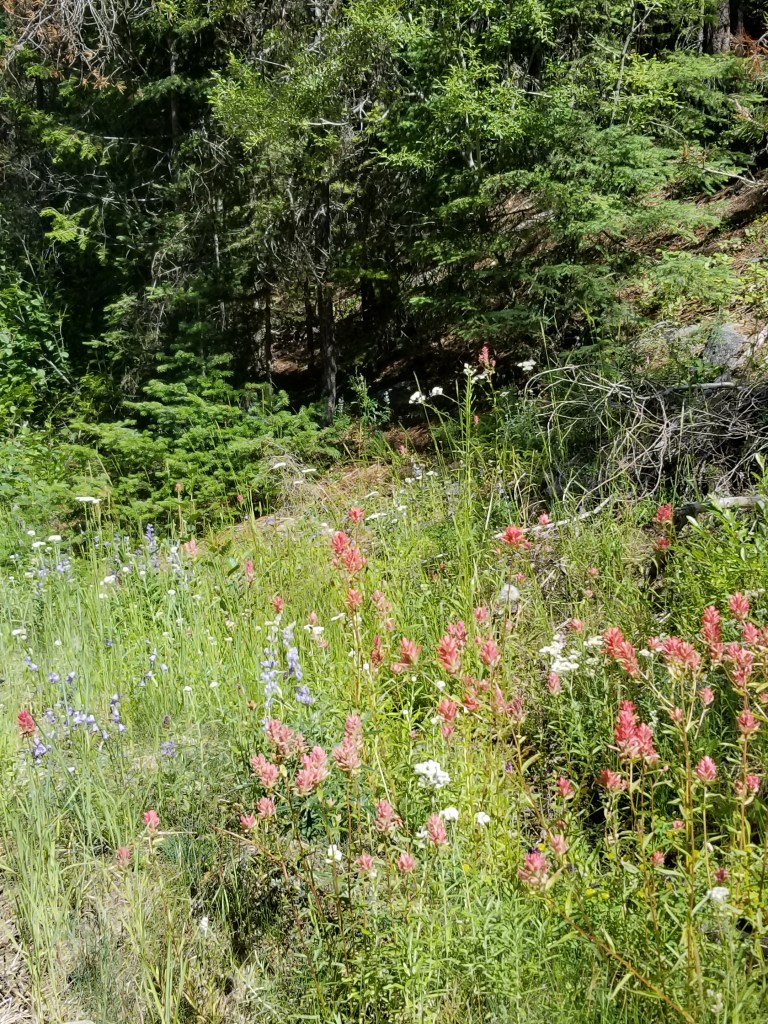
Indian paintbrush (red/orange) and lupine (purple) are attention getters in meadows.

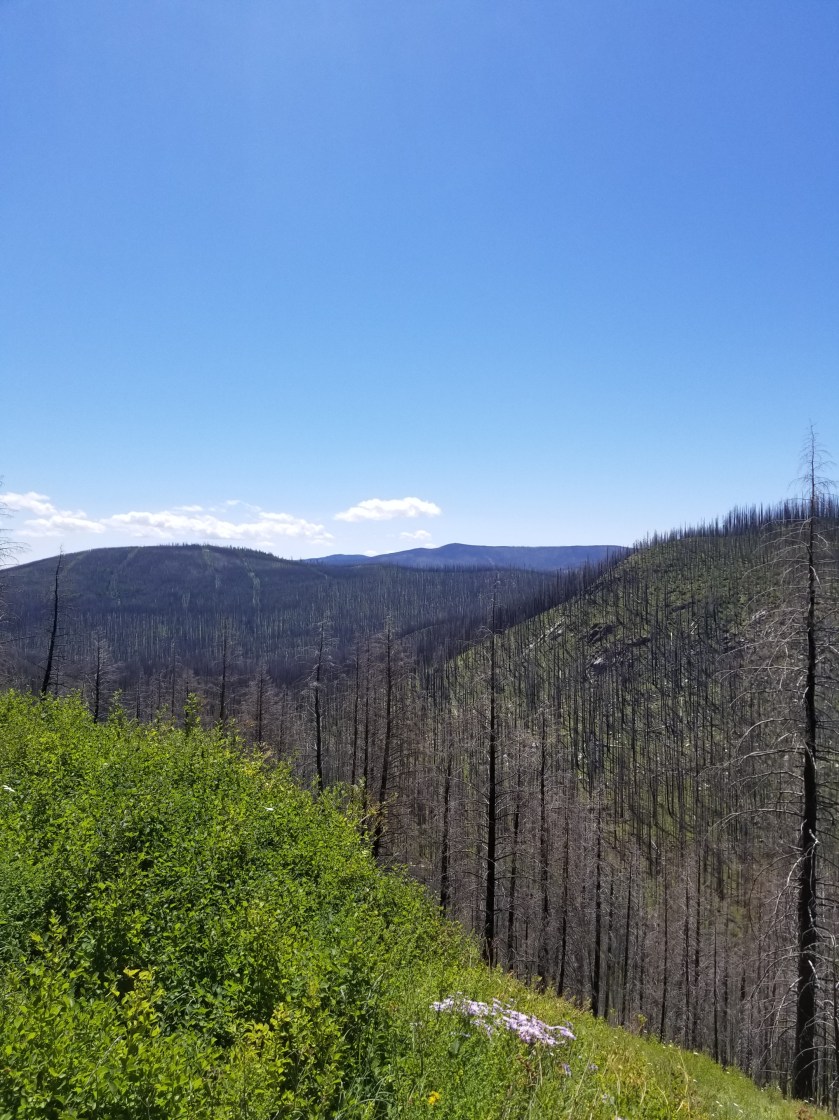
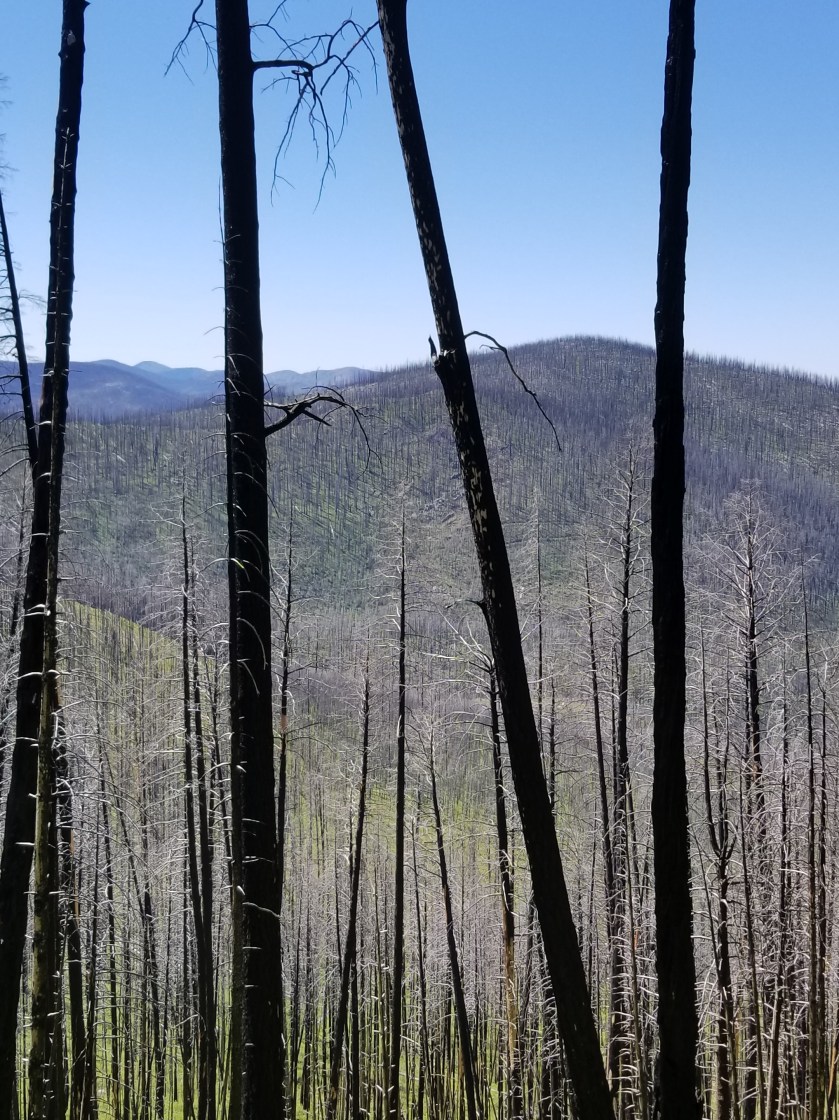
The day changed tremendously when I entered the burn area. In 2015, a massive complex of fires swept over a large swath of this country. I entered an area of standing deadwood, charred fallen logs, fireweed, and lupine. The trail dwindled from a gravel road used to salvage usable burned wood to abandoned forest service roads with multiple blowdowns.

It is such a contrast between the massive carnage of a forest fire and the rapid evolution of plants scrambling to seize the open terrain. Lupine has an explosive takeover strategy. It develops seed pods that twist and then pop open, scattering seeds. The most interesting thing to me was the absence of pine, spruce, and larch seedlings. They must bide their time and rely on their height genetics to overcome the early lead of other plants.

I’ve only seen two sets of footprints. That is, until I got to an intersection with a paved road. Then, a new pair of prints appeared. This was the famous Kettle Crest Trail.

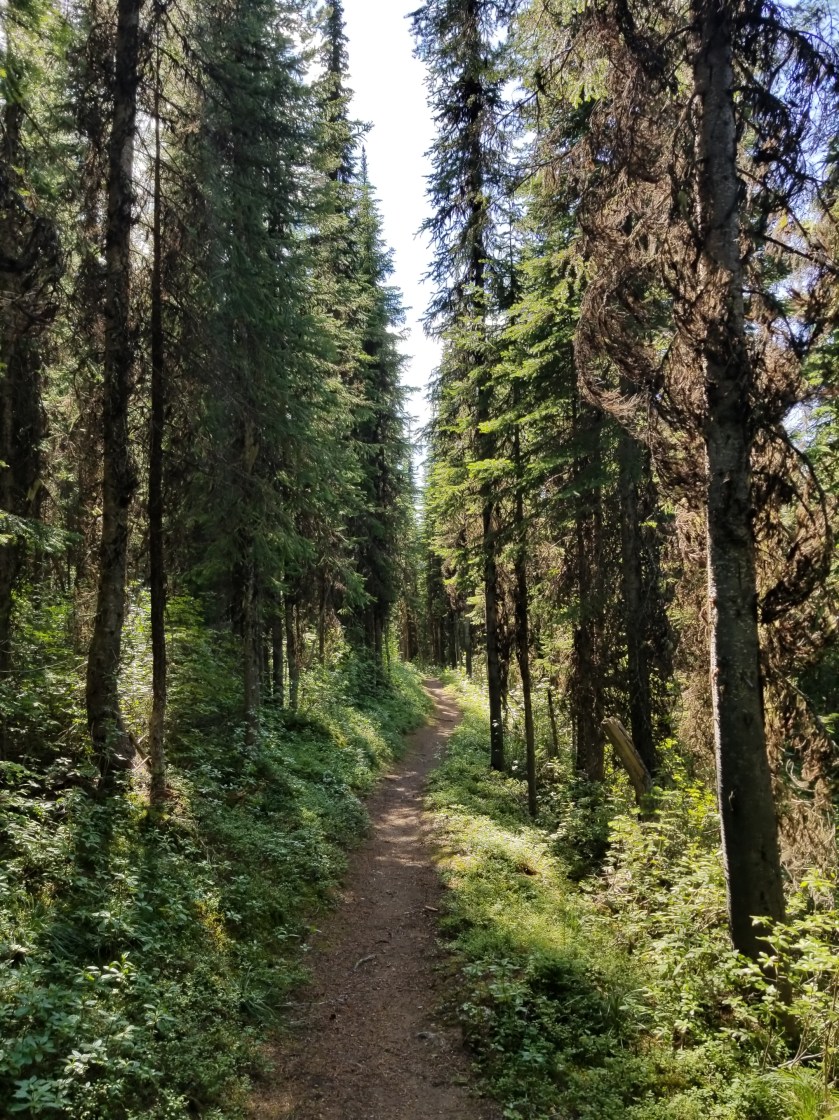
Kettle Crest was a well maintained trail. I could not recall how many days since I had been on a real trail. It was good, but again seemed more like a bike trail than a hike trail.

I was able to get my last water supply and then followed the trail as it switched back and forth uphill. The map showed three turns, but there were at least six.

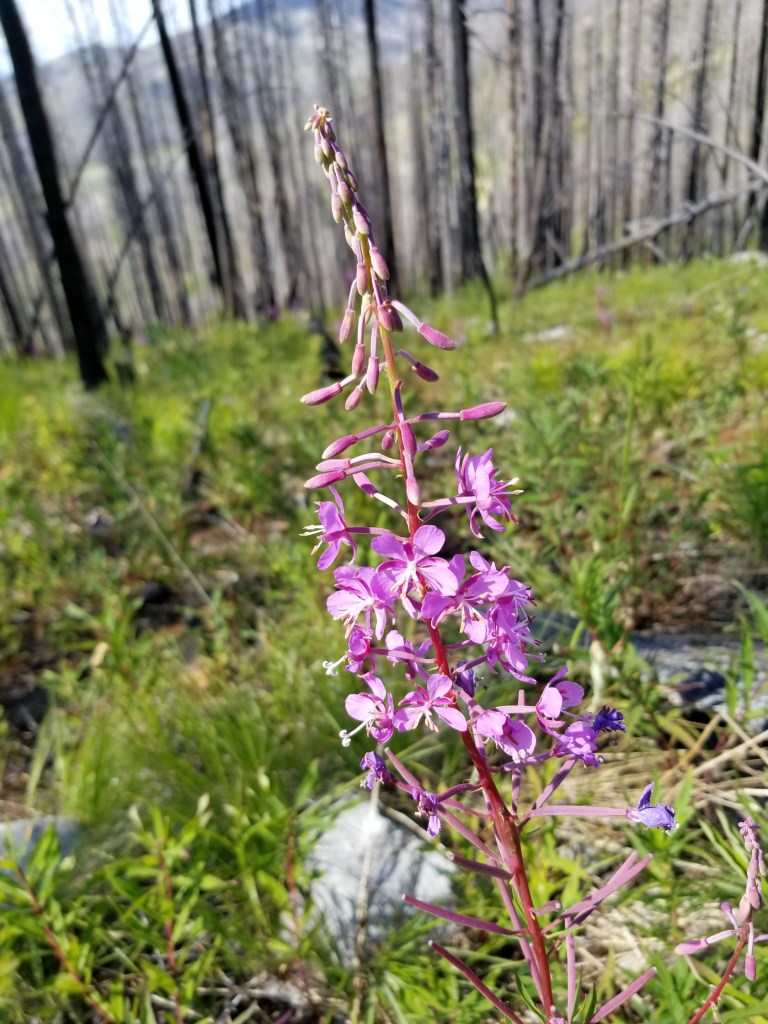
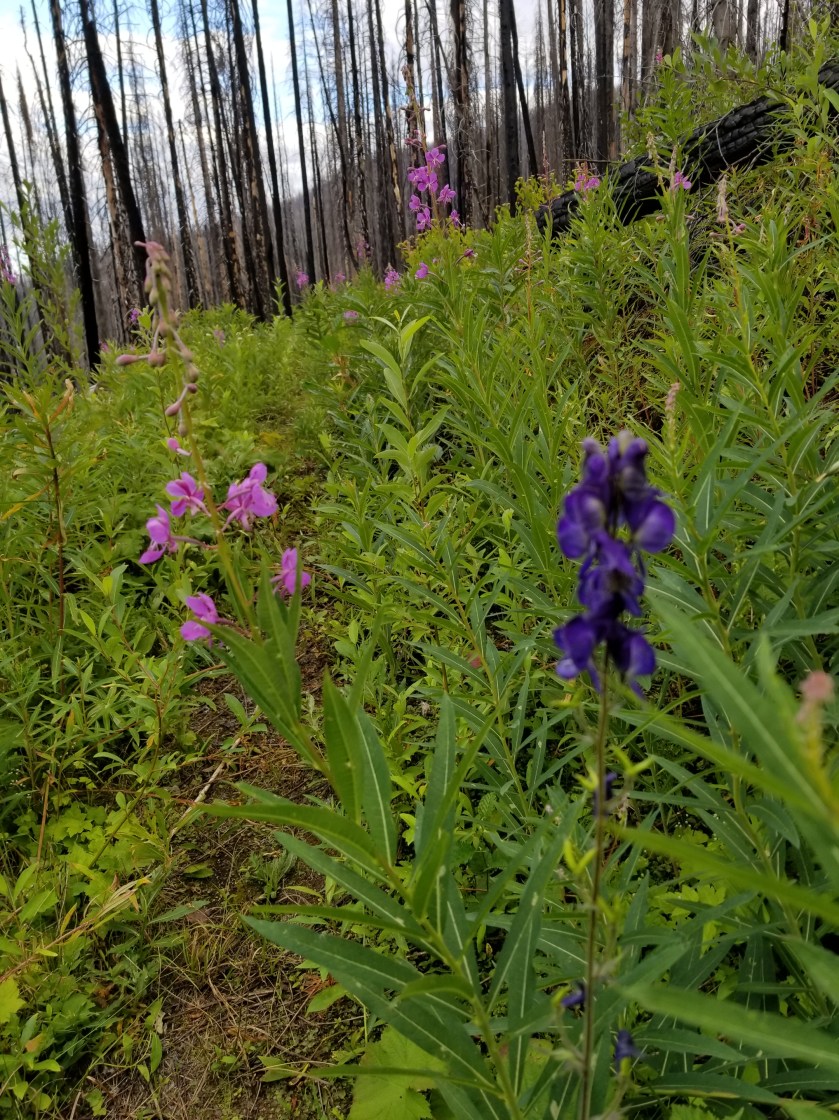
Fireweed
Sorry for bad focus, but seeing fireweed next to something that looks like a delphinium was an unusual sight.

Eventually, I reached the saddle I was shooting for. There was about 45 minutes before sunset. An odd cloud of smoke hung in the air. Plus, for once, it was windy. So, I made camp quickly, avoiding standing dead trees. I pointed the open end of my tent away from the wind. I had to put on my wool hoody plus my down puffy.

View from the saddle. The mountain saddle; I’m not on horseback.
Sun behind smoke cloud.

As a shock element, while I was eating my dinner, a mountain bike went whizzing past. Not sure if he saw me, but I hoped he made it to the road before dark.

My Zpacks Altaplex tent. The company stopped making them. Too bad because they were great for tall people.
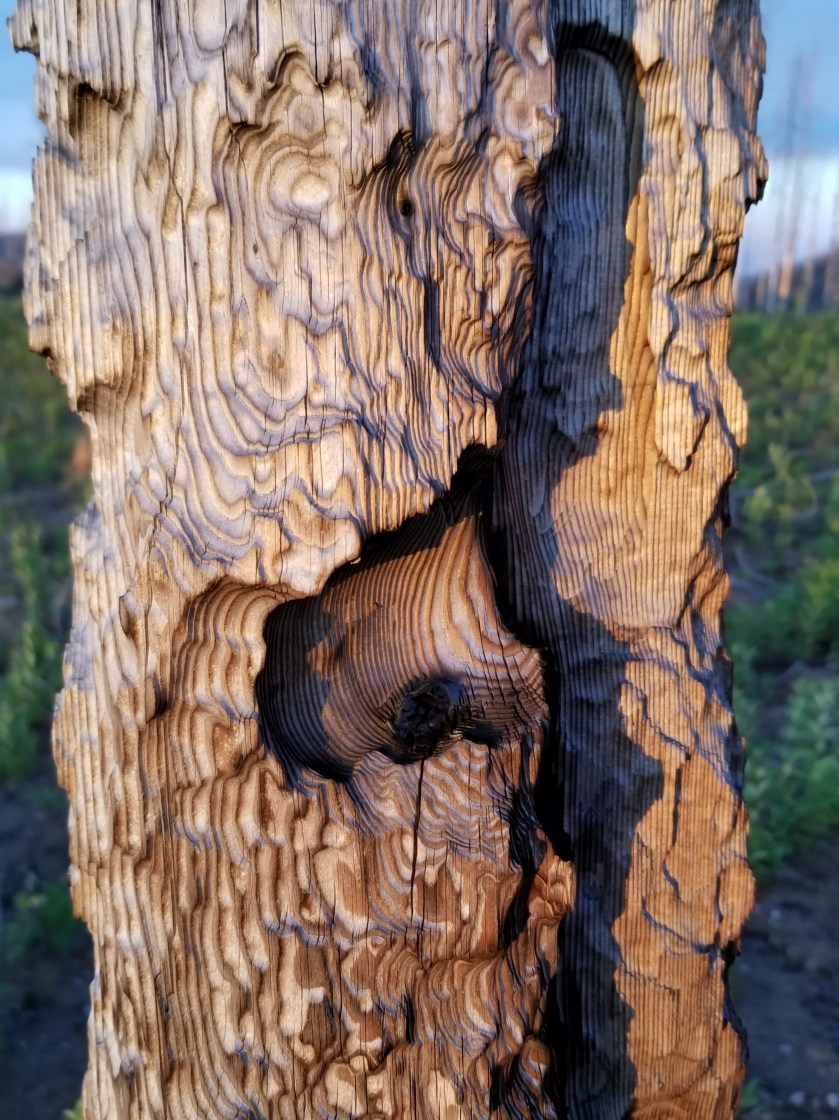
First fire, then wind carved this.

It was the first cold night in weeks. I liked it and I liked sleeping up so high. It was a long hard day, but tucking in to a warm sleeping bag was a great reward.

All Kinds of Roads

July 20, 2018. Northport to stealth camp near the Kettle River. 24 miles

I woke up early and packed. I hadn’t mentioned this previously, but this was a big resupply. I would not get supplies again for 130 miles at Bonaparte Lake Resort. Averaging 20 miles a day meant six days. I usually bring about two and a half pounds of food per day. So, I would be leaving town with 18 pounds of food plus my regular, base weight.

Trying to carbo load, I ordered huevos rancheros with two extra eggs. I then ordered dessert: strawberry rhubarb crisp. With ice cream. The Mustang Grill was a great place. They were fast, organized, the food was good. Indeed, for the first half hour, about every five minutes a different bachelor rancher or farmer came in and got “the usual.”

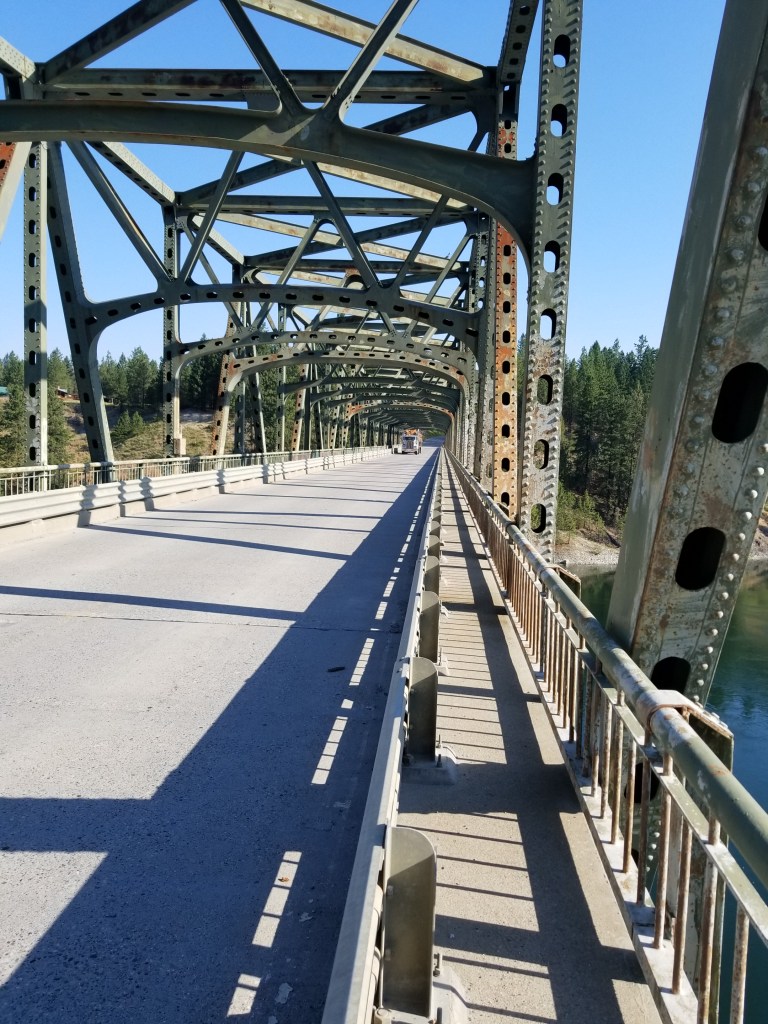
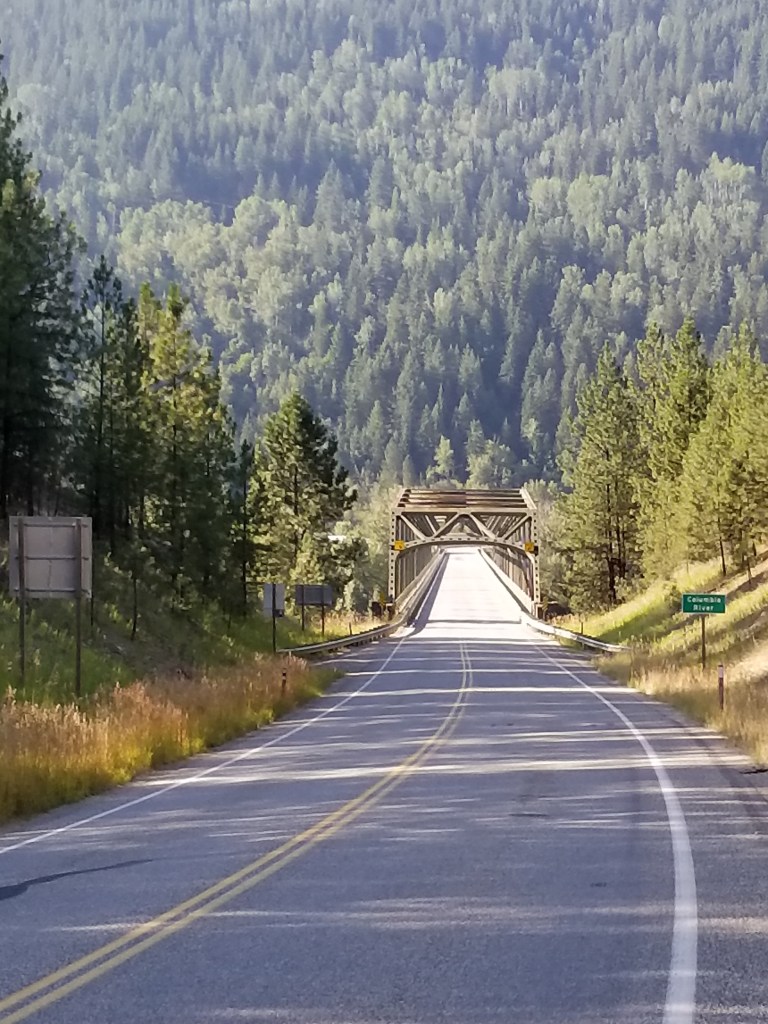
The first part of today’s travel was to cross the Columbia River. Unlike prior bridges, there was no pedestrian walkway. Instead, there was a narrow catwalk with a low barrier between me and the vehicles and a waist high railing over the river.

As I started across, I noticed it was proudly built in 1947. At first, I steadied myself and took tiny steps. Twice, cars came by and the bridge didn’t rattle. Too much.

About halfway across, I was taking adult-sized steps. I looked ahead and saw my second worst fear: a logging truck barreling towards me. My worst fear? Another one coming from behind.

Here comes the log truck….

Suddenly, huevos rancheros seemed very, very stupid. I almost dropped to all fours, but then realized I wanted to plummet to my death with dignity. So I stood and waited as the truck got closer. The bridge was shaking pretty good as the driver waved passing by me. As the sound of the truck faded, so the grinding and popping of the bridge faded. From that point, I fairly sprinted to the end. What a great start.

Looking back at the bridge.

After a short pavement walk, I started on gravel roads again, then dirt. Early on, I walked up Sheep Creek road. Every once in a while there were cuts between the forest road and the creek. On many, it was clearly just families tucked in for camping. On a few, however, it seemed like this was home for some people. Kind of depressing.

Later I walked through areas the forest service had sold for logging. It looks rough at first, but modern logging is so much better than the old clear-cutting ways. Now, they mark a section and within it designate mature healthy trees to protect. Waste is piled. Yes, it looks logged, but it is not a barren wasteland.

It looks rough, but at least some healthy mature trees remain.

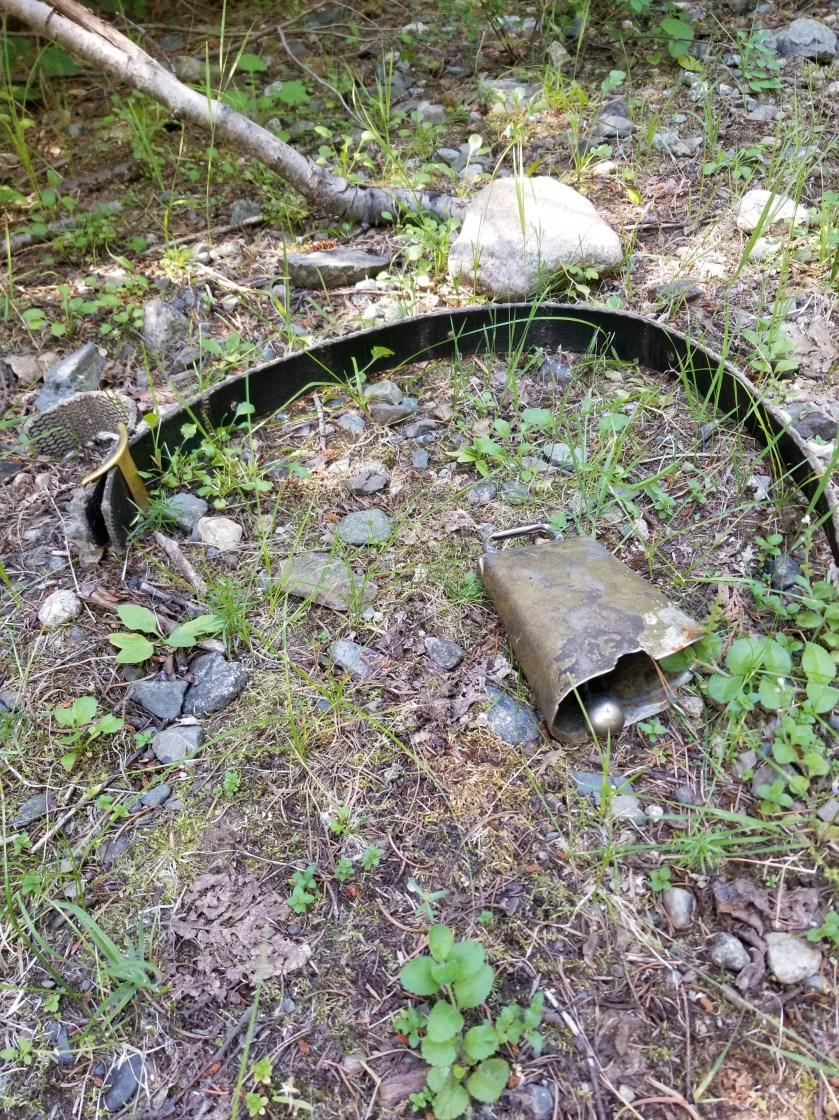
Along the way I found a cow bell and collar. Clearly signs that some happy cow had broken free from that noisey bell.

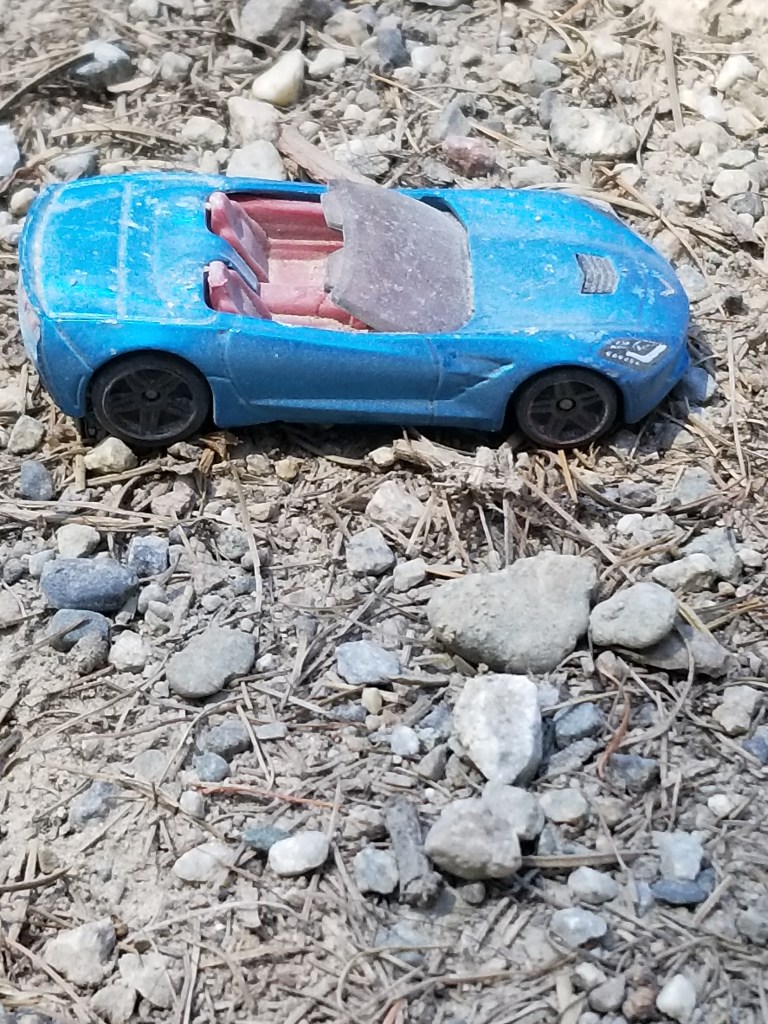
Also, a matchbox car was so out of place.

Not meant for forest roads.

I saw a small snake in the road.

Later, I found an entire ant colony moving across the road. Each was carrying an egg.

I was at my 20 mile goal, but there was some daylight left. I opted to skip the public campground at Pierre Lake because it was a one mile walk in the wrong direction. Instead, I thought I could find water and public land before my next big river crossing, the Kettle River.

At first, there were just a few large ranches. However, as I went down the road toward the river, the no trespassing signs increased and there was no water. I went past a volunteer fire department and seriously considered stealth camping behind it. Around 7:30, I found a small creek on my side of a barbed wire fence. It probably had some type of ag runoff, but at least it would be wet. I drank a filtered liter and filtered two more to go.

I was getting pretty desperate. I hate trespassing. At my final road juncture, I saw a plateau above a slope. I walked up 200 feet and down 200 feet. No signs were posted. Most importantly, it looked like it had been logged several years ago, reminiscent of the public lands.

I hiked up the slope and came out on a beautiful plateau with widely spaced mature ponderosa pines. Carefully, I scanned for any signs or buildings or roads. None. I ate my dinner quietly. As it got dark, I set up my tent, sort of confident I was on public land. Laying down, I had visions of guard dogs barking at my tent as a trespasser, but the fatigue of a 24 mile day overwhelmed everything.

Asphalt

July 19, 2018. Silver Creek campground to Northport.

Not much to report on this day. Originally, I planned on stealth camping a few miles before the town of Newport, and the next morning go in for breakfast, pick up my General Delivery package at the Post Office, and be on my way. I did not think I could reach Northport before the Post Office closed. Ideally, I would camp overlooking the Columbia River.

The overarching theme for this day would be sun and asphalt. I packed up and left before Indigo and Snowberry were ready. While I started on a forest service gravel road, after three miles it took a right turn on to a paved county road. There was an older gentleman sweating at some yard chore at the junction. We exchanged greetings and I was on my way to 15 miles of asphalt.

In previous years, the PNT to Northport was shorter and mostly trail. However, a landowner decided they no longer wanted to provide access. Now, the PNT walks about 12 miles on pavement. I do not know the details, but it seems absurd.

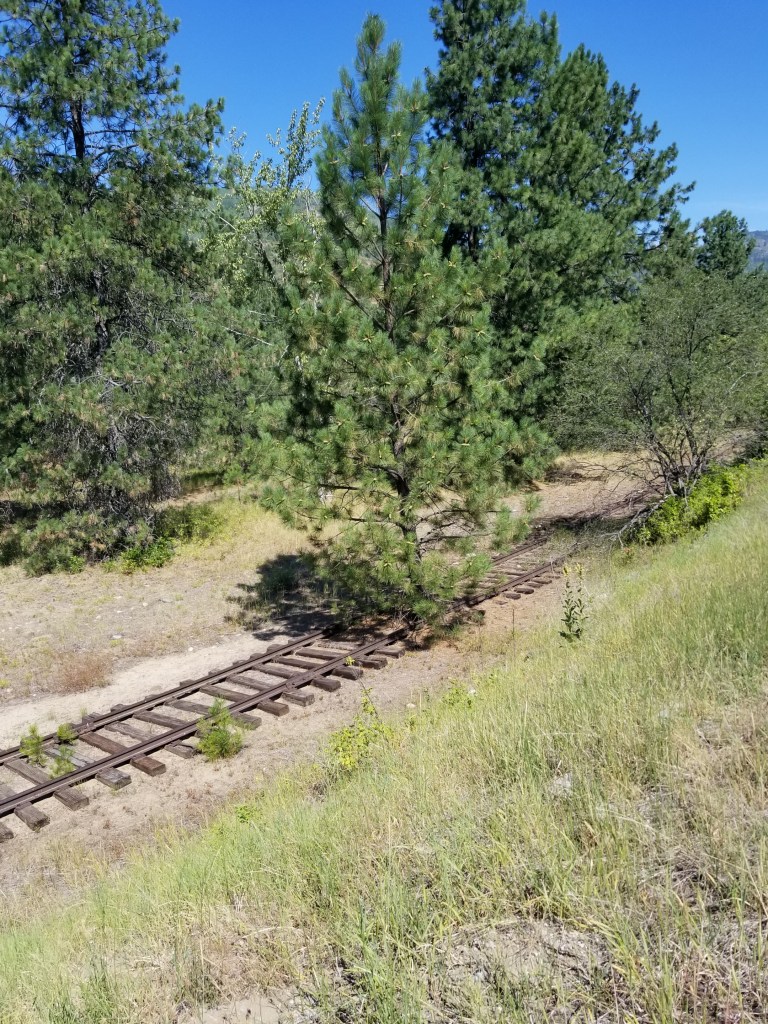
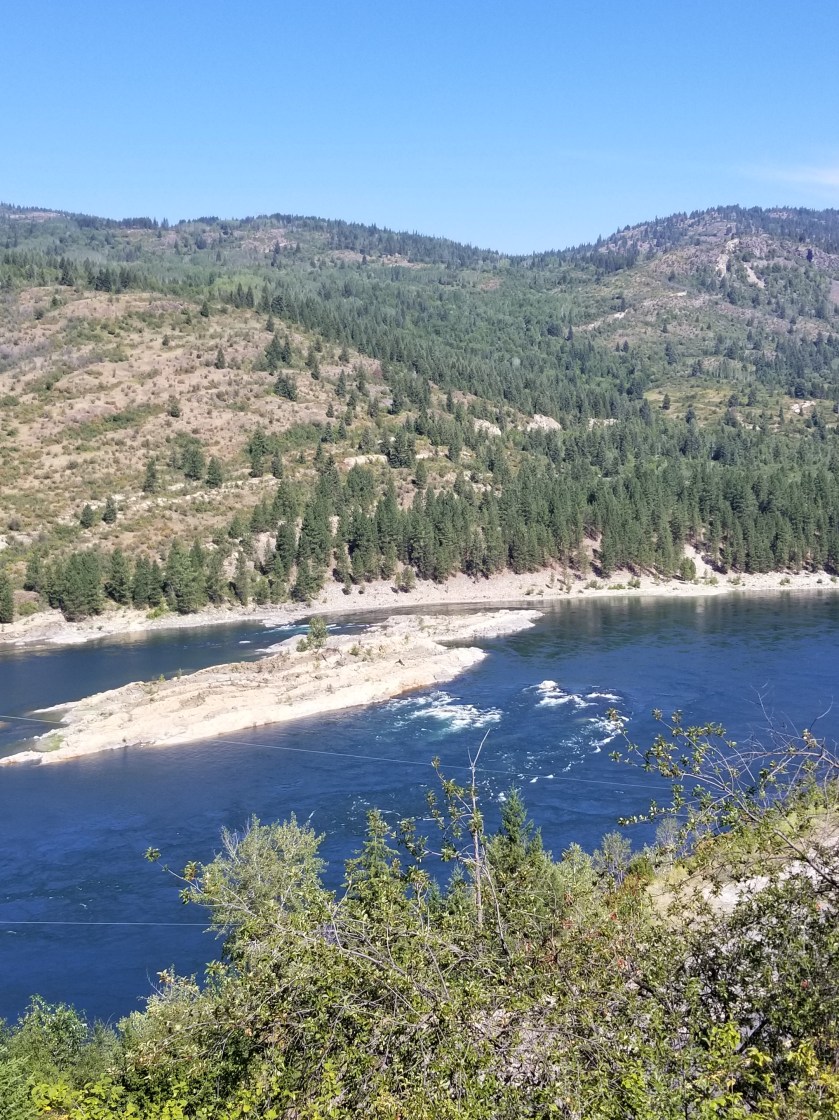
After approaching the Canadian border, I turned south and began walking south parallel to the Columbia River. When visible, it broke the monotony. Between the road and the river, an abandoned railroad track gave rusty testimony to an earlier time of economic prosperity.

There seems to be something on the track.

One guy stopped and offered a ride. Locals in pick ups and truckers waved and gave me a wide berth when there was no shoulder. Surprisingly, Canadians always seemed to cut it close when passing.

As I checked my pace, I realized I could probably get to my package before the Post Office closed. It was now stinking hot. I was sweating pretty good. At one point, a Border Patrol officer stopped. By his questions it seemed to be a combination of investigation (where did you sleep last night? Where are you headed) and welfare check (do you have enough water).

The bridge over the Columbia at Northport.

I pressed and got to town in time. There was a simple cottage with a vacancy so I grabbed it. On my way from the post office to the cottage, I was hailed by Snowberry. They had stopped at the intersection of the gravel and paved roads and asked the man working in his yard if he would give them a ride to Northport. He did.

The cottage had a/c, so I took a shower and lowered my body temperature. Later, I had a two entree dinner and drank what seemed like a gallon of water.

I was glad I got to town and the cottage. Tomorrow, I would wait until the other restaurant in town opened for breakfast. Until then, sleep.

No Fitch

July 18, 2018. Metaline Falls to Silver Creek campground.

I slept awfully in the hot stuffy room. The restaurant opened at 7:00 and I was there. So, too was Indigo. I ordered while she skyped with her family. Her hiking companion, Snowberry, joined us. They were going to have somebody pick them up later and drive them for a good chunk of today’s trail.

I had a big breakfast, said my goodbyes, paid my bill and was off. I swung by The Rock House for a last look.

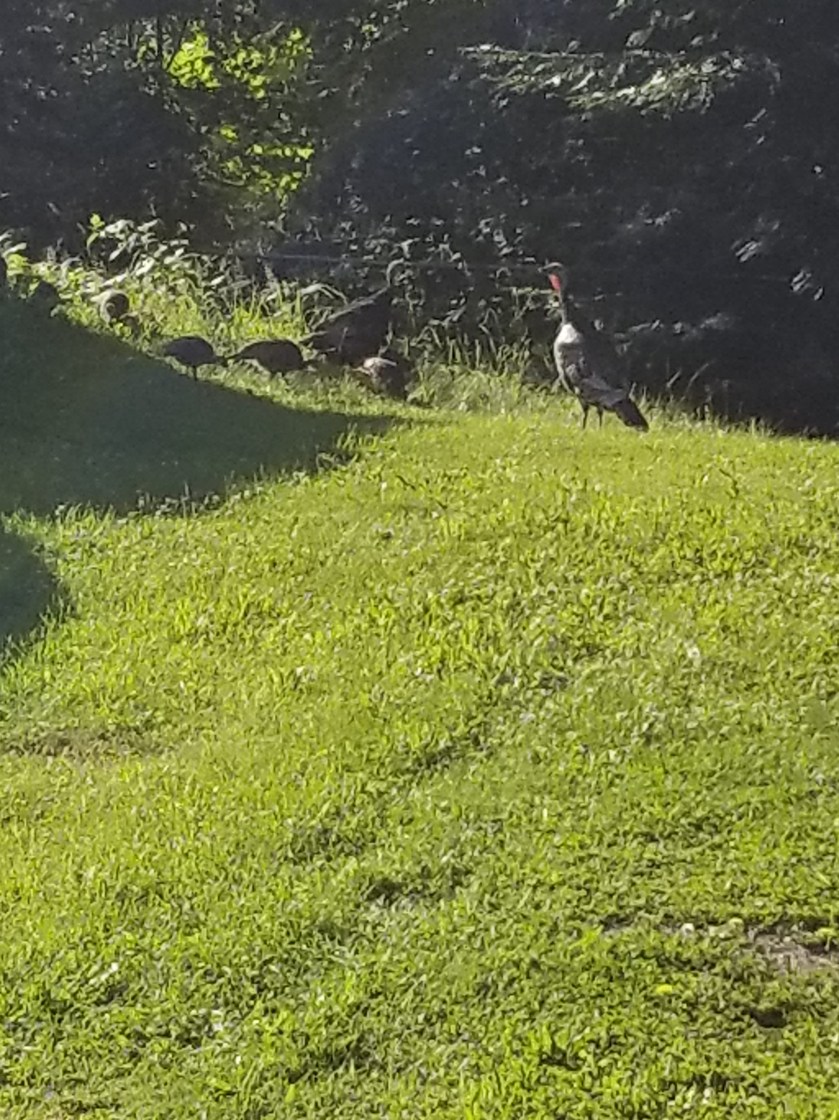
Today’s mission was to leave Metaline Falls at 2,100 feet above sea level, ascend Abercrombie mountain around 7,100 feet and then climb down to Silver Creek campground at 3,100 feet. Five miles of pavement walking awaited. Even though it was morning, there some steep, sweaty climbs. I did see some wild turkeys on the way.

Instead of mosquitoes, it seemed today’s pest was going to be gnats. As an adult, I still cannot tell you anything about gnats. It seems they exist solely to fly around you, waiting to be inhaled or to land in your eyes or ears. Perhaps they are nature’s Ear, Nose and Throat specialists.

By 11, I was on gravel forest service road. I passed one lady collecting huckleberries and two forest service vehicles. Other than that, it was a boring eight mile hike up a gravel road.

Finally, I switched to trail. I was actually feeling pretty good. Nearing the top there were long switchbacks and I was able to go all the way before pausing at the turn.

One pleasant diversion was a spring near the top. With the dry weather and heat, I assumed it would be dry. Instead, it came gurgling out from underneath a tree. Fresh cold water at 6,000 feet on a hot day of hiking is a way to pump up the gratitude.

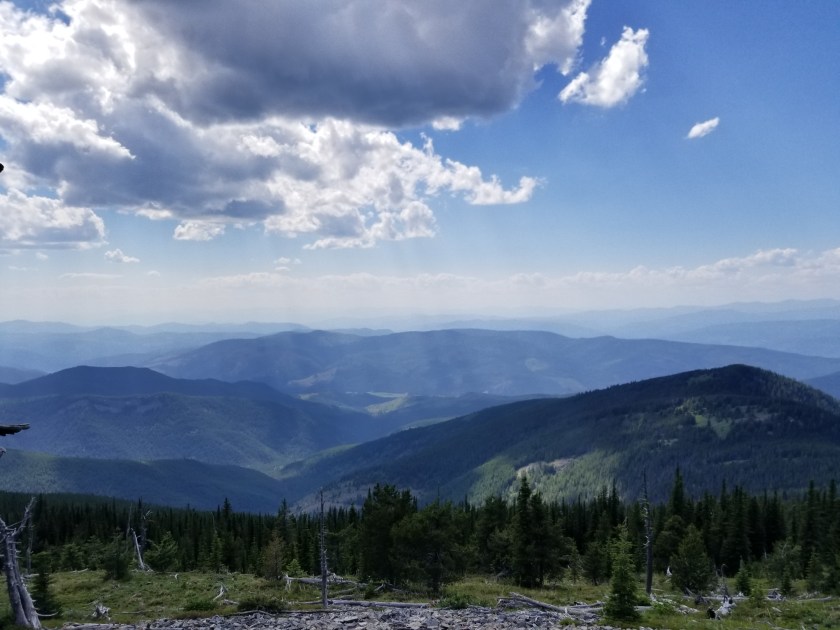
The view fron Abercrombie Mountain was impressive, but muted slightly by smoke. I love mountaintop views, but in this section all the mountains look roughly the same. In many mountain ranges there is a diversity which adds interest and gives reference points. For example, the Cascades have some distinct whoppers. To be clear, the views are great, just not exceptional. Oh, and I was disappointed Abercrombie and Fitch had not created a Fitch mountain nearby. Selling naming rights for mountains is an untapped revenue stream for the forest service.

I thought the hike down would be challenging as it started with a lot of scree in the trail and I had on new shoes which might slip a bit and result in blisters or jammed toes. It worked out okay, but the trail changed in another, negative way.

This may be too “insider” but some trails seem designed for backpackers and some for mountain bikers. A backpack trail will be longer and straighter on switchbacks. A mountain bike trail will be more gradual and emphasize “S” curves. If you are backpacking down, like I was on Abercrombie, I just wanted to get down safely, not float down like a Disney ride.

I made it to the bottom, later than I had expected. The great news was a crude campground was at the trail head. Nobody was there and there were five campsites. Simple folk, backpackers consider a picnic table, pit toilet, and fire ring a luxurious setup.

About 90 minutes after I got there, ate, and set up my tent, Indigo and Snowberry showed up. They camped nearby.

I was feeling good. It had been a great climb, I found a sweet campsite, and the new shoes felt good. Just before going to sleep, an owl showed up. I could see its profile and it was smaller. I called this a polite screech owl. It made a measured screech every minute or so, but nothing as loud as a real screech owl. Regardless, it was not enough to keep me awake.