July 7, 2018
Stealth camp on road to stealth camp near stream.
There is an acronym attributed to hiking the Appalachian Trail: PUD which stands for Pointless Up and Down. Obviously, backpacking through mountains includes a fair amount of going up and down, but today on the Pacific Northwest Trail it went from neccessary to PUD.
The mountain range I am in is called the the Purcells. They all max out around roughly 7,000 feet above sea level and most have rivers between them. They cover the northwestern part of Montana and the eastern part of Idaho’s panhandle. They are not as steep as the mountains between Polebridge and Eureka. This means they are slightly more amenable to forestry. Therefore, a lot of the hiking is through forest that:
- could be harvested,
- was harvested (30 years ago) or
- a burn area.
By far, the “could be harvested” is the most compelling to hike through. Huge trees block out almost all undergrowth with the forest floor mostly old pine needles. This duff almost feels like walking on those really thick shag carpets from 1970s (younger readers use your imagination or Google). It is eerily quiet. And big trees produce big pine cones.

The “was harvested” is okay. It feels like a working forest. While clear cutting was the old method, the newer approach is to leave a few mature trees and let nature runs its course. Impenetrable understory of alder and huckleberries and young conifers battle for space. Except for the conifers, the shrubs top out at five feet, roughly. Unless opened by a landslide or natural meadow, the general feeling is of the understory pushing in. It is very clear why there are so many animal tracks on the trails; these are the only really viable way to get around. Except for moose. There is a lot of moose scat in these woods.

The “previously burned” areas offer some harsh contrasts. Nature abhors a vacuum, so dense stands of young pine and larch grow. On rocky slopes, grasses and flowers make a land grab. The shrubs take what they can. Hiking through these forest offers more vistas, but they can feel a bit claustrophobic walking between dense walls of thousands of tall skinny 15 foot trees.
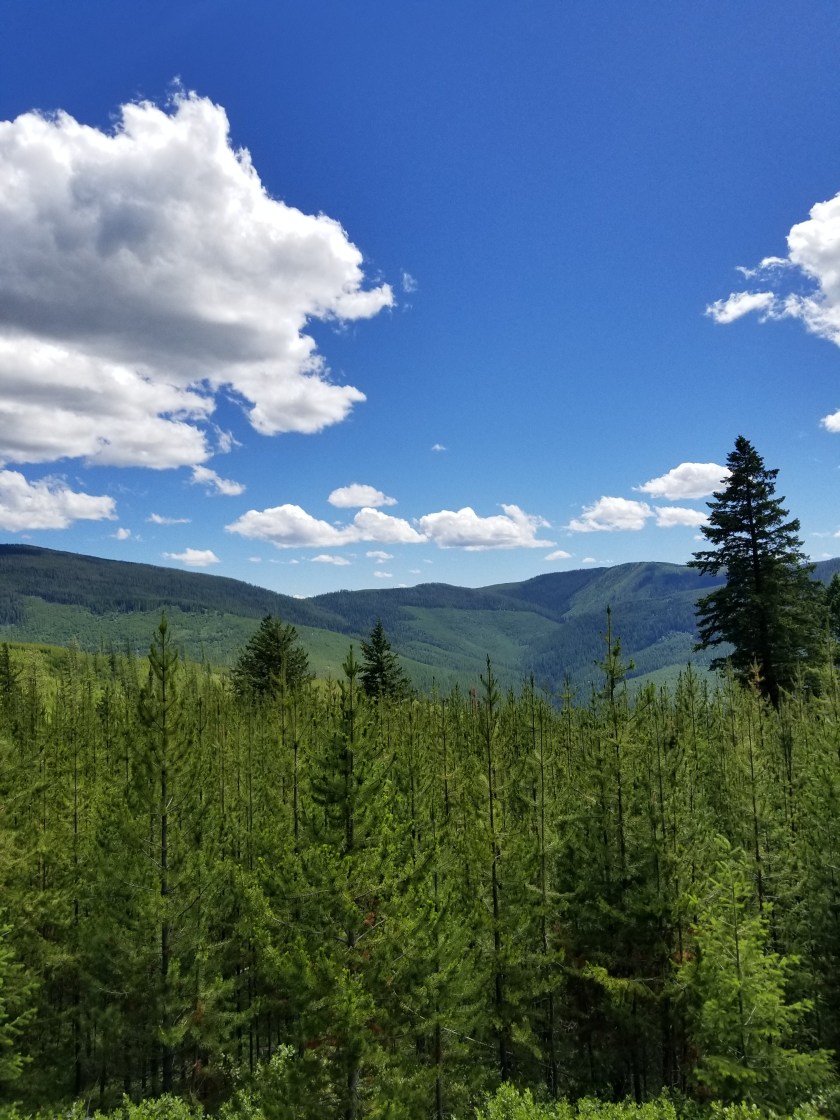
All of this is backdrop to today. I started in a harvested area. Mostly shaded, the early morning climb was perfect. Except for the mosquitoes who were fast and relentless. (I don’t use bug sprays or headnets when hiking. The chemicals are too harsh and the headnet feels like walking around in shady cheesecloth. At camp, it’s a different story.)
I got up to the first mountaintop and the next several hours were a rolling climb along a ridgeline with ok views. The “highlight” was a climb nearly to the top of Mount Henry which had a lookout tower.
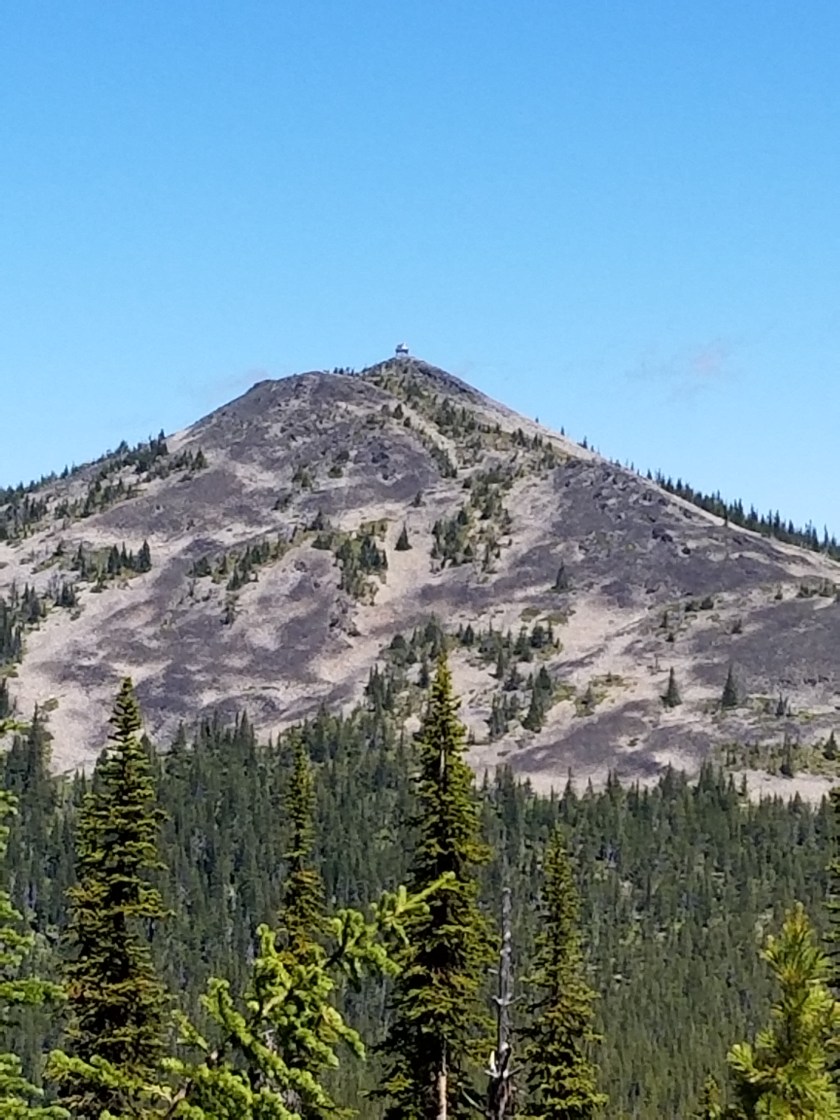
From there it was a kneecap crushing descent from 7,000 to 3,500 feet over 4 miles. It was about 3:30 when I bottomed out at Fish Lakes and stocked up with water. A campsite was available, but the directory noted “rodent problems.” Regardless whether it is eating, sleeping or traveling, my hard and fast rule is to avoid anything with a rodent problem. So, I began a long steady climb up a mountain, in all a seven mile trip gaining 3,000 feet and losing (you’ll never guess… ) 3,000 feet. I was going for Mt. PUD.
About a half hour in to the switchbacks, I saw a trail sign to a forest road. The number seemed familiar. I looked at my map and that road went along the south and west side of the mountain which was where my current trail would connect. Should I stay on the official footpath or take an unknown shortcut? I chose to stay on my current route over what was to become Mount PUD.
Slowly ascending switchbacks through an area that had previously burned, I was in a walled off corridor of conifers for a long time. The trail was losing visibility when it popped out to a grassy area higher up. I got the feeling this trail had not been maintained in the last two years.
While it was nice to be able to have a view, the barely visible trail through knocked down trees suddenly changed gradient. Previously, I had to stop every five minutes from the exertion. Now, the trail designers suddenly must’ve identified a new target market. However, they chose toddlers and seniors as the target. Watching the sun creep lower while making no uphill progress was infuriating.
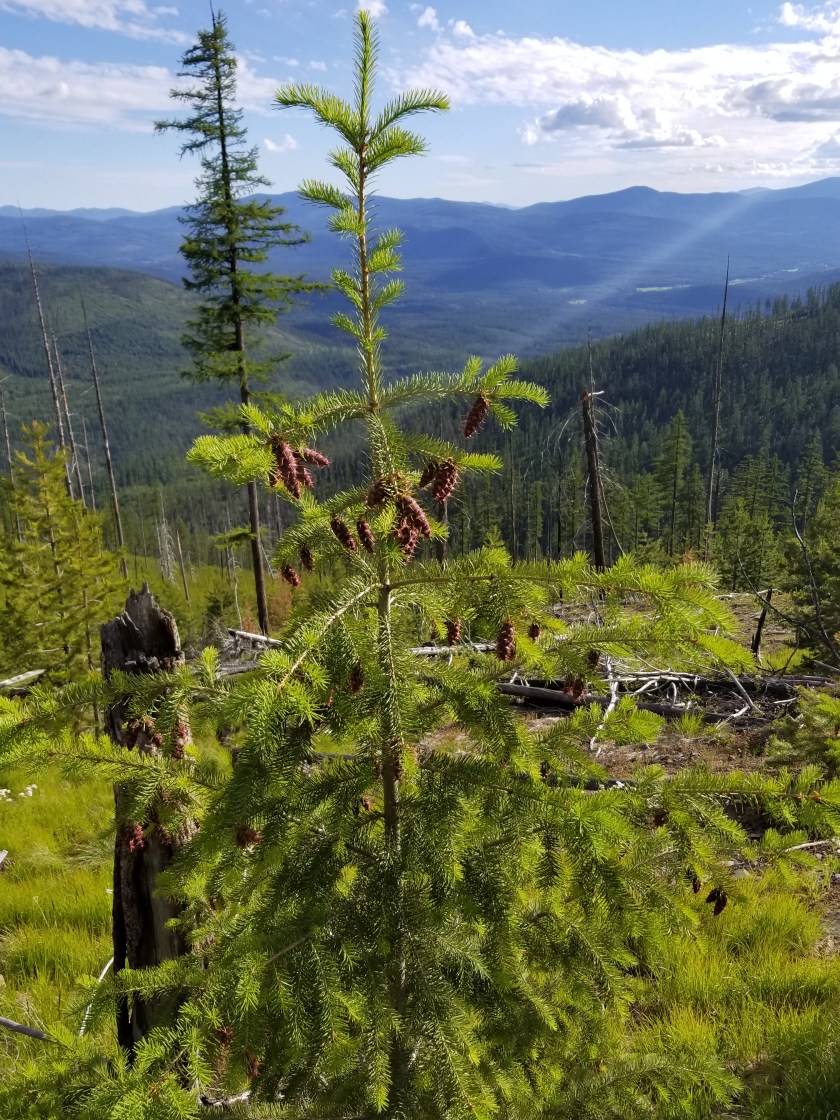
Eventually I was mostly above tree line. Trails are difficult to see on hard surfaces. Heavily traveled trails will have small stacks of rocks called cairns. Unfortunately, this trail was so forlorn it was hard to tell what was a cairn and what were two random rocks. I was generally able to patch together the trail and reached the zenith where I was to cut through a rock canyon and finally begin my descent.
This rock canyon was v-shaped. As such, all trees that fell on the sides rolled to the bottom. It was blowdown central. Tired, knees aching, light fading and now I have to parkour my way through this.
When I came out the other side of the canyon, my shorts had a new breathing panel where one least expects such a thing. Down to one pair of town shorts.
I surprised many grouse today. Some have no chicks, some have hatched chicks, and some have flying hatched chicks. If you aren’t familiar with grouse, they are primarily land based birds, taking flight just to avoid danger. Agrouse chick flying is the cutest thing in the world, reminiscent of a piglet flying.
The sun was just sliding behind the western mountains. As I was starting to feel some relief, the trail now headed east. Crabby, I cussed the trail designer who created a route to the Pacific Ocean that goes east.
At least it was through ancient forests. It took some stress off these old legs bounding down on a blanket of needles, many years old and many inches thick. The canopy blocked a big chunk of the fading light. I had to get down to a creek at the bottom. Not only for water, but also a flat place to camp.
Around 9:00 I found a relatively open space and cleared a spot. I did not feel hungry, but forced myself to eat. Right after brushing my teeth, I went straight to my tent. Once inside and away from the mosquitoes, I thought I would just drop to sleep. Instead, I listened. There was nothing. The soft ground absorbed any sounds that made it through the silent canopy above. Sometimes I have difficulty sleeping when it is so quiet because even the littlest sound from far away is magnified. Fortunately, a bird somewhere started its evening song and that’s all I needed to fall deeply asleep, ending my adventure on Mount PUD.
 backpacking over the hill
Look forward to Parker Ridge, some of the best Ridge hiking. But many many switchbacks to get up to 7000 ft…
LikeLike
Tackling that Beast this morning. Looking forward to the ridgewalk.
LikeLiked by 1 person