October 15th
Well, it was not the cars that kept me awake. Bull elk apparently are partial to the National Park Service. All night I heard from across the road the various grunts, bellows, and bugles that are the ruminant equivalent of a Barry White medley. The fact this must work does not speak highly of elk cows. Perhaps the almost full moon added a little extra zest to their passion, but I was glad for my alarm to go off at 4:30.
Have I mentioned that New Mexico is freakin’ cold? Again, I had everything on and was cold. I was first walking down the highway and then cut over to a dirt road that went up Sand Canyon, another well-named geographical feature.
My first water source was supposed to be a solar well. Since this was pre-dawn the pump would not be working and, besides, I could not find it in the dark. I later also skipped a one mile side trip to a wind mill rumored to have good water.
I passed many hunters camped along the road. The few I spoke with all said there were signs of elk but they could not find them. I wanted to explain where the bags under my eyes came from, but chose not to. After all, if the fact something kept me awake at night was reason enough for me to send hunters with guns to kill it, many dogs and car alarms would be gone by now.
I climbed steadily upward. I met my last two elk hunters as I neared the peak for the day. We were on a dirt road. They asked what my route was. I told them I would follow this road, cut north, and then descend a canyon on the opposite side. They were well intentioned and twice warned me this road dead-ended just ahead. I thanked them and went along. I grabbed water from a “tank” which was an earthen dam that collected muddy run-off. I would filter it as a last resort.
The hike down Armijo canyon went fast. The temperature waremed quickly. I came to a vary old cabin and dry spring. Allegedly, the original building dated from the 1200 and various occupants had added bits over time.
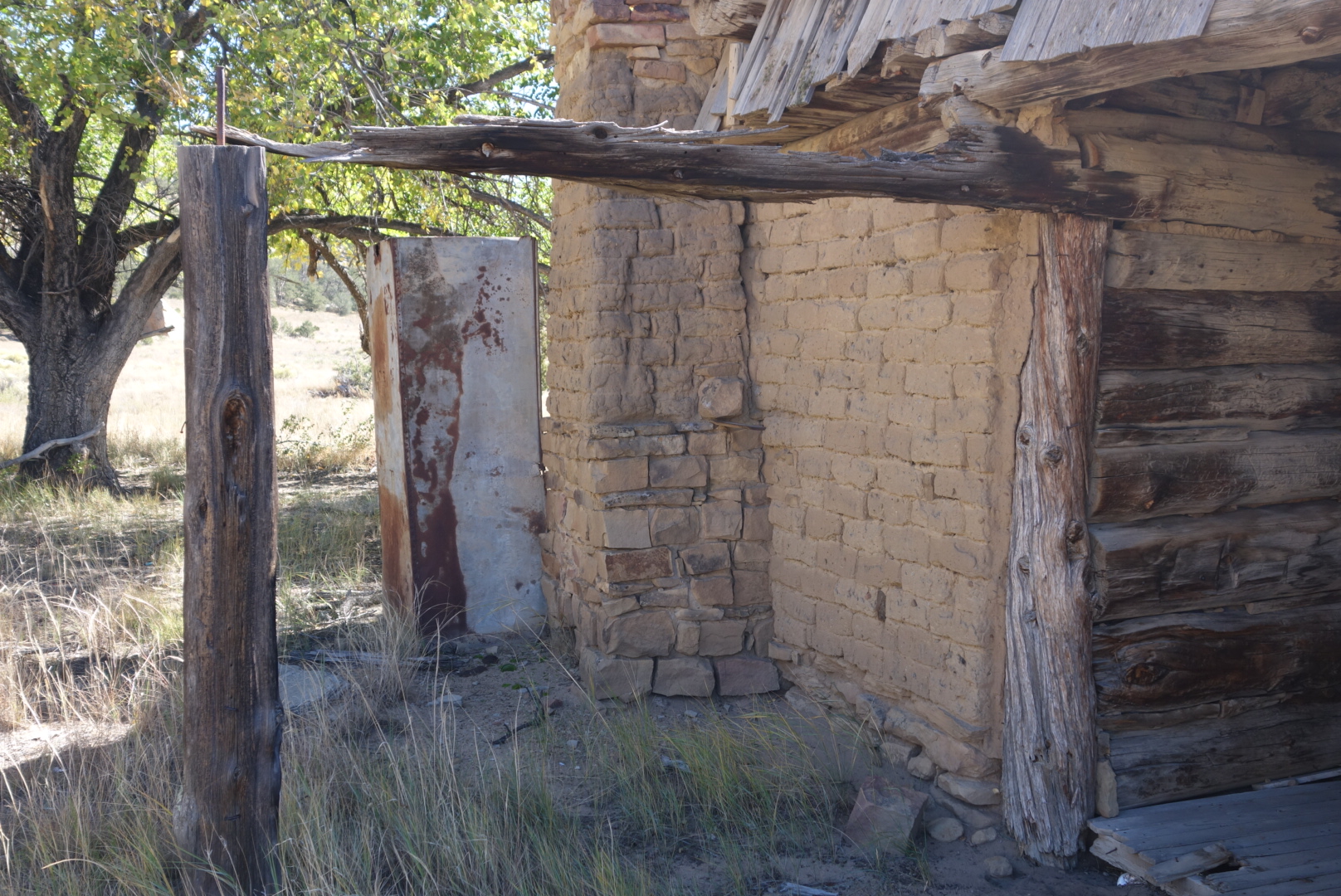
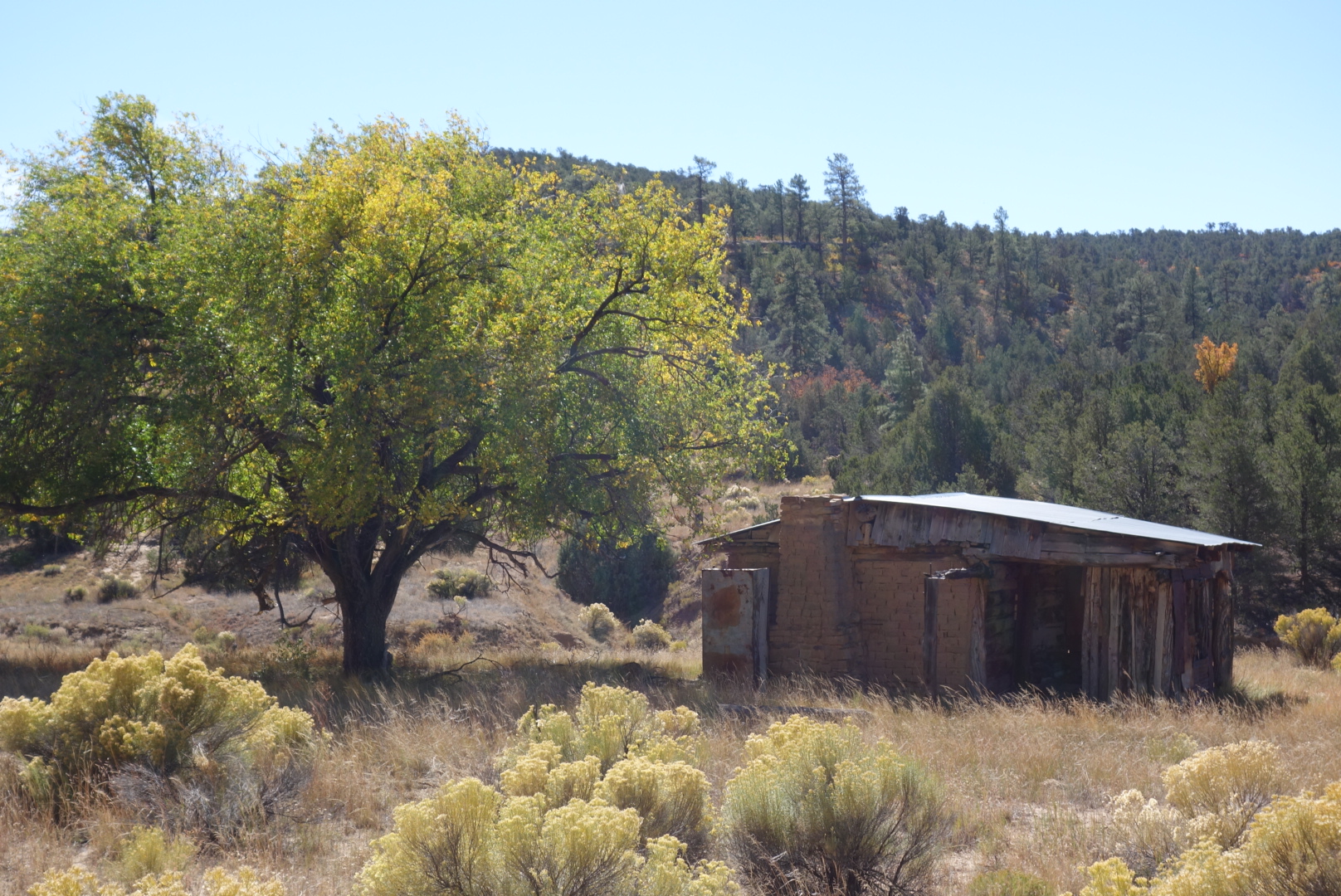
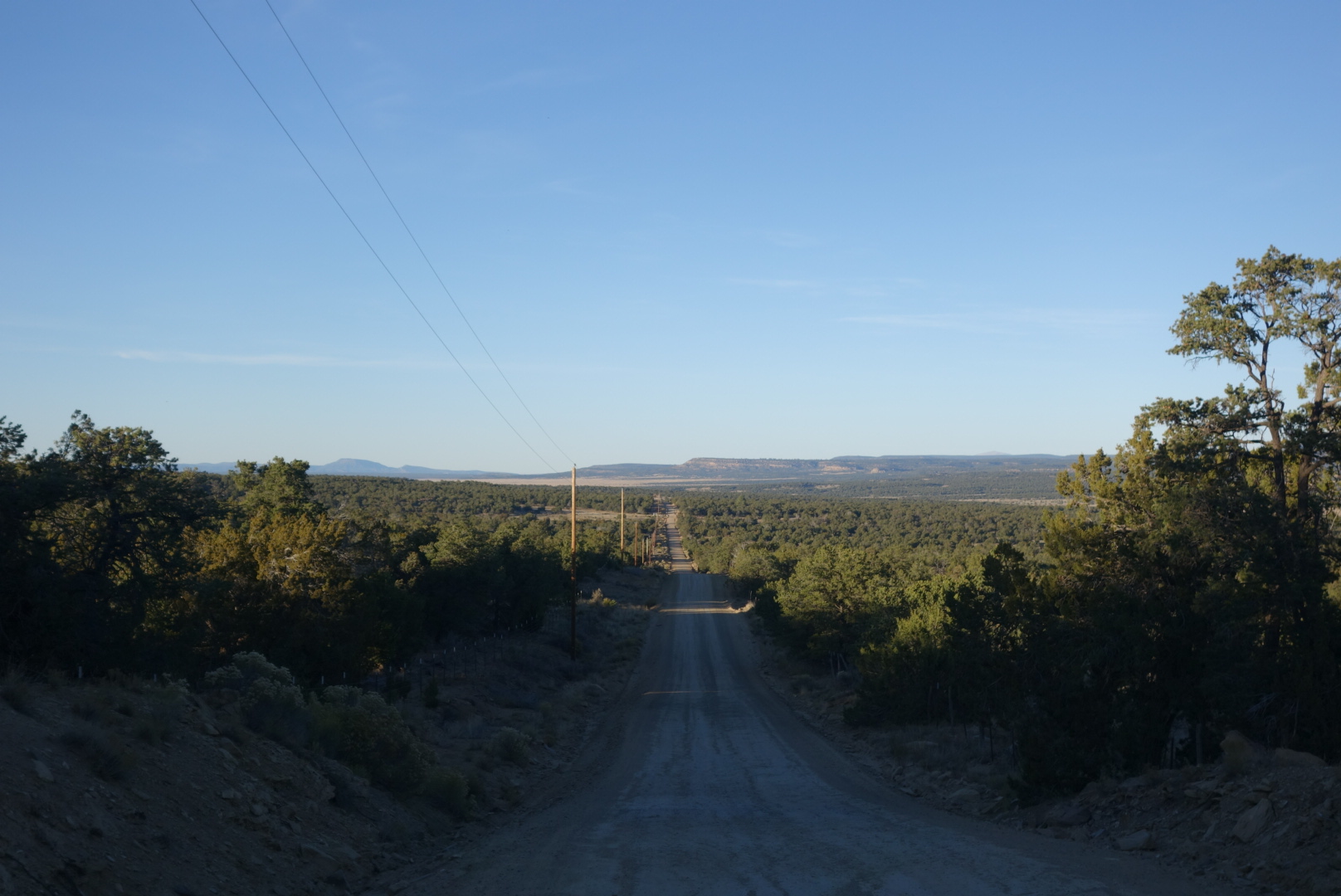
Finally, the canyon drops out into a broad canyon where ranching is the only activity. In fact, there is only one ranch, the York Ranch. ( Later I learned it is 180,000 acreas and was recently sold for $11million). The gravel road that would be my home for the next 24 hours was the York Ranch Road. Yup, York Ranch is the boss out here.
I was down to my brown tank water. About every 20 minutes a vehicle would go by. I would shake my water botttle at the approaching vehicle, a sign I needed water. Nobody stopped. I gave up. At this point I was approaching a reliable solar well. It was big and beautiful. A solar pump poured water into a huge metal tank that must’ve been 20,000 gallons. when it came out of the pipe, the water was cold and delicious, coming up (I later learned) from 900 feet below.
As I got back on the road hydrated and lugging 5 liters (10 lbs) of water, the first car that came by stopped and asked if I needed anything like water or food. In fact, three more cars did that. Two drivers said there was another hiker behind me on the same road.
I made good time on the road, but as it got darker, it was clear that I was not finding any public land. On each side of the road, the familiar New Mexico hospitality signs of barbed wire plus “No Trespassing” greeted me for miles. Finally, around 6:00 I reached the Thomas Mountain Ranch which has a sign out front encouraqging hikers and bikers to come in for water. I came in and hoped I could find a patch of land to camp on.
The grounds were a collection of welded water tanks, a few idle recreational vehicles, and a large metal shed/ hangar. I was there during supper time, so I cautiously looked for a place to camp. Out of the hangar pops John Thomas. He insisted I come in. I met his wife Anzie. Over the next three and a half hours I would learn about their life preaching, working as a metal fabricator,, service in the Korean war, and political beliefs.
He was 84 and she was a bit younger. Both were sharp and entertaining. They lived full and intersting lives. They bought a little piece of retirment land and it turned out the Continental Divide Trail went right by their front door. They loved helping out the hikers and bikers with water and a place to sleep. They kept a scrap book. For every hiker there was a page and a number and a note. (I was number 261, I think.) The first entries were some college students from Minnesota that stopped and asked for water in 1999.
I was offered a defunct RV to sleep in. It had a bed and sofa. I slept on the sofa and left early the next day. In contrast to the cold, no trespassing, and barbed wire, I was glad to end my day in the warmth of the Thomas Ranch, their hand-welded fire box, and a warm family.
 backpacking over the hill